
The rider repeating his ordeal by pedalling

2' min read
2' min read
If there is still a European neorealist cinema, Boris Lojkine's The Story of Souleymane fits right in. The film, made on a derisory budget and winner of the Fipresci, Jury and Best Actor prizes in the Un certain regard section at Cannes, could have stood well in the main competition to climb the palmares for its ability to tell the story of today's times, without infingenuity or morality, as much as the Dardenne brothers did with Rosetta (1999) and L'Enfant-Una storia d'amore (2005), which won gold.
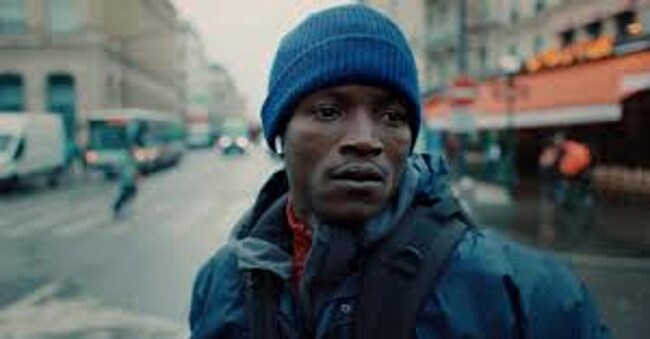
The story starts slow on the protagonist Souleymane (Abou Sangare), initially in the Paris offices where his request for asylum as a political persecuted by the Guinean government for his activism as an opposition trade union leader is being examined. Souleymane repeats his ordeal as he rides as a rider on 'rent' from the real account holder, who demands almost half of the turnover. We follow him from one delivery to the next, whirling, feeling his physical exertion, his will to squeeze out any remaining energy. We are with him as, exasperated, he reacts to a restaurateur who makes him wait too long and when he walks seven floors and helps an elderly man open a pizza box. He has only 48 hours to learn his 'story' before his 'audition': he desperately looks for his compatriot Barry (Alpha Oumar Sow), who 'prepares' behind him for help. While waiting to be received, Souleymane overhears Barry forcing a girl to recount her rape by her 'legitimate' husband, supported by her father. The girl struggles, but Barry explains to her that it is precisely for these 'stories' that the Refugee Commission is more sensitive. Souleymane listens, bows her head and is moved. Because that is the point of this beautiful Story: the reasons why people migrate are many and all legitimate. Humanity, species have always migrated, explains the beautiful musical and theatrical performance, Nomadic, by Telmo Pievani and Gianni Maroccolo, with a scientific approach. Humans flee war, political persecution, hunger, ignorance and superstition, in search of a better future or by instinct.
Lojkine's first feature film, Hope (2014), followed a Cameroonian and a Nigerian woman as they try to reach Europe. Now the director looks to the 'after' with another story. He wanted a very light crew (three to five people), non-professional actors, he shot the scenes on the road from a bicycle, doing the sound himself, he never stopped the traffic, the lighting is natural for a sans papier Paris, made up of dormitories and free meals (perfect but relentless gear), where the danger is the cops, exploitative immigrants and homesickness. The screenplay (by the director and Delphine Agut) is always balanced: even the Europeans are given the same look, at once ruthless and human, with an unforgettable finale.


