
The road home leads to the heart of the Dolomites
Matteo Righetto calls for defending Latemar and Catinaccio and involving people in a new environmental responsibility

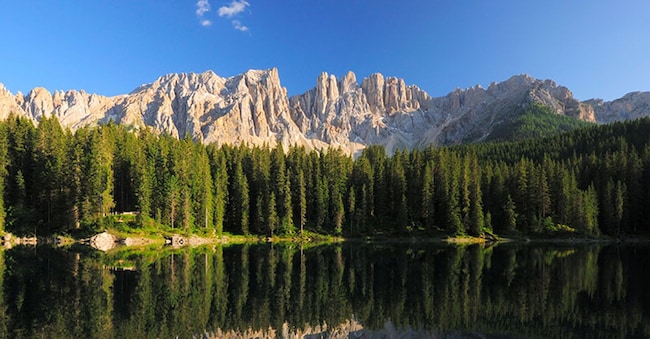
Home is a horizon of freedom, the mist of thoughts that rises and reveals the peaks. Those explored by Matteo Righetto, writer and aedo of the Dolomites: 'they are the mountains where I feel I have always lived. My home. Living up here, walking through the valleys, on the slopes and peaks, breathing this air, for me means, fundamentally, coming home'. He set off again between peaks and words, between dawns and deer, between doubts and self-searching with The Road Home. Pensieri di un cuore alpino, a sentimental education to find the tracks of a roe deer, the profile of the Catinaccio and that indescribable and very personal immensity that is home.
After the successes of The Bear's Skin, the Trilogy of the Homeland or The Call of the Mountain, Righetto now recalls the first mountain trails, Dad's backpack and his wonder born 'in the enchantment of those moments and places, in the scents carried by the wind, in the sounds of the forest, in the secure hold against his strong back'. It is the story of a father and son, it is a story that can belong to everyone. All you have to do is set out. Because it is not only a matter of trekking, hiking and mountaineering, but above all the far more important matter of crossing nature on tiptoe to respect it, in a communion that makes us feel part of a greater design to be respected and told, as Righetto does. His emotional experience grew up with the unique spectacle of the enrosadira, the frankness of the mountain people, their languages, their complex history, the millenary legends, the cuisine, the different cultures of each valley, the architecture, the Ladin aesthetics. In the small, he has found the greatness of the peaks, he shares it and, after following climate change, global warming, the retreat of glaciers, the loss of biodiversity, landslides, floods and mudslides, he tries with his storytelling to "involve people in the construction of a new form of responsibility, leading to a sustainable, respectful, slow tourism. An approach that protects this geographical and cultural heritage, because when the mountain becomes just an object of profit and entertainment, the consequences for society are devastating'.
The beginnings are in Andalo, then in Fiera di Primiero, San Martino di Castrozza, Val Canali, for the definitive falling in love between Latemar and Catinaccio: 'Going to the mountains was like opening a door and finding my own space. Heimkoma, the Icelanders say. It is the pleasant, comfortable feeling one gets when returning home after a long, tiring journey'. In the slow steps that the altitude imposes, in the glances at the peaks, there is 'the limestone Latemar, which has always been for me the mountain associated with the moon, with suggestion, with Ladin legends, with a deep and evocative poetic feeling' or the Rosengarten, the mountain of sun and energy.
In the enclosure of a room, Righetto's words become supports and handholds towards a new dimension of self. The weight evaporates, there is the lightness of light, the majesty of the roaring of a deer or the enchantment of a golden eagle. These are pages of steps and wonder, of reflection and magic, of ski descents and research: 'If it is true that we all urgently need the mountains to remain human, the opposite is equally true: the mountains also need us to remain wild. The Highlands are a fragile frontier ecosystem, a last bastion of resistance against an unsustainable development model. Defending the mountain environment means promoting an ecological conversion that passes through responsible cultural action to support and safeguard Alpine biodiversity. Every form of education is environmental education, and environmental education is high culture, ancient wisdom'.
In addition to the eyes, dazzled by the flicker of a ptarmigan, the heart breathes deep and feels a vital breath: 'a mountaineer gets depressed, gets sick like everyone else, dies like everyone else. But he knows that inside him there is something that does not get depressed, does not get sick, does not die. And that, I call the wild spirit'. The Dolomites are Righetto's conscience and, through pages and photographs, some minimal, others choral, they get under our skin, they are the props of our fears because 'climbing a peak - whether it was the Tofana di Rozes or the Antelao - did not mean winning a challenge for me, but fulfilling an inner gesture. It was not so much an ascent upwards as a descent inside myself'.


