Film Festival

"Pedro Almodóvar's 'The Room Next Door' is a competition of bravura between actresses

The Spanish director's film, his English-language debut starring Tilda Swinton and Julianne Moore, was presented in Venice
by Andrea Chimento

3' min read

3' min read

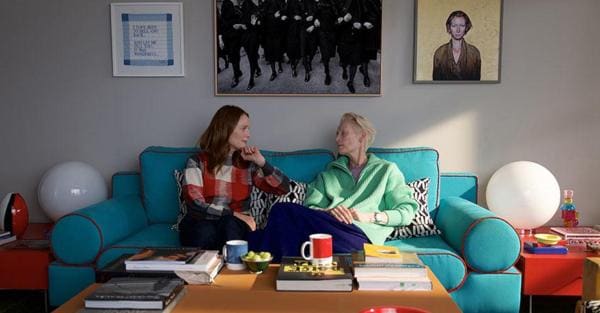
A competition of bravura at the Venice Film Festival: it is impossible to say who is the best between Tilda Swinton and Julianne Moore, both perfect and of extraordinary intensity in Pedro Almodóvar's 'The Room Next Door'.

Based on the novel "What Are You Going Through" by Sigrid Nunez, this is the first English-language feature film for the great Spanish director who, despite the production move, takes up many of the themes that have made his cinema recognisable in the past: the theme of female complicity, first and foremost, but also that of motherhood.

Loading...

At the centre of the story are Ingrid and Martha, two long-time friends who meet again after many years in a decidedly dramatic circumstance: one of them, now ill for some time, has chosen to put an end to her suffering and asks the other to accompany her on this journey.

It is not (only) a film about euthanasia, 'The Room Next Door', a film that soon turns into an existential journey that touches past, present and... even the future.

With several references to 'The Dead - Dubliners', John Huston's magnificent 1987 film based on James Joyce's novel, Almodóvar signs a touching work, which grows at a distance after a somewhat cumbersome start and victim of too many flashbacks.
Having passed this stage, the film has moments of great strength, as much in its writing as in its photographic choices, managing to touch deep chords in several passages. It is a possible candidate for a major award in the final palmarès.

Disintegrated families

.

The theme of broken families meanwhile continues to be one of the most present on the billboard of this year's Venice Film Festival: after Tim Burton's 'Beetlejuice, Beetlejuice', Alfonso Cuarón's 'Disclaimer', but also to some extent Brady Corbet's 'The Brutalist', a film totally focused on this aspect was presented in the Orizzonti section.

"Francesco Costabile's 'Familia' takes its cue from the true story of Luigi Celeste and his book 'It won't always be like this' to talk about how domestic tensions can lead to real tragedies.

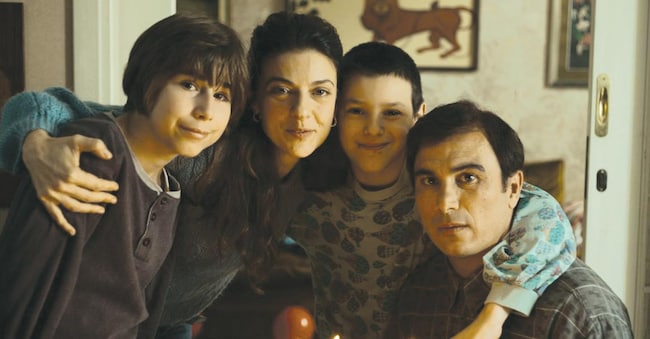
Luigi's character in the film is 20 years old and lives with his mother Licia and brother Alessandro. The three are united by a deep bond. It has been almost ten years since any of them has seen Franco, their partner and father, who has made the two boys' childhood a terrifying memory. One day, however, Franco returns, managing to convince his (former?) family to take him back.

Opening with an incipit that recounts the childhood of the protagonist and his brother, "Familia" is a film that begins from the very first minutes to play with light and shadow, already showing how darkness is a fundamental element of the entire work: not only on a photographic level, but also in relation to the darker aspects of the human soul that are analysed within a narrative that crosses various genres.

The family melodrama often gives way to a psychological thriller that even veers into violence, with some sequences so disturbing that they make it seem like a kind of full-fledged domestic horror film.

In both the screenplay and the direction, however, there are some unnecessary strains: several aesthetic choices are too conspicuous and a couple of passages (relating to the young man's militancy in extreme right-wing groups) would have benefited from more depth.

Despite these limitations, 'Familia' is nonetheless a product that manages to engage effectively from beginning to end, thanks to a good rhythm and editing choices capable of keeping the tension high until the conclusion.

I'm Still Here

A dramatic family separation is also at the centre of Walter Salles' 'I'm Still Here', another film based on a true story that shocks.

Set in Brazil in the early 1970s, the film deals with the life of a family that is shattered when the father, a former deputy, is taken away for questioning under mysterious circumstances. His wife will be forced to reinvent herself and fight for her children.

The experience of the desaparecidos told by those who stayed behind: from this basis, Salles wanted to describe the times of the Brazilian dictatorship, creating a committed film that makes the spectator experience the horrors of that period.

Twelve years after the disappointing 'On the Road', Salles has returned to directing a fiction feature film, rediscovering the good results of some of his past films such as the famous 'The Motorcycle Diaries'.

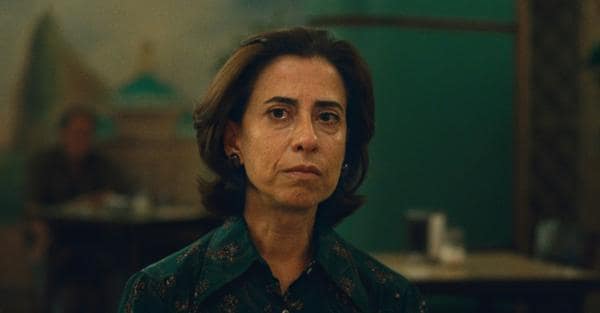
The cut of 'I'm Still Here' is rather classic and conventional, but the film still manages to shake, despite a few tired moments in the middle section. Excellent performance by actress Fernanda Torres.

Copyright reserved ©
Loading...

Brand connect

Loading...

Newsletter

Notizie e approfondimenti sugli avvenimenti politici, economici e finanziari.

Iscriviti