
La Russa to Fenix: 'The tricolour flame is a symbol of love and freedom'
The president of the Senate spoke at the Fratelli d'Italia youth rally. "In the eyes of the left they were Real Madrid and we were Cremonese, but Cremonese wins the championship, beats them and makes them fail all forecasts".
3' min read
3' min read
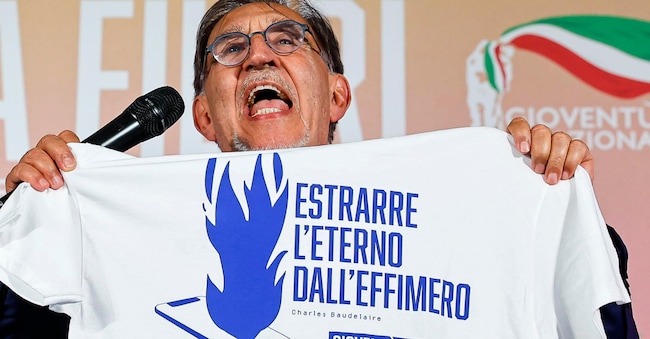
There are the symbols, the historical memory. But also football metaphors, the politics of 'us against them', or rather, of 'them against us'. It is a Ignazio La Russa who almost casts off the robes of the president of the Senate to re-wear those of the militant who today, 18 September, spoke from the stage of Fenix, the kermesse of National Youth (the youth organisation of Fratelli d'Italia) held in Rome, in the Eur district.
He shows the party t-shirt. "The front of this T-shirt is beautiful, but the back even more so, because there is the flame. They want to say,the flame is a symbol of love and freedom...,' he says. Then remembrance: 'Let us do the minute's silence' for Charlie Kirk (extreme right-wing activist killed by a killer in the United States), 'which some left-wingers denied, even yesterday in Milan'. He recalled the years of lead: 'There were mourners on the right and on the left. I remembered Ramelli, but also Fausto and Iaio'. And he proposes an asymmetrical reading of political violence: 'But if it is true that there has been violence against both right-wing and left-wing boys, in this sad dramatic ranking of episodes of absurd violence there has never been an ambush under the house by right-wing boys, even those a thousand years removed from the Italian Social Movement. Never has there been an episode of cold-blooded waiting violence under the house.
The register then shifts to the present contention. In the crosshairs, the oppositions: "The only thing they were honest about is when they said that theirs is an alliance of purpose. They are only united by the 'no's', there is not a shred of a common programme. I am glad, because when even the alliance of purpose loses, you will see how they will cry bitter tears...'. Football hyperbole seals the frame: 'We beat them. And it's as if Real Madrid, excuse me Madrilenians if I offend them, were playing against Cremonese, because in the eyes of the left they were Real and we were Cremonese, but Cremonese won the championship, beat them and made them fail all predictions'. And the conclusion: 'Sooner or later there will be a rematch, in the next century'. It is an identity storytelling: overturning the expected power relations, restoring the idea of success against odds, redrawing the map of consensus as a social and cultural revenge.
There is praise for leadership: 'Giorgia Meloni has become the reference point for the entire centre-right worldwide... Thank you Giorgia!". And there is the attempt to embrace the path of moderation: 'Perhaps the climate of hatred on the left stems from the belief in a claimed moral superiority... We must be consistent with ourselves and not accept that anyone tries to turn the tables on us. We must insist that the tone must be lowered on everyone's part'. And again: 'There is no possible equation between what we do to raise the tone and what the left always does. We are the only ones willing to say let's take a step back. We are the only ones willing to say let's take a step back'.
On the militancy side, La Russa draws an ethical line of demarcation: 'In the youth movement, I have never taken part in an initiative aimed at preventing a demonstration by others. This attempt has never come from the right. We have never disturbed a rally of others. We have never prevented a student from entering a university. Always remember this difference of which we must be proud.


