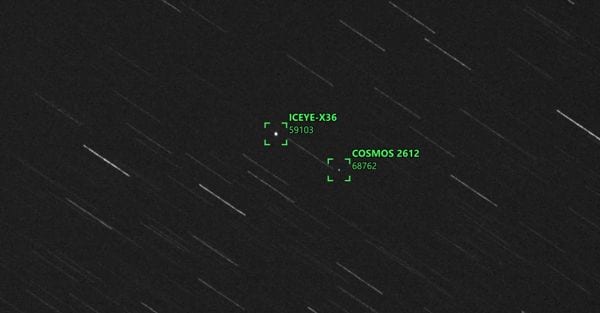
The Russian satellite playing cat and mouse
The Russian satellite Kosmos-2612 orbiting ICEYE-X36 belongs to the Finnish-founded ICE group

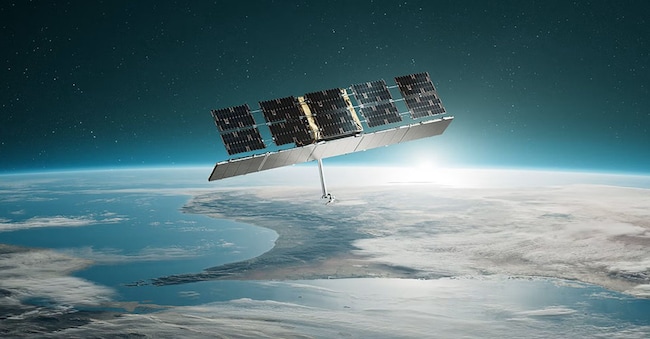
Provocation, intimidation or a dress rehearsal for an attack in space? The manoeuvres carried out in mid-October by the Russian satellite Kosmos-2612 around ICEYE-X36, which belongs to the Finnish-based ICEYE group, do not allow us to arrive at a definitive answer. However, they do demonstrate something concrete: the ability to reach another country’s satellite, accompany it along its orbit and approach it to potentially very close distances.
According to the analysis by the US company COMSPOC, which specialises in monitoring space objects, between 16 and 18 October the two spacecraft spent around 24 hours less than two kilometres apart and around twelve hours within one kilometre of each other. The closest approach, on 17 October, is estimated to have been around sixty metres. This figure should be treated with caution: for that point on the trajectory, the analysis itself indicates a maximum uncertainty of around 950 metres. Not a confirmed distance, therefore, but a close approach that merits attention given the entire sequence of manoeuvres that preceded and followed it.
Kosmos-2612 was not there by chance. The reconstruction describes an orbital ascent, a phase of regaining distance and subsequent thruster firings, until it reached the same orbital plane and altitude as ICEYE-X36. According to COMSPOC, the latter did not manoeuvre. The Russian satellite then moved away on 18 October.
The speeds require some clarification. What is striking is not the speed at which both travel round Earth’s orbit – thousands of kilometres per hour – but the slowness of their relative motion: at the points of closest approach, COMSPOC calculates relative speeds of between 15 and 90 centimetres per second. Not a spacecraft skimming past another, then, but a slow, controlled passage of two spacecraft. It is precisely this ability to accompany an object that makes the manoeuvre strategically significant.
However, trajectory analysis alone does not reveal intent. A close approach may serve to observe and characterise another satellite; it may also demonstrate a capability that could be used to interfere with its operations. Without information on the on-board systems and the commands received, defining the incident as an attempted attack would go beyond the evidence on the record. The very technology used in ‘inspector’ satellites lends itself to a variety of uses, ranging from surveillance to potentially hostile operations.