
The Saint cuts the directors down to the bone
Rossellini, Cavani and Zeffirelli steered the direction towards simplicity, shunning sanctity and portraying him as a man through actors such as Castel and Rourke

Key points
Francesco strips himself of the superfluous, but so too do the directors who explore his life. Thus, when it comes to the Saint, Rossellini, Cavani and even Zeffirelli submit to formal simplicity. It is almost an inevitable path, a deference that strips the direction down to the bare essentials. Before them, Francis had already made his debut in silent cinema with a number of firsts: Enrico Guazzoni’s Il poverello d’Assisi (1911) was the first film in the history of cinema dedicated to the saint’s life. Then there is *Frate Sole* by Mario Corsi and Ugo Falena from 1918, considered one of the historical masterpieces of early Italian cinema. Finally, there is Frate Francesco (1927) by Giulio Cesare Antamoro, a blockbuster with extensive international distribution. Rossellini, having established himself as a master of Italian Neorealism, went on to direct Francesco, God’s Jester in 1950, following Rome, Open City (1945), Paisà (1946), Germany Year Zero (1948). Together with Fellini, he prepared a screenplay loosely based on the *Fioretti di San Francesco* and restricted the use of the camera to what was strictly necessary for the film’s ten episodes.
Rossellini’s Francesco
Here, the landscape forms the backdrop; in the foreground are the characters’ trials and joys. Francesco (Nazario Gerardi) is almost a secondary figure, acting as a protector and guardian to his brothers, particularly Friar Ginepro (Severino Pisacane) and Giovanni il Semplice (Peparuolo). Aldo Fabrizi plays Nicolao in the almost fairy-tale role of the tyrant who is moved by Franciscan purity. As for Chiara (Arabella Lemaitre) and her fellow sisters, Rossellini gives way to reality: he deliberately portrays them as alluring in the company of men – almost like freaks – who are incapable of living civilised lives in the world, and who break the law out of naivety or excessive generosity. Liliana Cavani returns to the subject of Francis three times, with two television miniseries – Francis of Assisi (1966) and Francis (2014) – and a film, Francis (1989). Francesco d’Assisi marks her directorial debut and is also her first production for Rai.
Cavani makes his debut as director
Like Rossellini, Cavani is not interested in sainthood, but in the young man of the 1200s, and in the power dynamics between the nobility – to which the friar belonged – the Church, tormented by heresies, and the poor. For the lead role, the director chose Lou Castel, who had just finished filming Marco Bellocchio’s *Fists in the Pocket*; Bellocchio himself also appears in the cast as Pietro di Stacia. Castel symbolises rebellion and a break with the bourgeoisie; through Cavani, he echoes the hippie movements of the 1960s, which embraced love as a prodigious force. For the screenplay, the director draws on unofficial biographies, such as the legend of Francis’s three friends – Angelo, Rufino and Leone – taken from The Life of St Francis of Assisi by Paul Sabatier, published in 1896. Shot on film and almost entirely in one take, she devotes just two sequences to Chiara (Betty Low/Ludmila Lvova), in which she is portrayed as a devoted disciple.
Mickey Rourke’s appearance
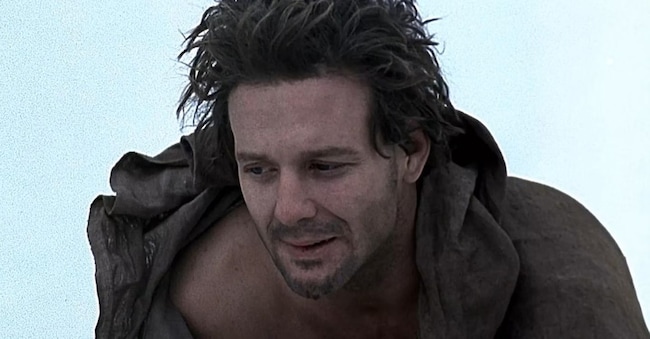
Cavani makes amends with Francesco, in which Chiara (Helena Bonham Carter) opens and closes the film – in the prologue, Francesco is dead – and is an equal partner in a ‘mad’ choice of love, which recognises no gender differences and presupposes a constant blurring of boundaries. Twenty-three years on, the director still shuns sanctity and returns to the human story, insisting on Mickey Rourke for the lead role. She writes the screenplay with him in mind – this time based on Franciscan sources – and Rourke literally brings to life a powerful, uninhibited and poignant Francis, a mirror image of Christ.
Zeffirelli and the Catholic spirit
When he directed the miniseries Brother Sun, Sister Moon in 1972, Franco Zeffirelli was already a star, an icon of Italian taste abroad. In retracing the footsteps of the ‘Poverello’, he set aside what the Italian intelligentsia snobbishly termed his ‘kitsch streak’ and brought to the fore the Catholic spirit that led him, three years later, to direct the epic Jesus of Nazareth (1977). He chose an international cast, which proved to be the right choice, including Graham Faulkner (Francis) and Judi Bowker (Chiara). Among the Italian actors, he cast only his friend Valentina Cortese in the role of Pica, Adolfo Celi as the consul, and Francesco Guerrieri as Deodato. The movements of ’68 had just breathed new life into society, a breath of fresh air that also swept over Zeffirelli’s saint, who had initially been brought to his knees by illness, imprisonment and war. Evil is overcome through the joy of living in close contact with nature, whilst also coming to terms with sensuality. Chiara and Francesco are, in fact, drawn to one another, and to put a stop to any potential carnal danger, Zeffirelli – who also co-wrote the screenplay with Suso Cecchi d’Amico and Lina Wertmüller – introduces the story of a companion who must leave his brothers because he does not wish to live in chastity. The music is one of the film’s strong points.


