
The Sarroch refinery, Saras' jewel: one fifth of Italy's fuel comes from here
The Sardinian plant is not only one of the largest, but also one of the most sophisticated. It would be the third to end up in foreign hands if control passes to Vitol
2' min read
2' min read
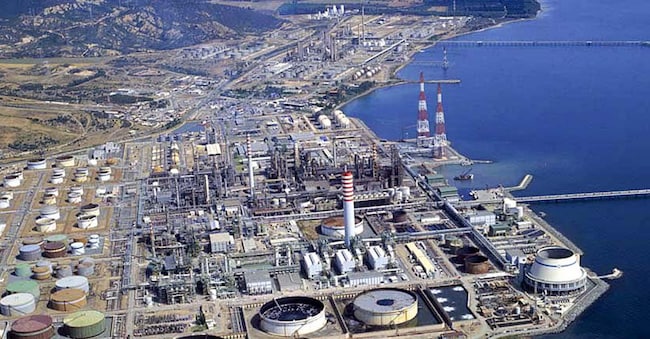
If the agreement between Vitol and the Moratti family goes through, another piece of the Italian refining system will end up in foreign hands. And it is not an insignificant piece. Both in terms of size and characteristics, the Sarroch plant in the province of Cagliari has always been one of the jewels in the crown of Saras (which, not by chance, stands for Società Anonima Raffinerie Sarde), and it is not surprising that it is coveted by a global oil giant.
The refinery not only accounts for one-fifth of Italy's fuel production capacity, but is one of the most sophisticated in Europe, capable of performing all types of processing and quickly modifying processes to adapt to the use of crude oils of different qualities (it processes around 30 crude oils of various origins): a precious skill, especially in 'hot' periods like the current one, marked by wars and sanctions, which force frequent changes of suppliers and supply routes.
The Sarroch site is equipped with no less than 13 berths for oil tankers and more than 4 million cubic metres of storage capacity, an asset of particular interest to Vitol, which is the world's largest independent oil trader, until now without a 'base' in the Mediterranean. In addition, the refinery is autonomous in terms of energy: it has a combined cycle gas power plant, integrated with the facilities, with a capacity of 575 MW, with which it produces over 4.1 billion kWh of electricity per year, which it also feeds into the grid, satisfying almost half of Sardinia's needs.
The refinery, controlled by Saras through Sarlux, is capable of producing 300,000 barrels per day of fuels (mostly diesel, for which Europe is not self-sufficient), a capacity equal to more than 20% of the total in Italy.
In terms of size, it rivals only Isab in Priolo, Sicily, a 320,000 bg plant (but divided into two sites) that has not been in Italian hands for some time now: after Erg left the scene, a decade ago it passed to Russia's Lukoil, only to be taken over in May 2023 by the Cypriot fund Goi Energy.


