
The Schifano case: cataloguing the work between litigation and international revival
In order to restore an international dimension to the artist, the mapping of the work from the 1960s onwards has begun, a second tome will follow: a registry with the complete archive and online a platform will collect the entire corpus

Key points
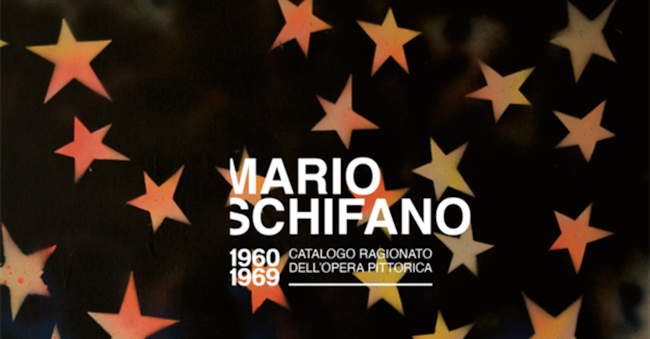
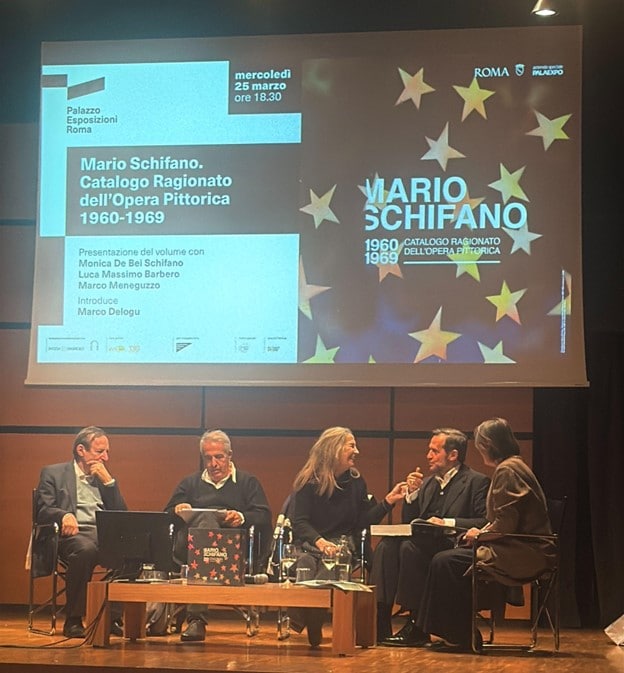
The Catalogo ragionato dell'opera pittorica 1960-1969 by Mario Schifano (1934-1998) was presented in Rome on 25 March. The catalogue, published by Skira, is divided into two volumes and costs 350 euros. The event is part of the review linked to the "Mario Schifano" exhibition at the Palazzo delle Esposizioni, open to the public from 17 March to 12 July 2026. The book was edited by art historian Marco Meneguzzo and byMonica De Bei Schifano, the artist's widow, who together with her son Marco Giuseppe looks after the Mario Schifano Archive as heir.
Reprinted six or seven times during its gestation, the catalogue presents itself as an 'atypical publishing project'. More than a simple catalogue raisonné, constructed with scientific rigour according to the strictest archival criteria, the publication, especially in the first tome, restores not only the artist's work, but also his life and the international atmosphere that gravitated around the Rome of those years.
Ambient photographs, actions and performances alternate with private images portraying Schifano alongside central figures of the cultural scene of the time, such as Frank O'Hara, Andy Warhol, The Rolling Stones, Anita Pallenberg, Marianne Faithfull, Alberto Moravia, Dacia Maraini and Sandro Penna. What emerges is a rich and enthralling excursus through a crucial decade, marked by the birth of fundamental cycles such as 'Monochromes', 'Esso' and 'Coca-Cola', 'Anaemic Landscapes', 'Futurism Revisited', 'True Love', 'Tuttestelle', 'Oasis' and 'Compagni Compagni'. Bringing the narrative even more alive are the 'narrated' captions, which analyse execution details, artistic intentions and the stories hidden behind works and photographs.
For the following decades, a similar model will probably be followed: a first tome 'the best of' will be followed by a second tome: a registry with the complete archive, work by work, while a progressive online platform will be developed to collect the artist's entire corpus.
A difficult and ever-expanding catalogue
The archiving of Mario Schifano's works was complex, mainly due to disputes between the heirs and the M.S. Multistudio Foundation. After the artist's death in 1998, the Foundation (today the M.S. Multistudio Foundation) was established to preserve and protect his work and has gradually built up an important archive. In 2003, Monica De Bei left the Foundation and created, together with her son Marco Giuseppe, the'Archivio Mario Schifano. The heirs then started various legal proceedings against the Foundation, at the end of which it was ruled that it could issue expertise on the works attributed to the artist, but not use his name in the name, nor present itself as the only entity authorised to certify authenticity (Trib. Rome, 9 July 2010). In 2008, the Foundation, together with the University of Genoa, published the 'Methodological Study', a six-volume work containing the computerised cataloguing of approximately 24,000 works. The heirs, through the Mario Schifano Archive, took legal action for copyright infringement. While the Court of Appeal of Milan had initially attributed the publication to the exception of citation under Art. 70 of the LdA, the Court of Cassation (8 February 2022, no. 4038) ruled out that the reproduction of the works in their entirety falls within the scope of free uses. It clarified that such uses are permitted only if they are limited, functional for purposes of criticism, discussion or research, and not in competition with the economic exploitation of the work, which includes any form of reproduction suitable for entering the relevant market, including photographic reproduction.
A further obstacle to archiving, Monica De Bei Schifano explained, concerned the scarcity of documentation for the period 1960-1969: 'For the 1960s we had very few images. We hired investigators and photographers to track down and document the works. It was only after three or four years from the start of the research that we started to get results'.

