
A Sea of Music at the Chigiana
“Isole”, the programme conceived by Nicola Sani, offers an archipelago of diverse musical experiences, yet follows logical paths that are anything but random

The island as a metaphor for an era, a language, a composer – to be explored and perhaps discovered; not isolated, but connected to other islands. Because, after all, the sea – the sea of music – is the same. This is why the programme devised by Nicola Sani for the summer season at the Accademia Musicale Chigiana in Siena was entitled ‘Isole’ (Islands), running alongside the historic advanced masterclasses: to offer an archipelago of diverse musical experiences, yet following logical paths that are anything but random.
Hans Werner Henze
The main island, the one brimming with the most surprises, was dedicated to Hans Werner Henze, the great German composer – though Italian by adoption – commemorated on the centenary of his birth. La Chigiana presented over forty of his compositions: almost certainly the most substantial and comprehensive tribute to Henze to date. And the programme was by no means predictable, considering that the festival opened with the Requiem, a work whose performances, at least in Italia, can be counted on the fingers of one hand. A work composed by Henze in the early 1990s, a requiem relying solely on instrumental timbres, which takes the liturgy into account but does not follow it step by step, and which speaks of a humanity that is desperate yet alive, frightened, grotesque and ferocious. In a sweltering but sold-out Church of Sant’Agostino, that hour and a little more flew by in the blink of an eye, because from the podium Kai Röhrig created a constant sense of anticipation, bringing out all the expressive intensity and theatricality of the Requiem, whilst relying on the rock-solid responses of the Orchestra della Toscana and the Chigiana Percussion Ensemble. Special mention must also go to the soloists involved in these ‘sacred concertos’, as Henze described them: Emanuele Arciuli on the piano, whose logical approach skilfully enabled him to navigate the particularly dense score, and Joroen Bewaerts on the trumpet, whose versatility and virtuosity brought the intended concertante role to the fore.
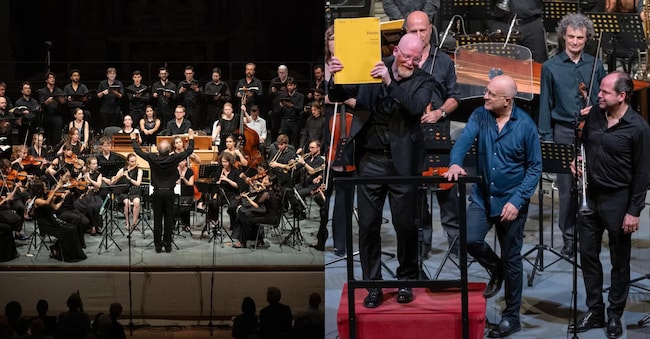
Whilst the programme remained firmly rooted in the contemporary (two world premieres, commissioned by the Chigiana: Tell me all. Tell me now by Philippe Manoury, and Requiem per Giulia by Andrea Mannucci), there were also forays into the ‘islands’ of Baroque music. Among these, Bach’s Mass in B minor stood out as the culmination of the Chigiana-Mozarteum Baroque Programme’s educational and artistic journey; a successful project, launched in 2021, which brings together two institutions with a long history: the Accademia Chigiana and the Universität Mozarteum in Salzburg. And the result bore the hallmarks of the highest professionalism, for whilst the musicians of the Mozarteum Baroque Orchestra are mostly students, they possess considerable discipline and confidence, and above all a sense of musical refinement which, in this monumental masterpiece by Bach, translates into naturalness. They play period instruments; the timbres and phrasing are those of historically informed performances; and there is no shortage of challenges in maintaining correct intonation, given the summer humidity that permeates the halls of Sant’Agostino. Yet there is not a moment’s hesitation in this Mass by Bach, characterised by discipline and good taste; it is transparent and graceful in the contributions of the Siena Cathedral Choir, carefully shaped by Lorenzo Donati, with vocal soloists who, whilst not outstanding, are quite adequate (the sopranos Olena Pinkowska and Julia Stocker, the tenor Llya Dovnar, the contralto Lana Kolomiets, and the basses Tim Winkelhofer and Shunsuke Suzuki). And underpinning it all was the orchestral direction of Alfredo Bernardini, a meticulous effort to harmoniously guide all the performers in recreating Bach’s Mass in B minor —a work that flows smoothly throughout, never heavy-handed, characterised by meditative tones yet also imbued with joy. The audience was enthusiastic.

