The photograph

Second-hand: the second-hand market worth over 500 billion dollars

In Italia, the second-hand sector accounts for 1.2 per cent of GDP. Saving money and sustainability are among the main reasons for choosing second-hand items. Online sales are the driving force behind this trend.

7' min read

Translated by AI
Versione italiana

7' min read

Translated by AI
Versione italiana

Until a few years ago, the idea of buying second-hand made people turn up their noses. For a long time, the social stigma surrounding second-hand goods meant it was impossible to move beyond the association between ‘second-hand’ and ‘low quality’. And whilst sceptics remain, today the second-hand market is firmly established globally, both economically and in terms of its image. One need only think of the success of apps such as the Lithuanian Vinted and websites such as the French Vestiaire Collective. Not to mention the throngs of people flocking to markets.

Market volume

The figures leave no room for doubt: the second-hand market is worth more than 500 billion dollars – according to 2026 estimates by the consultancy and research firm ‘The Business Research Company’ – with a compound annual growth rate (CAGR) of 12.6 per cent compared with 2025. Projecting these figures towards 2030, the turnover generated by the second-hand market could reach $854 billion. If we consider the clothing sector alone – based on the 2026 Resale Report by the online resale platform ‘ThredUp’ – this year’s figures stand at around $289 billion, with projected growth of $100 billion by 2030. The most striking figure concerns the trend over the last six years: since 2021, the second-hand clothing market has doubled in value.

Loading...

Our country is also part of this shopping trend: the second-hand market is worth 27.2 billion euros and accounts for 1.2 per cent of GDP – according to the ‘Second Hand Economy 2025’ survey conducted by Ipsos Doxa for Subito. 71 per cent of buying and selling takes place online and mainly involves clothing and accessories. Another interesting finding, which reflects the shift in Italians’ shopping habits, is that the second-hand market has become the starting point for more than half of those surveyed. So, before even looking for something new, people turn to second-hand goods. This trend is also evident in the luxury sector: according to a study by Bain and Altagamma on global markets for luxury personal goods, around half of luxury consumers check the second-hand market before buying a new product.

Vintage and/or luxury items

The second-hand market is a vast world that is not limited to the simple definition of ‘used’. It can encompass the sub-categories of vintage and luxury, which, in turn, may overlap. It is important to note that ‘vintage’ and ‘second-hand’ do not mean the same thing. An item is defined as vintage when it is at least 20 years old and can be traced back to a specific period based on its aesthetic and/or its historical and cultural value. By contrast, an item is second-hand if it has already had one owner. It is also true that buying a vintage garment or object generally means buying a second-hand item – precisely because, being dated, there is a high probability that it has already belonged to someone else.

Vintage fashion plays a significant role within the second-hand market. Generation Z, in particular, has brought back the aesthetic of the 1990s and the early 2000s, driven by a sentiment that could be described as collective nostalgia: people are taking inspiration from the style of Leonardo DiCaprio, Johnny Depp and Brad Pitt, who were in their twenties at the time; they are seeking out pieces of furniture that evoke the living room in *Friends*; and there is a renewed appreciation for Polaroid photos. In Italia – according to data from Ipsos Doxa for Subito – vintage fashion experienced a boom in 2025, topping the preferences of both sellers and buyers of second-hand clothing. Yet it is difficult to isolate the figures for second-hand vintage items because global reports and national surveys lump them together with the general data for the second-hand market. This is also because a large slice of the vintage market still passes through high-street shops and local markets, making it complex to produce a combined figure.

The difficulty in quantifying turnover does not apply to the luxury sector. Global sales of designer goods have exceeded $40 billion this year – according to estimates by The Business Research Company – and are forecast to reach $60 billion by 2030, with a compound annual growth rate of 9.6 per cent. Europe, home to the leading high-end brands, records the highest figures: the second-hand luxury market is worth $22.3 billion – according to calculations by IMARC, a global market research, business consultancy and strategic analysis firm. France leads the way, largely thanks to the online giant Vestiaire Collective, followed by the United Kingdom, Germany and Italia.

Among the most sought-after items, too, are second-hand luxury vintage goods. The Gucci Jackie bag, Dior’s mask-style sunglasses, the Molteni D.655.1 chest of drawers: the fact that these items are designer pieces and that their aesthetic harks back to styles and trends of the past imbues them with iconic status and, consequently, desirability. And the second-hand market acts as a further positive factor, bringing prices down and turning purchases into unmissable bargains.

The role of the internet and artificial intelligence

Vinted, eBay, Vestiaire Collective, Subito.it. These are just a few of the many websites and apps available for buying and/or selling second-hand items and clothing. The online sector is, in fact, one of the channels that has most facilitated the rise of the second-hand market and is the one experiencing the fastest growth.

Italian consumers – as highlighted by Ipsos data for Subito – account for just over 70 per cent of online sales and purchases: they do so from wherever they prefer, whenever they want, more quickly and with a wider range of products to choose from.

The second-hand fashion sector also confirms the success of online shopping: according to the Italian study ‘NetRetail Fashion 2026’ – carried out by Netcomm in collaboration with Veepee – one in two purchases is made directly via dedicated platforms and e-commerce sites. This behaviour reflects a generally positive trend in the online fashion market in Italia, which saw an 11 per cent increase in 2026, reaching 7.3 million people.

Loading...

Furthermore, the implementation of artificial intelligence is bringing even the most discerning consumers online: AI tools make it possible to personalise the shopping experience, compare options in terms of value for money, materials and fit, and verify the authenticity of items. These features provide greater peace of mind and prove particularly useful in the pre-owned luxury sector. The leading companies operating in this sector are, in fact, adopting applications that utilise artificial intelligence to enhance the user experience, providing them with the tools to verify the quality and authenticity of the items on offer. One example is the UK-based app Sellier Selected, launched by the resale platform Sellier Knightsbridge, which uses AI technology to offer a carefully curated selection based on precise metrics.

Furthermore, on 30 September, Deda Stealth – a company specialising in technological solutions for the fashion and luxury sector – announced that it had signed a strategic agreement with Trove, a leading US-based technology platform in the branded second-hand market. The collaboration aims to integrate Stealth Revalue – the platform that enables fashion and luxury brands to monitor prices, demand and dynamics in the secondary market in real time – with Trove’s equivalent. The ultimate goal is to streamline the second-hand luxury market by monitoring and evaluating all the factors that determine its competitiveness.

Physical places endure

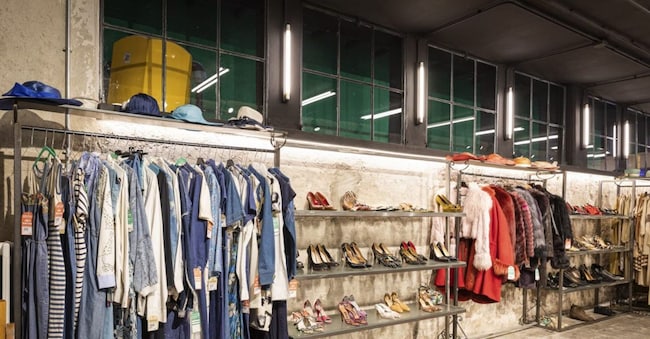
Yes, it’s true: e-commerce reigns supreme, but human interaction is holding its own. People still want to handle items with their own hands, see them in detail and try them on. Physical shops retain a charm and an atmosphere that are difficult to replicate online.

For example, walking through the streets of Shoreditch, one of London’s most creative and unconventional neighbourhoods, you feel as though you’ve stepped back in time. Camera cameras, vinyl records, sunglasses, jeans, fur coats and leather jackets: everything screams of the 1990s and the early 2000s. This is Brick Lane Market, a must-visit destination for lovers of second-hand vintage clothing and accessories.

It’s the same on the streets of Milan, in the city’s many second-hand markets: from the Brera district to the Navigli, from the East Market every third Sunday of the month to the more sporadic European VinoKilo fair. And how could we fail to mention the many boutiques and shops specialising in the resale of second-hand clothing and items? There’s even a dedicated tour that takes in the most renowned spots for vintage and second-hand shopping.

Generally speaking, physical locations offer an experience – a concept around which the entire world of shopping is being redefined: people today are looking for something that goes beyond the mere act of purchasing. And markets, just like shops, manage to create an atmosphere around the item itself.

Why buy second-hand

But why, then, are people buying more and more second-hand goods? Whilst the second-hand market is based on the rhetoric of the circular economy – a model that extends a product’s life cycle and seeks to minimise waste – there are other reasons too that drive consumers to turn to this sector.

One such benefit is the money saved by selling one’s own items and buying second-hand ones. Money is the main motivation for 62 per cent of Italians who buy and for 42 per cent of those who sell. Doxa data for Subito shows that selling second-hand items provides tangible financial relief for almost 30 per cent of people. For buyers, second-hand goods lower the barrier to accessing a product, especially if it has a high initial value – as can be the case with furniture or high-end clothing.

The revival we have been witnessing in recent years of the aesthetics of the 1990s and 2000s – as mentioned earlier – is also having a significant impact. A whole cultural imagery associated with that period has emerged, which has spread particularly amongst Gen Z, and many people are keen to snap up second-hand vintage items, even if only to follow the trend.

Environmental sustainability, however, remains one of the driving forces behind the second-hand market: buying second-hand is seen as an act of environmental responsibility, as it reduces waste and the generation of rubbish – even though on platforms such as Vinted, items are often sold with a view to reinvesting that money in other purchases. If we consider the fashion sector alone, in fact, the environmental footprint is very high: the industry is responsible for around 8–10 per cent of global greenhouse gas emissions, 35 per cent of the microplastics that end up in the oceans and 20 per cent of global water wastage. It is therefore clear that there is a need to embrace a circular economy, of which the second-hand sector is a strong advocate.

Copyright reserved ©
Loading...

Brand connect

Loading...

Newsletter

Notizie e approfondimenti sugli avvenimenti politici, economici e finanziari.

Iscriviti