
Rome's secrets in the golden 'bulla'
The Gallery of Roman Antiquities at the Ashmolean Museum in Oxford reopens: objects tell the story of the lives of emperors, slaves, domus and gardens

5' min read
5' min read
Who knows how many amulets have been contained in this gold filigree bulla. It is almost like a water bubble, precious and refined, and parents used to put it around their children's necks to protect them from supernatural forces, according to a tradition that continued in ancient Rome until the 4th century A.D. and came from Etruria, so much so that it was called Etruscum aurum. Today, the bulla, preserved at the Ashmolean Museum in Oxford and which also belonged to Empress Joséphine, wife of Napoleon I, is one of the masterpieces that tell the story of life in the empire's most shining moment and is part of the Gallery of Roman and Etruscan Antiquities that has just reopened, thanks also to the intervention of Intesa Sanpaolo and the involvement of Stefano Lucchini.
The British institution, a microcosm that has much of the British Museum, the National Gallery, the Victoria & Albert and the Natural History Museum in it, offers an endless journey through time and space, from the Egyptian art collections to Paolo Uccello's Night Hunt, from Samurai robes to Antonio Stradivari's Messiah Violin, and the refurbishment enriches the offer: "Rome, with its heritage, speaks of us, of our present," explains Paul Roberts, former curator of the Antiquities Department of the Ashmolean Museum and curator of the Galleries of Roman and Etruscan Antiquities. Our European roots, because I feel European, are born among the frescoes of Pompeii and the sculptures of the Via Appia Antica and are a flame to be kept burning like in the Temple of Vesta in Rome'. The new Gallery, designed by architect Clare Flynn, is just that, a flame for knowledge, especially for young people, and a way to enhance the Roman and Etruscan part of the museum's Antiquities Department, a treasure trove of 400,000 objects in all. The project was born after the success of the Last Supper in Pompeii exhibition, which Ashmolean and Intesa presented together in 2019 and recorded 87 thousand visitors in six months, becoming the most visited exhibition in a museum with 1 million admissions a year. That was the way, telling the story of everyday life, of the emperors and soldiers, and also of the poor Christs because, as Gabriel Zuchtriegel, director general of the Archaeological Park of Pompeii, often reminds us, in the city destroyed by Vesuvius two thirds of the houses had only two rooms. This is the life told by the bulla and the other objects chosen to discover Romanity. Which would not have existed without Etruria and the peoples of ancient Italy.
At the beginning of this itinerary, there is a sculpture of a lion that had wings: it comes from Vulci, it guarded the entrance to an Etruscan tomb datable to 600-580 B.C. and opens the door to the banquets frescoed on the walls, the importance of women, the fear of death and the desire to overcome it with beauty. Which is also that of the corner dedicated to the Italic peoples, from the Apuli to the Piceni, from the Messapi to the Samnites, often so neglected but at the basis of Rome's multiculturalism and thus its greatness. The new gallery is a glimpse into the brightest moment of the empire, between the 1st and 2nd centuries, when Rome's power extended over 75 million people and 5 million square kilometres. And it reached as far as Britain, whose conquest was begun by Caesar in 55 B.C. and ended under Claudius in 43 A.D. There are many artefacts from that period, such as the fragment of a mosaic floor from the 2nd century A.D., found in 1909, in Cirencester, the ancient Corinium. The tesserae of local coloured stones depict a cantarus and a heart-shaped leaf to tell the story of how art travelled the roads of the empire.
Rome was teeming with meetings and exchanges: it was the life of emperors and priests, soldiers and foreigners. Like the Greek physician Claudius Agatemero and his wife Myrtale. Their funerary inscription, written in Greek, is moving: 'I rest here, Claudius Agatemerus, the physician. Expert in the speedy recovery of all illnesses. I erected this shared monument for myself and for Myrtale, my wife.... Now we are with the blessed in the Elysian Fields'. First, however, came life with time spent in gardens, in a triclinium, among glass cups and jugs, among spoons and oil lamps, or in a cubiculum, a place of love - often a fluid love -, sleeping and jewellery. In Oxford's repositories there are thousands and thousands of artefacts, the result of a centuries-long stratification that begins with the collections of the Tradescant family, the royal gardeners, who were passionate about objects of 'ethnoarchaeology' and natural history, bequeathed to Elias Ashmole in 1650 and in 1683, on Ashmole's death, to Oxford University, together with Ashmole's personal collection of coins, books and manuscripts. Thus, in 1683, the Ashmolean was born as a free museum for the public.
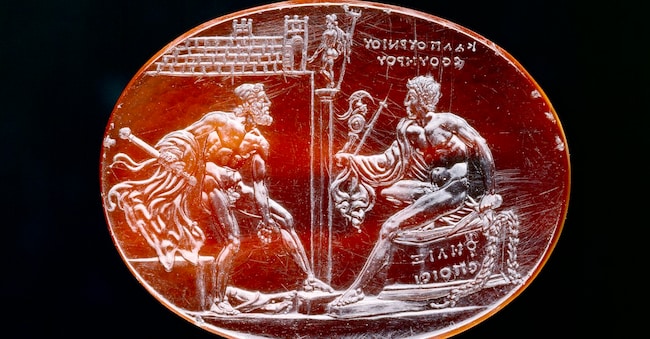
"Our heritage," continues Roberts, a passionate ambassador of the Italian spirit, "is immense and we have chosen the objects to be exhibited to intrigue visitors as much as possible, especially the younger ones in whose hands and research preservation is placed. The Gallery is legacy and legacy". There is art in these spaces and the life of slaves because Rome was immense but cruelty and institutionalised slavery remain deeply disturbing aspects. There is the living of women and soldiers, a video reconstruction by Matthew Nicholls (University of Reading and Oxford) of Rome, like a walk from the Forum to the Circus Maximus, and also the refinement of certain objects, such as the Gemma Felix, named after the carver who left his signature on the stone placed next to the name of Calpurnius Severus, the first owner. A few centimetres of sardonyx that, between 20-50 AD, are carved with a scene from the Trojan War. Odysseus scolds Diomedes, who has killed a guard, whose feet are barely visible on the ground, at the temple of Athena, as he steals the Palladium, the wooden statue of the goddess, and the gods punish the Greeks by delaying their victory.


