
The shadow of a great photographer: at the Lido Ferdinando Scianna narrated by Andò
Roberto Andò's beautiful documentary is a tribute to the maestro, but also the story of a friendship, which is inextricably linked with Leonardo Sciascia

3' min read
Key points
- Andò's homage to Scianna
- The book 'Religious Feasts in Sicily
- A black-and-white film
- Origins and career
3' min read
"Friendship is a stroke of lightning more mysterious than love," says Ferdinando Scianna, a photographer who does not want to be called a master although he is one: he was the first Italian to be included in the famous Magnum Photos, founded in 1947 by Robert Capa, Henri Cartier-Bresson, David Seymour and George Rodger.
Roberto Andò, who pours his poetics with equal skill into directing and writing, is Scianna's friend. That 'love at first sight' that has lasted 'forever' and is undiminished by time was triggered between them.
Andò's homage to Scianna
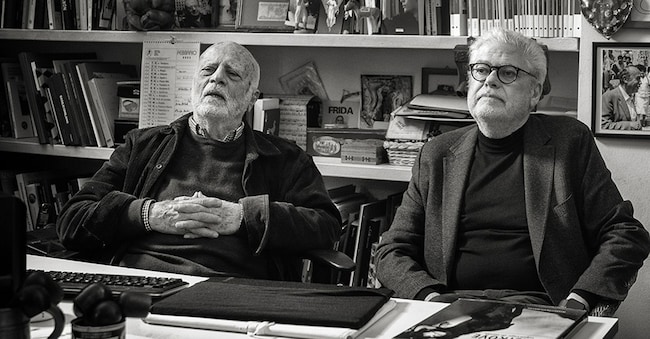
.Andò wished to dedicate a portrait and homage to his friend entitled Ferdinando Scianna - the photographer of the shadow. The two intellectuals, artists of civil society, aware of the 'responsibility of the gaze', are united not only by friendship, but by their common Sicilian origins and their bond with Leonardo Sciascia.
Together they embark on a journey to their land that they have left to realise themselves elsewhere - Scianna first in Milan and then in Paris, Andò in Rome - to which they owe a certain form of magic in their poetics and to which, in the same way, they find it difficult to return. Necessary roots, but 'cursed' for their scope of love and repulsion, from which one must free oneself in order to find one's own identity. "Disgust at the change of place. Resentment and love go together,' Scianna comments.
He returned to Bagheria, where Scianna was born in 1943, to retrace the origins of his inspiration: it was his father who gave him a camera at the age of 16 and when Ferdinando told him that he wanted to be a photographer, he replied: "But what kind of job is one that kills the living and resuscitates the dead? In Bagheria, in fact, the photographer was the one who took the pictures that went on the tombstones when the person was already dead. He would draw eyes on them. Scianna began to document what he saw, but it was Sciascia who revealed to him the true nature of his work: 'You are a storyteller' and not a scientific documenter.


