Collectible handicrafts

The face of the shamaness: discovering the nembori, the ancient ritual masks

A journey into the heart of one of the world's most dangerous places, the Darién rainforest, between Panama and Colombia. Here Corinne Bally works with Emberà women who weave the chunga palm and the nahuala.
by Monica Piccini

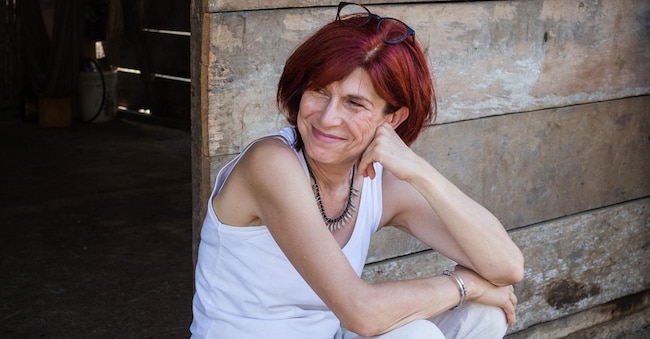
Corinne Bally in un villaggio della foresta tropicale del Darién, tra Panama e Colombia. Qui, artigiane locali realizzano a mano le maschere che lei aiuta a vendere tramite il suo showroom Ethic &Tropic. ©Raphaëlle Trecco

7' min read

7' min read

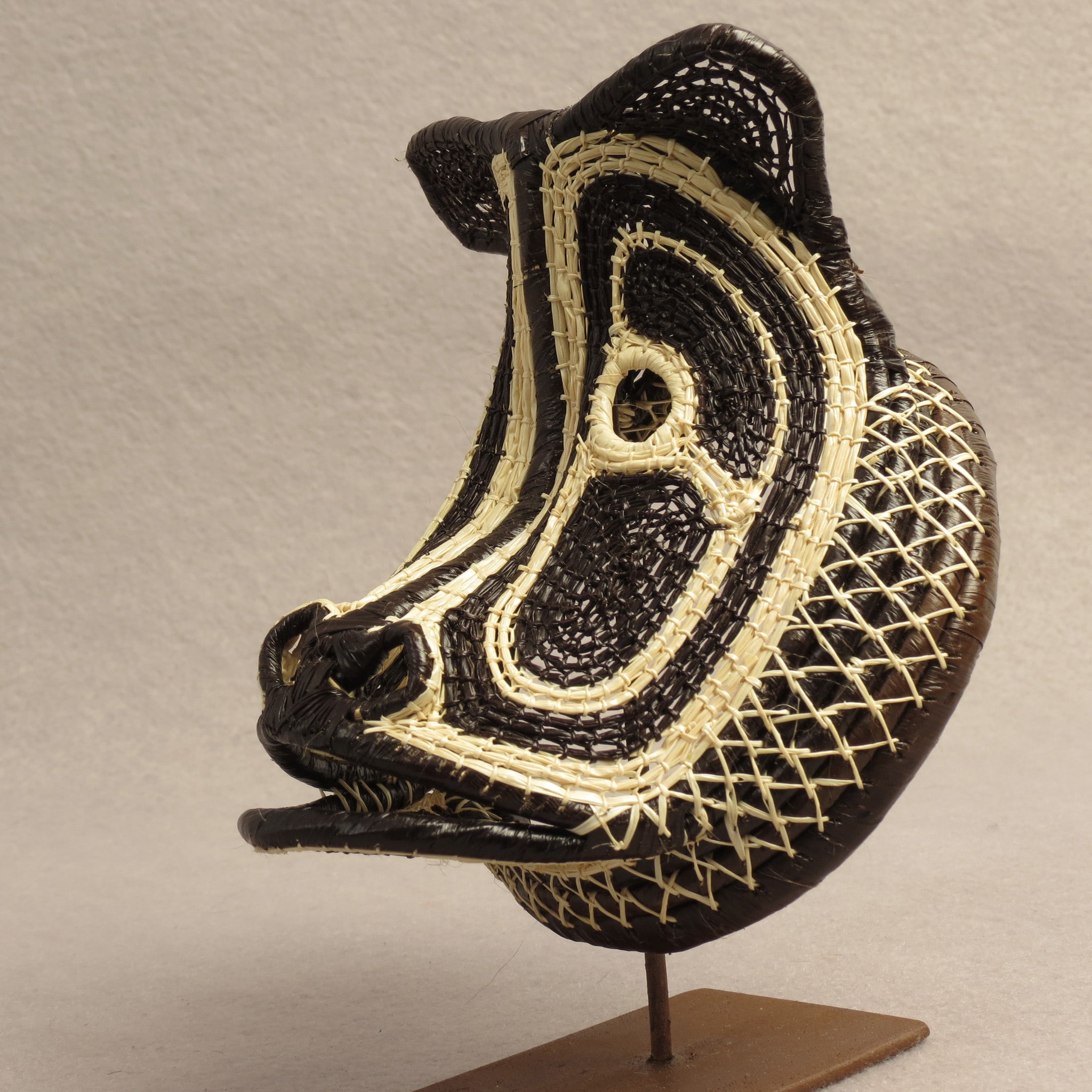
From the most dangerous place on the planet, the Darién rainforest on the border between Panama and Colombia, to the largest interior design fair in Paris. For more than ten years, Corinne Bally, 58, French by birth and Spanish by adoption, has been working with the indigenous women of the Emberà tribe, among the most isolated on Earth, in Central America. Together they make tribal masks called in the local dialect nemboro (meaning 'head') with great symbolic and anthropological significance. Originally, these artefacts represented, along with herbal potions, chants and litanies, the tools of the trade of the local shamans, still present in the community today. Today they are works of art, decorative elements exhibited in concept stores, libraries and, recently, at Maison&Objet.

"Wearing one of these masks, the shaman, part healer and part psychologist, is able to communicate with the invisible world, to get in touch with the evil spirit that torments sick people, who turn to him for help," says Corinne Bally. Before her first trip to Panama, inspired by the book Panamá split by Ernesto Endara, she had already lived two professional lives, as the director of a European Community programme ("I worked with small bakers, against the competition of industrialisation") and as a gallery owner in Valencia where her showroom Ethic & Tropic is based. Here today, in the shop window, are the woven masks that, without her curiosity and tenacity, would not exist: they are born to be destroyed, at the end of each shamanic ritual they end up in a big bonfire.
Loading...

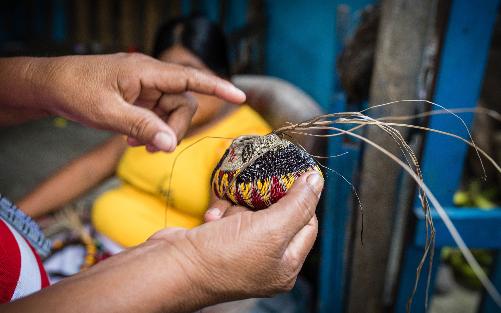
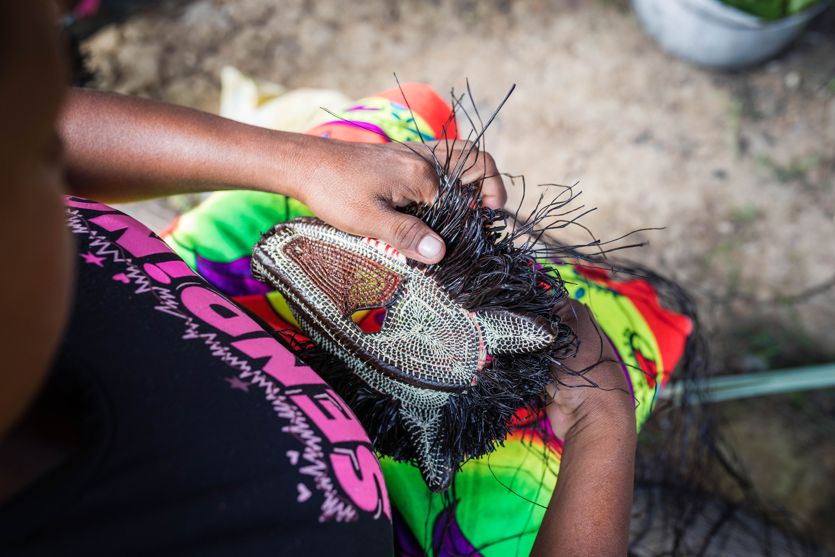
Qui e sotto, alcune delle fasi della lavorazione delle maschere, create intrecciando palma chunga e nahuala

"The first time I saw these masks woven from dried leaves was at the old Panama City market. They impressed me so much that I decided to go to the place where they were made to learn about their origin. Acquaintances and friends discouraged me: I was a 50-pound, 50-year-old foreigner who wanted to go to what everyone called the jungle of death, a forbidden as well as dangerous place. I got on a bus without really knowing how I would proceed. Along the way, peasants in work clothes, mothers with children, street vendors, and at one stop even an evangelical preacher who, despite the potholes in the road, stood for the whole of his journey to warn us of God's wrath, got on board. I had an appointment with Danitza, an Indian woman who had been introduced to me by an acquaintance; she lived between Panama City and the jungle. She would be my intermediary with the artisans of the forest. She could have been the right person (although a year later, she turned out to be the exact opposite and stole a lot of money), but on my first journey into the unknown, she was the only reference I had. The agreement was that he would pick me up at the bus stop on the way to Puerto Lara, a village of his tribe, which in the dry season can be reached by road and river. I got off at the agreed point, but there was no one waiting for me. Impossible to phone her, because she obviously had no mobile phone. All I could do was stand there on the side of a deserted road at the edge of the jungle and wait. After more than an hour, which seemed endless, she arrived and took me to meet the Emberà artisans up close.
Since then Corinne has returned some thirty times ('organising myself, because the intermediaries turned out to be swindlers'). A trip every three months, the first leg in a pickup driven by Jesus, a trusted driver, and then in a motorised pirogue carved out of a tree trunk. The only way of communication, the river. "We set sail at dawn from Yaviza, the pueblo where the road ends and the forest begins, to avoid being caught in the dark in this area known as the Darién Gap, where the Pan-American Highway that connects Alaska to Patagonia for 30 thousand kilometres only breaks for 100 kilometres, in an inaccessible and dangerous section. Because of the presence of crocodiles, poisonous snakes, unhealthy areas that are hotbeds of disease and the largest cocaine traffic from Colombia'.

The first village is four interminable hours away, also because we often stop because of oppressive heat or tropical storms (the rainy season runs from the end of April to the end of December). "My luggage never lacks a mosquito net, hammock, sleeping bag, boots and waterproof bags to protect my masks on the return journey. I try to cover myself as much as possible to avoid mosquito bites and especially morongolls, tiny insects that also sneak in under my clothes. The precautions are quite useless: I always return with bite marks that remain with me for several months'.
In the villages - a dozen or so huts built on river banks on stilts against the floods -, the Indian women (the men work far from home) wait for her. 'In these 10 years I have shared life and work, I have seen their children being born, I have integrated because I am a woman and we share time, experiences, habits. Between us we speak Spanish. I think I am an extraterrestrial in their eyes: I have no children (compared to their 9-10, the first at the age of 14), my hair is short and red and I travel for work. I usually do not stay more than five days, because there is no electricity, no running water and we live in the open. While Emberà women are used to sleeping on the ground on the wood, I sleep in a hammock, protected by the mosquito net. I fall asleep with the beating of bat wings and wake up with the cries of monkeys, roosters, birds and stray dogs. Even my diet is Spartan on those days: rice and fried plantain, I avoid meat and game. I bring drinking water 'from home', in a dugout, because I cannot drink water from the river, which for those who live here is the source for consumption and daily activities. In the river they wash, clean the fish we eat and the children play almost all day long. The rhythm of the days flows according to the rhythm of nature.

I am the only one around here who cares about time and deadlines, the craftswomen can never tell me, for example, how long they spent making a mask. It can take from a week to a month, depending on the size, but also on many other factors'.

La miniatura Solal realizzata da Alaysa della tribù Emberà. Si tratta, come tutte le creazioni, di un pezzo unico (270 €).

As poor as they are, each village is provided with a tienda where they can buy basic foodstuffs, a medical station (usually a nurse), a primary school teacher and a police station. "El Servicio Nacional de Fronteras, the police who control the border, always knows where and with whom I am," says Bally. 'In order to move through the jungle, I need special authorisation and if I don't comply they come looking for me. Once the policemen denied me permission to go to a village where they were waiting for me. I got very angry, but the next day I learned that there had been an armed revenge between drug traffickers and Colombian criminals who were heirs of the former paramilitaries. For a few years I also had the escort of two armed policemen. However, to be honest, I trust the natives more than the police'. Currently in this area, which is already impenetrable because of the dense vegetation and the absence of roads, there is another emergency: the exodus of Haitians, Venezuelans, and Ecuadorians fleeing, at the rate of almost 1,500 a day, from wars that never ended and destroyed economies, to the United States. "It is a humanitarian tragedy. You see entire families, including many children, who on the way become ill, exhausted, dehydrated, and many die'.

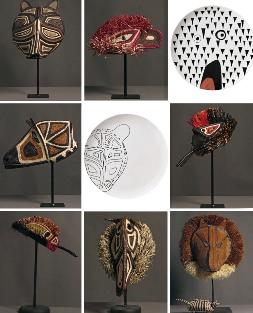
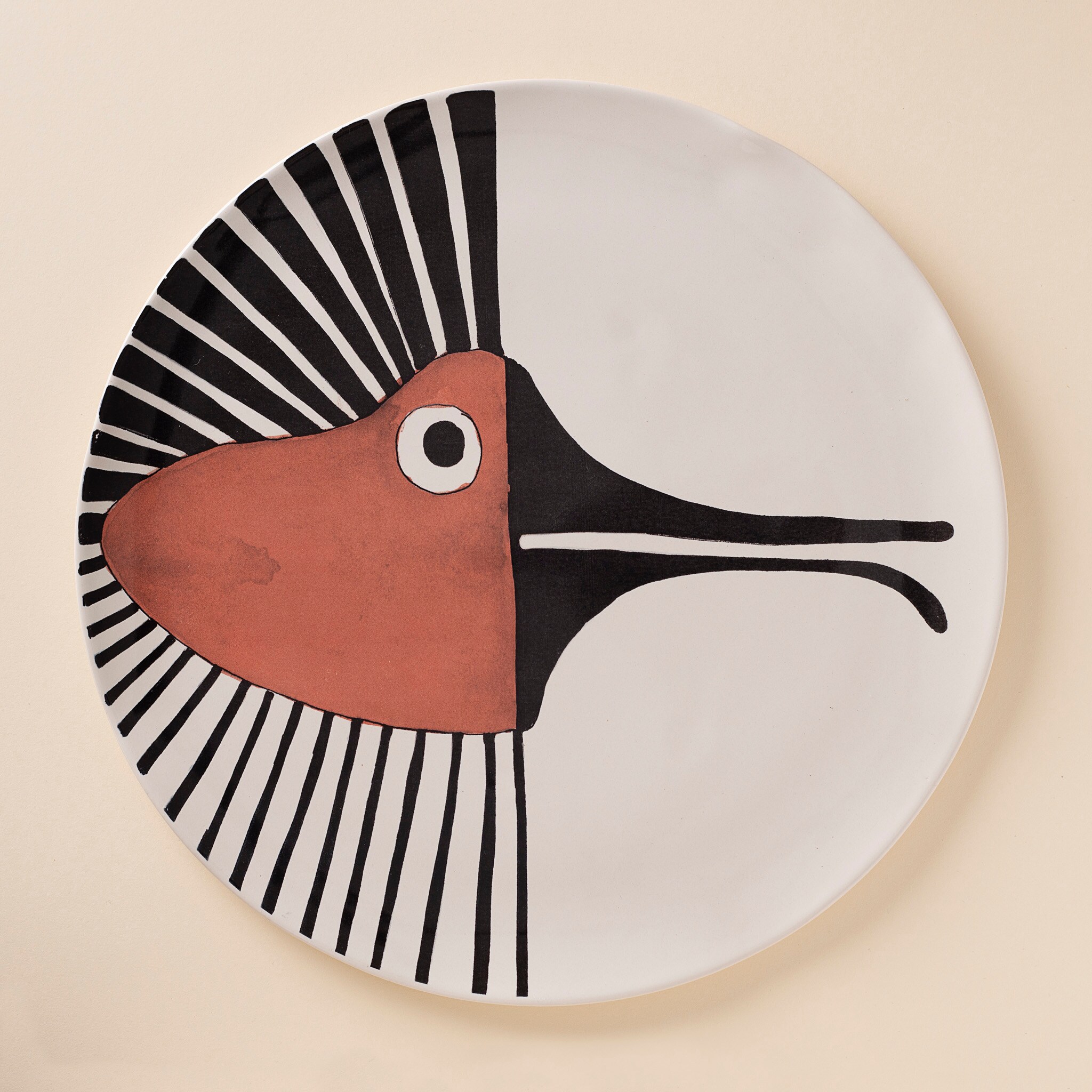
il piatto Pez, progettato dal designer Francesco Paolo Ambrosio. La sua interpretazione delle maschere create da Bally insieme alle donne indigene sono alla base dei disegni che animano la collezione di ceramiche Veragua(128 €)

In the Emberà villages, Corinne has developed an economic model, on a minimal and domestic scale, since each artisan works at home, at her own pace, but which represents a source of income and at the same time a valorisation of ancient knowledge. "Every time I go to Emberà villages, I buy all the masks they have made for me in the previous months (in a year they produce, all by hand, an average of 500 pieces) and give instructions for the next pieces. In the beginning, the masks were not as beautiful as they are now. I was very picky with the colours, creativity and working method. The only tool they need is a needle'. The weaving material is called chunga, a type of palm tree whose leaves are dried, bleached in the sun and dyed with vegetable dyes (e.g. yellow is obtained from turmeric root, blue with jagua juice also used for their traditional body paint). The structure of the mask, on the other hand, is made from a more rigid plant, the nahuala, which is, however, completely covered once the work is finished. "They are faces of monkeys, birds and other strange beings. What some of these masks represent remains a mystery, even to me. When I ask the craftswomen to explain it to me, they avoid my gaze and laugh'.

Nella prima riga, da sinistra, maschera Carabagí realizzata dall’artigiana Grimalda. Nemboro Tucumati creato da Doritza (250 €). Piatto Buho, parte della collezione Veragua. Al centro, maschera Zambapalo (270 €), piatto Tigre dalla collezione Reina del Darién (96 €) e maschera Cabasara lavorata dall’artigiana Rudilsa. Nell’ultima riga, maschera Ofuaa, il colibrì creato da Licenia (320 €); nemboro Malanga realizzato da Alejandrina (320 €) e maschera Chifar prodotta da Verónica (350 €).

Corinne's arrival in the villages is cause for celebration, not least because with her comes renewed opportunities to buy food (everything they do not grow or hunt), clothes and... mobile phones. Indispensable for those who can take more than a day to get from one village to another. "Mind you, I am not an NGO, I am their customer. I buy their works at the right price (masks are on sale from 250 euro). And this is the first time anyone has taken an interest in their work. People think that the few indigenous tribes that still survive in the jungle are a world apart and should only be supported with subsistence schemes (for example, the Panamanian government gives money to the family for every child sent to school, ndr). Instead, I believe that these communities are the custodians of a wonderful art, rooted in an ancestral culture that is in danger of disappearing. With humility I try to preserve this extraordinary knowledge from extinction'.

THE JUNGLE CUSTODIES CORINNE BALLY, ethictropic.com.

Copyright reserved ©
Loading...
Loading...

Newsletter

Notizie e approfondimenti sugli avvenimenti politici, economici e finanziari.

Iscriviti