Cannes Film Festival

'The Shrouds', technological prophecies and Cronenberg's existential reflections

Also in competition is 'The Apprentice', a film by Ali Abbasi focusing on the early part of Donald Trump's career

3' min read

3' min read

Filming what happens after death in order to maintain contact with those who are no longer there: this may be the summary of 'The Shrouds', one of the darkest and most melancholic titles of David Cronenberg's career, presented in competition at the Cannes Film Festival and among the most eagerly awaited features of the competition.

Two years after 'Crimes of the Future', with which this latest work has several points of contact and whose connection can already be seen from the opening credits, the master of body horror signs a highly personal film that can be linked to the death of the director's wife, Carolyn, who died of cancer in 2017.
Loading...

The Apprentice

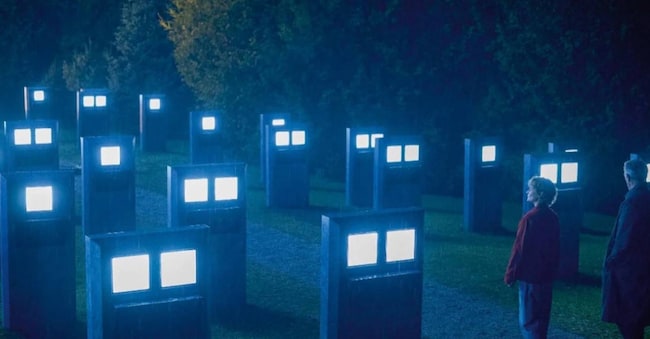
Vincent Cassel is undoubtedly an alter ego of the Canadian auteur - as much for his hairstyle as for his outfit choices - in this film in which he plays Karsh, a widowed businessman who invents a controversial and revolutionary technology that allows the living to observe their loved ones after death, while they are inside special shrouds (hence the film's title).

One night, however, the graves of this particular cemetery are destroyed and desecrated: Karsh will then start investigating to find out who is behind such an extreme act.

A sombre and touching melodrama linking life and death, 'The Shrouds' is a nostalgic operation, a constant and never-ending elaboration of a mourning from which the protagonist - and perhaps the director - can no longer emerge.

Love and death are nothing new in Cronenberg's cinema (one thinks of 'Inseparable', a film that often comes to mind during viewing), as is the presence of food - the cemetery stands next to a restaurant - and sex as a form of liberation but also of guilt.

Eerie Dystopia

.

Cronenberg recounts a 'credible dystopia' with this film, which reflects on the increasingly extreme contemporary obsession with filming and archiving every image available to us, but does not limit itself to this and also reflects on artificial intelligence and its increasingly humanising forms.

Technological prophecies of which the director has always been a master - one thinks of 'Videodrome' (1983) or 'eXistenZ' (1999) - and which here are linked, a bit like in 'Crimes of the Future', to possible global conspiracies and paranoia that can also make us think back to 'The Naked Lunch'.

Despite an ending that is not as incisive as the rest of the film and a little too much confusion in the screenplay, 'The Shrouds' remains one of those existential and philosophical films that can shake you up, a journey into darkness made by a director who is over 80 years old and who proves once again to be one of the youngest minds in world cinema.

Between hints of Hitchcockian flavour and moments of great formal elegance, Cronenberg signs a sort of self-analysis session, painful and capable of delving deep into his own mind and that of us spectators.

The Apprentice

.

Also in competition was 'The Apprentice', a new film by Tehran-born 1981 director Ali Abbasi, who returns to the Croisette two years after 'Holy Spider'.

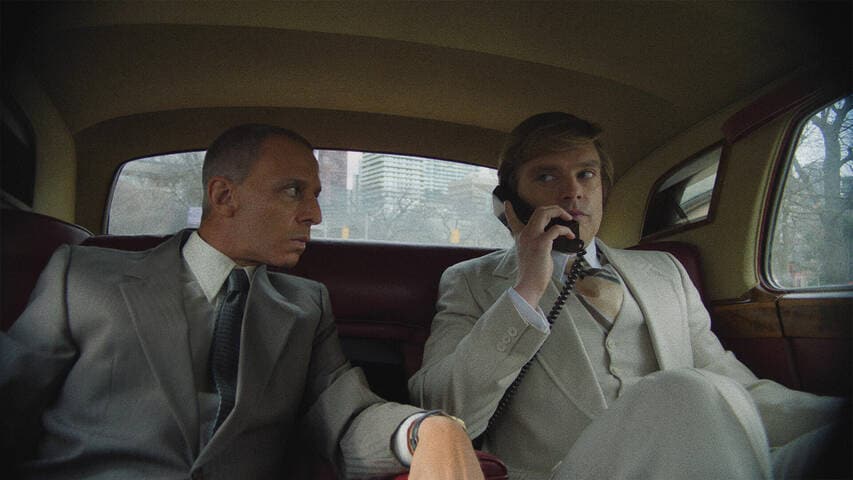
At the centre of this new film is the story of Donald Trump's rise to power during the 1970s and 1980s: more than the story of the young entrepreneur, however, it is above all the story of the relationship between him and the controversial lawyer Roy Cohn, who mentored him to be able to understand - and overcome - certain 'mechanisms' of the laws and American society.

Now in his fourth feature film, Abbasi raises the bar of ambition with this film that is in effect a coming-of-age story about how one can become powerful in the United States, but also a shadow analysis of the early career of Trump, a rampant unscrupulous entrepreneur who will soon realise how Cohn's lessons are crucial to success.

Filmed with good stylistic maturity, "The Apprentice" is an interesting film in terms of the rhythm of the story and the narrative methods, with the exception of a few overly hasty passages and a sense of having already seen the dynamics of the relationship that develops between the two main characters. A few too many simplifications are present, but it is striking that it is not (only) a biographical feature film: 'The Apprentice' is above all a film about an individual to describe several decades of American history, of which Abbasi shows more the vices than the virtues.

Remarkable performance by Sebastian Stan who confirms his excellent form after his fine performance in 'A Different Man', seen a few months ago at the Berlin Film Festival

Copyright reserved ©
Loading...

Brand connect

Loading...

Newsletter

Notizie e approfondimenti sugli avvenimenti politici, economici e finanziari.

Iscriviti