
Sicily's meat district risks disappearing due to lack of water
The alarm of the farms, which cannot guarantee water and fodder for the animals. In many areas the grain harvest has been skipped

4' min read
4' min read
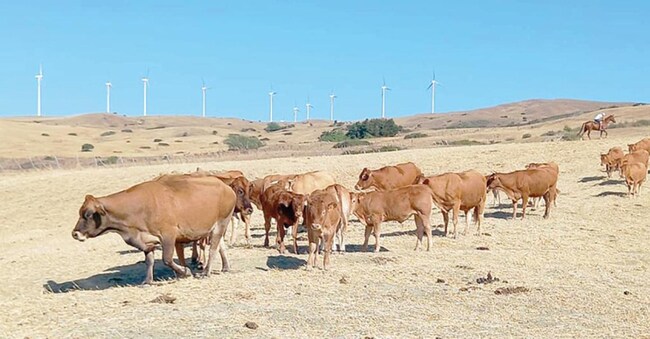
By the side of a dirt country road, in a tank full of water, which in these parts is called gebbia according to a strictly Arabic origin, there are goldfish that look like sea bass, so big are they. A violent punch in the stomach, in this countryside debilitated by dryness and lack of rain. Yet this is how it is, in this piece of land in Sicily, among the olive groves and cultivated fields of San Mauro Castelverde, in the province of Palermo. Some a lot (goldfish), some nothing (cows, sheep and so on) dying of thirst or worse sent to the slaughterhouse prematurely by breeders who can no longer guarantee either water or fodder.
Farming on its knees
.Scenes from an expected and foretold disaster: 'Last year we had already had strong signals, this year the situation has plummeted,' says Giuseppe Giaimo, an agronomist and farmer with his brother with over 130 cows: the company's headquarters is in the San Mauro Castelverde area (it also produces an extraordinary oil) but at the moment the animals are grazing in the Nicosia area, in the province of Enna, as happens every year. He adds: 'The whole system is in great difficulty: in many areas there has been no wheat harvest, there has been no fodder harvest. But if animal husbandry disappears, Sicilian agriculture disappears. And the signs are all there. The hay voucher is a palliative also because the system is too cumbersome and even expensive to bring any real benefit. This is the word of a man who is in the country every day of the year because animals eat and drink every day and need constant attention: 'Next year we will see the real effects of this bad year. The herds risk being halved and not only on the Madonie,' Giaimo says.
The landscape between San Mauro Castelverde and Gangi, a little over a thousand metres above sea level, is marked by this scorching summer: even the olive trees show signs of suffering and make one fear the worst. For the rest, everything is as it seems: scorching as if the good Lord had forgotten to turn the oven on. Of course it is not the desert because just a few kilometres away stretches the lush green forest of the Madonie Park for thousands of hectares. And here everyone knows that it is a problem of man's pressure, they have learned it from their fathers, from their grandfathers. 'We have between 400 and 500 farms, 350 of which are cattle and sheep farms,' says Giuseppe Ferrarello, mayor of Gangi, one of the most beautiful villages in Italy. 'I have ordered the seizure of a well belonging to a private individual and every day the water for the farms starts from there, with an average of 300,000 litres a day. The water is free but the tanker is not and those who do not have the possibility pay dearly. Costs on top of costs: a bale of hay costs 60 euro and only two years ago it cost 15.
These are the severe and serious numbers that call into question the survival of what is a small meat district that revolves around the slaughterhouse with an organisation of producers dedicated only to Sicilian meat: 150 breeders and the presence in 35 sales outlets of 'Carni di Sicilia' branded products. And it is certainly not enough that it does not snow (on the Madonie, the snowfields that once guaranteed ice for the food for the hot citizens of Palermo and elsewhere have disappeared), that it does not rain and that the subsoil also takes its toll: there are not many water tables within reach and when they are found, the water is salty or stinky because here we are in a special area, not so far from the salt mines. And it is no coincidence that the Salso river, which the Arabs called 'the salty river', moves from here. And when water can be found but cannot be used, the farmers have to fret like so many little Mastro don Gesualdo.
Flesh value
.Because without water there is also a problem of meat value, of yield: 'In this complicated context we have more fragile and leaner animals and this obviously also affects the price of half-carcasses: the price varies between 2.30 and three euros per kilo but a drier animal has less meat and therefore yields less from an economic point of view,' Giaimo explains further. And that's another aspect of this: in concrete terms it means less income but more expenses for maintaining the farms to 'fatten up the animals'.


