Ideas

The silent revolution on the dining table

The ‘Nordic Table Design’ exhibition at the MIC in Faenza traces the journey of female Nordic designers in 20th-century society

4' min read

Translated by AI
Versione italiana

4' min read

Translated by AI
Versione italiana

 The notion of women as ‘angels of the hearth’ now sounds outdated and out of place in a culture that likes to describe itself as enlightened and aware. Yet, recognising that their central role in society – and beyond society – originated precisely in the domestic sphere is not a cultural step backwards, but rather the mark of a truly informed and mature perspective.

Women have turned the tables, as the saying goes; they have redefined the rules, customs and functionality of a home, which is by no means a minor sphere but merely a miniature model of the dynamics of entire societies.

Loading...

The exhibition *Nordic Table Design: A Silent Feminist Revolution (1900–1970)* at the MIC in Faenza, in fact, showcases precisely this: a place – the kitchen – and a stage – the table – around which everything revolves. To speak of a ‘silent revolution’ is not only historically accurate but also aptly fitting. It is a definition that hits the mark, because that ‘silence’ points to a domestic sphere that is certainly intimate, yet no less courageous or fundamental for that. Precisely because they have been confined to the spaces of the home, women have, over the centuries, honed techniques of survival, aesthetic sensibility, and a knack for practicality, order, organisation – and even leadership. Pots and glasses, then, as weapons and tools of a revolution that begins within the home, strong precisely because it has been honed in the very space where women once accepted being confined and of which, ultimately, they have become queens and directors.

La rivoluzione gentile della tavola che arrivò dal nord

Photogallery9 foto

Design objects

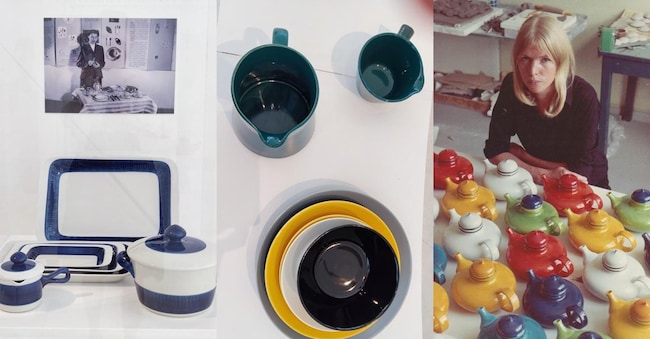
A long, well-balanced educational journey featuring display cases, table settings and recreations of domestic settings in which design objects are both works of art and functional tools, showcasing the beauty of their forms and colours alongside understated practicality. Ceramics, of course, always take centre stage alongside textiles and metals.

Nordic design brings fresh ideas, from stackable cookware to tableware sets in bold colours, and introduces modern concepts such as ergonomics, functionality and compactness. The kitchen must be tailored to women’s needs, and this aspect makes a visit there a pleasantly liberating experience.

Accompanied by texts, symbolic words in the various Nordic languages, and maps illustrating the differences in approach between regions and designers, the exhibition takes visitors on a journey through the many forms of expression found in Nordic design, from Danish ‘hygge’ (cosiness) to Norwegian ‘friluftsliv’ (outdoor life) and the Swedish concept of balance, ‘lagom’.

Design as a tool for emancipation 

Scandinavia’s long tradition in this field has meant that 20th-century Nordic women’s design has been celebrated not only for its aesthetics, but as a genuine tool for social struggle – a struggle that was natural and spontaneous, waged with the means at their disposal. Plates, glasses, cookware and cutlery were reimagined to be more functional and economical, without ever sacrificing beauty, experimenting with new materials and forms in accordance with the guiding principle of the Modern Movement: form follows function.

For Scandinavian women, designing household objects was a natural extension of their role, but also a practical way of making housework easier: not only did it lead to a more efficient and aesthetically pleasing everyday life, but it was also a genuine vehicle for social modernisation and equality.

As early as the late nineteenth century, the struggle for women’s emancipation and gender equality was already underway in Scandinavia. And although society remained patriarchal, Scandinavian women enjoyed considerable freedoms compared with other European cultures: they could own property, file for divorce and run their households entirely independently.

The MIC exhibition has a special connection with the museum’s history. Between 1964 and 1974, the Faenza Prize – International Competition for Ceramic Art featured a section dedicated to industrial design, in which numerous Nordic manufacturers led by women regularly took part, winning prestigious awards: among the best-known names were Grete Ronning, Marianne Westman, Rut Bryk and Hertha Bengtson.

Loading...

The protagonists and the exhibition itinerary

One hundred and thirty items on loan from museums, archives, private collections and iconic companies in Northern Europe, alongside an equal number of works from the bequests of the Faenza Prize. Forty-five Scandinavian designers, artists and intellectuals are the stars of the exhibition: from Aino Aalto to Estrid Ericson, from Nora Gulbrandsen to Marianne Westman, from Herta Bengtson to Ulla Procopè, right through to Grethe Meyer and many more besides.

The exhibition is divided into eight chronological and thematic sections, which explore how women, starting with the dining table, have reimagined and rewritten everyday life, from ‘The Far North’ – the identity of Nordic design and the deep connection between everyday objects and nature – through to ‘The Revolution at the Table’ – the optimism of the 1950s, the introduction of colour and children’s designs, featuring Arabia’s Kilta range and the experience of the all-female Marimekko factory, and ‘The Dining Table as an Expression of Social Change’ – the 1960s, the permanent entry of women into the workforce and the emergence of versatile objects capable of moving swiftly from the fridge to the oven, right up to the stylistic renewal of Royal Copenhagen.

The advent of democratic Nordic design has undoubtedly contributed – and this exhibition is a rich and dynamic illustration of this – to a silent yet far from superficial social revolution: a transformation which, starting with the most everyday of actions – setting the table – has ultimately redefined the very boundaries of women’s role in twentieth-century society. 

Nordic Table Design. A Quiet Feminist Revolution (1900–1970), MIC – International Museum of Ceramics, Faenza, until 10 January 2027

Copyright reserved ©
Loading...

Brand connect

Loading...

Newsletter

Notizie e approfondimenti sugli avvenimenti politici, economici e finanziari.

Iscriviti