
The Sinner effect, from sport to Made in Italy

3' min read
3' min read
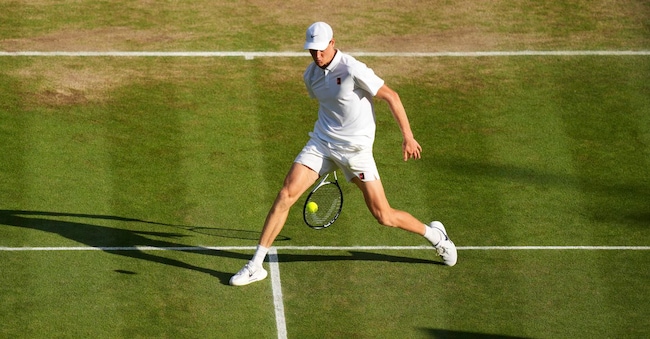
You didn't need a Wimbledon record to talk about the Sinner Effect, but the spectacle of last Sunday, 13 July, certainly corroborates its significance.
For more than two millennia, moreover, athletes with extraordinary sporting performances have periodically emerged. Performances that end up influencing knowledge, attitudes, behaviour, fashions, habits, values or even the fate of entire communities. In the early days, Milone of Croton (4th 2nd century BC) who, after no fewer than seven Olympic victories in wrestling, partly thanks to the exercise of Pythagorean virtues, led the Crotonians to a historic victory over the Sybarites. The former remained a symbol of discipline, strength, determination and a sense of continuous challenge (incrementalism ante litteram); the latter, on the other hand, notorious princesses of abundance and lust.
The studies on sport management and sport psychology, on the other hand, are recent. These are effectively referred to in a recent volume by Cesare Amatulli and Matteo De Angelis (Effetto Sinner, Luiss University Press, pp. 116, 15 euro) - published well before the Winbledon triumph - and constitute a young but promising field of application in the social sciences. And the contents proposed in De Angelis and Amatulli's volume constitute a real novelty. Their essay on the Sinner effect, in fact, combines the rigour of academic research on consumer behaviour and marketing with the overwhelming relevance of a phenomenon whose name or surname need only be mentioned, jointly or severally: Jannik and/or Sinner. The book contains empirical validations and measurements of the consequences (effects) of our athlete's celebrity. A celebrity built with such a naturalness as to appear preternatural, if not 'in spite of itself'.
The Sinner effect is articulated and, in the perspective of concentric circles, goes far beyond sport: from the most immediate one, within the tennis ecosystem, on athletes and fans, the effect extends to the audience of current and potential practitioners. Indeed, it reaches the spectators of all sports (see the data on television audiences and the apex topics covered in the conversational media), to the point of propagating, as empirically demonstrated in the book, on the values associated with the successful sportsman - as per the millennia-old tradition -, on sponsors and even on consumer values and choices. In the extreme, the Sinner effect even registers on the positioning of his 'country of origin' (albeit for a few kilometres), in short on the 'Made in Italy' brand.
Our beloved tennis player, data in hand, is not only a champion of sport but also, and in some ways above all, of attitudes and behaviour that communicate values that are not exactly commonplace. His talent is not only what we appreciate on the court but extends to his ability to have generated, in a relatively short period of time, a stock of cognitions and emotions - what used to be literally labelled as a 'lived experience' - proper to a great brand. A brand that can be extended across multiple product categories precisely because it is imbued with values perceived as authentic and effective, beyond tennis and beyond sport. A brand that, as you read the book, you will appreciate, is able to communicate an uncommon sense of responsibility and normality (humility), indeed substantially antithetical to the arrogance that seems to characterise many contemporary celebrities.

