Ideas

The six great paradoxes of Milan on show at the Triennale

The exhibition narrates the contradictions of a city in unstoppable social evolution through the interpretation of Afro-descendant artists

by Veronica Constance Ward

3' min read

Translated by AI
Versione italiana

3' min read

Translated by AI
Versione italiana

It is now clear that the economic and social gaps that characterised Milan have exploded, revealing an increasingly fragmented urban structure, a complex reality in which opposing tendencies coexist, real paradoxes that influence access to opportunities and condition the fate of an ever larger part of the population.

The exhibition Milano, paradoxes and opportunities is a tribute and a challenge to the city, a choral project that starts from an analysis of urban data conducted by the SI Lab of Bocconi University, which identified six major paradoxes that mark Milan today.

Loading...

Each of them was associated with an artist, who proposed a personal interpretation through one of their works.

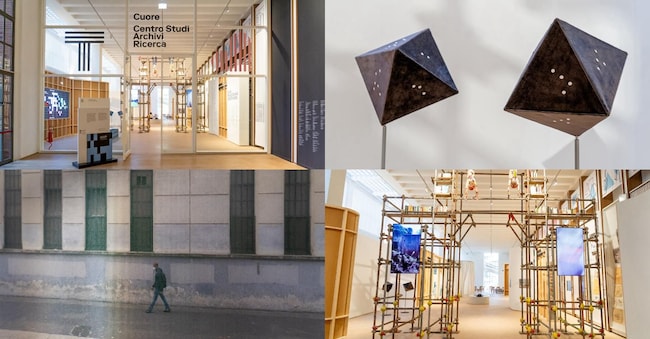
The Spazio Cuore, the first room on the ground floor, which is Triennale's bibliographic archive, becomes until 9 November, a living and relational archive, a place of confrontation, collective creation and continuous hybridisation, designed to stimulate reflection on the future of Milan and the need to innovate it in an inclusive, responsible and courageous way. An immersion in the city's contradictions, to reconsider apparently irreversible scenarios.

It is no coincidence that the artists are mostly Afro-descendants who are familiar with life in cities where the tangles of cultures are far from the centres that count, where the social division and even simply the landscape and architectural gaps impact on the perception of well-being in different neighbourhoods.
They know what it means to be a foreigner, the difficulties with documents, life on the fringes of cities.

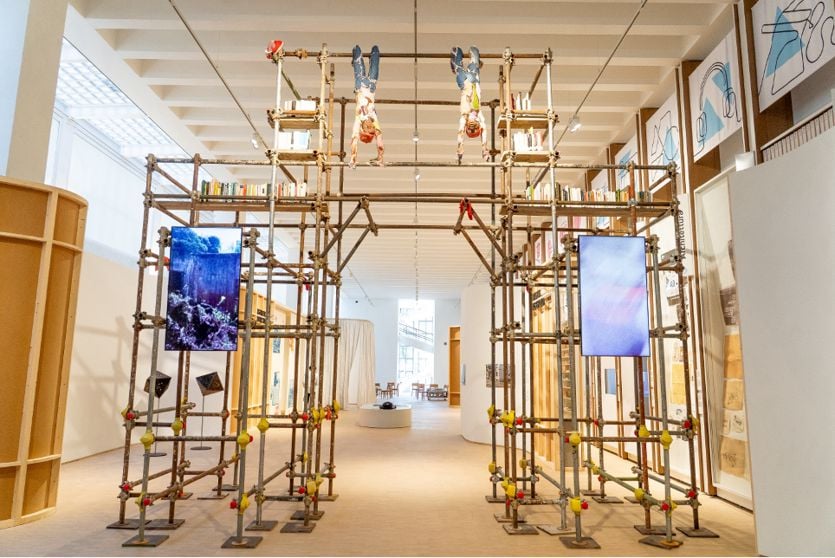
Justin Randolph Thompson Those of Us Buried Alive Are Called Mineral Rich, 2025. (Foto Paolo Tonato)

Justin Randolph Thomson

Starting with the Italian-African-American artist and curator Justin Randolph Thomson who in the work Those of Us Buried Alive Are Called Mineral Rich uses innocent pipes, screens, videos, fragments of quilt, wax, wood, shoe cream, mechanic's dishtowels, and books from the collection of the Piedmont Centre for African Studies to explore the construction of the notion of pax romana achieved through the economic and territorial domination of the centre on the edge of the empire. In a Milanese context where incomes rise more in the centre and rents rise more in the periphery, Thompson's work reveals the labour involved in maintaining and exacerbating this inequality.

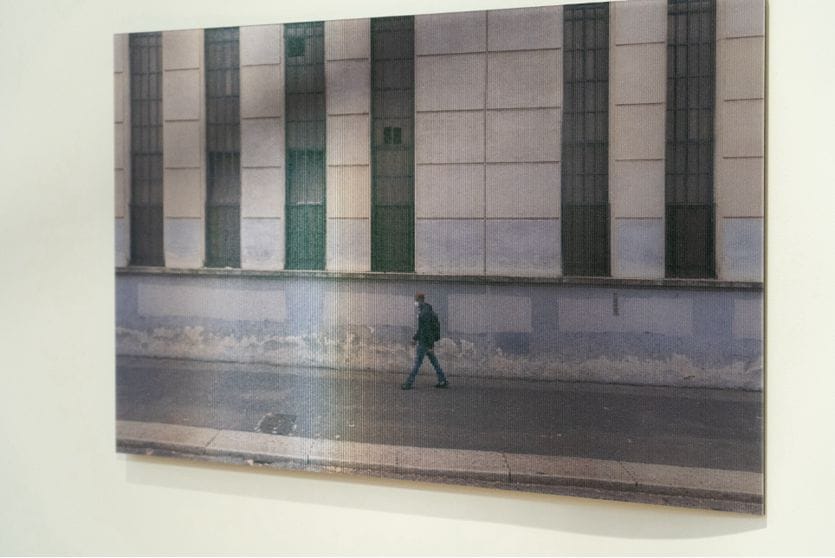
Theo Imani, Milano #1, (dalla serie A New Map of Italy), 2025 Milano#2, (dalla serie A New Map of Italy), 2025, 2025, Stampa Lenticolare, 84 x 52, 84 x 52 cm. (Foto Paolo Tonato)

Theophilus Imani

Theophilus Imani, an Italian-Ghanaian artist, in the works Milano #, Milano#2, from the series A New Map of Italy, uses the lenticular print technique playing between visibility and invisibility to invite us to reconsider the perception of urban space. In a city like Milan where families with two or more children are disappearing and single-person households have spread everywhere, this perspective becomes a metaphor for social fragmentation and urban loneliness.

Muna Mussie

Muna Mussie, an Italian-Eritrean brings the work PR (Public Relations), two octahedral dice made of metal yarn, aluminium, iron and fibreglass embroidered in Braille, one representing the compass rose and the other alternating an R (Rich) and a P (Poor), symbolising an inseparable pair in which one supports the other. The unmarked face of the dice urges one to go beyond the simple gaze and challenge clear-cut classifications.

Leyla Degan. 2025, Cianotipie, soundscape e due casse, 42 x 29,7 cm. (Foto Paolo Tonato)

Delio Jasse Jim C. Nedd, Leyla Degan

.

Intense is the installation by Delio Jasse, from Angola, who in Zone 1, Zone 2, through the technique of collage and the superimposition of documents, materialises the theme of access to education, highlighting how bureaucratic barriers can limit the possibility of using public spaces.

Jim C. Nedd, an Italian-Colombian artist, with his work Vuelvo al Sur, shows the dialectic between invisibility and desire, inviting us to reflect on what is hidden, neglected or excessively exposed. In Milan, his work stimulates a reflection on the silent but essential role of nature, often on the margins of the city's gaze, but crucial in counteracting phenomena such as heat islands that, as the earth's temperature rises, make the temperatures in urban areas with a strong presence of asphalt and a scarcity of vegetation and parks, higher than in surrounding rural areas, especially at night.

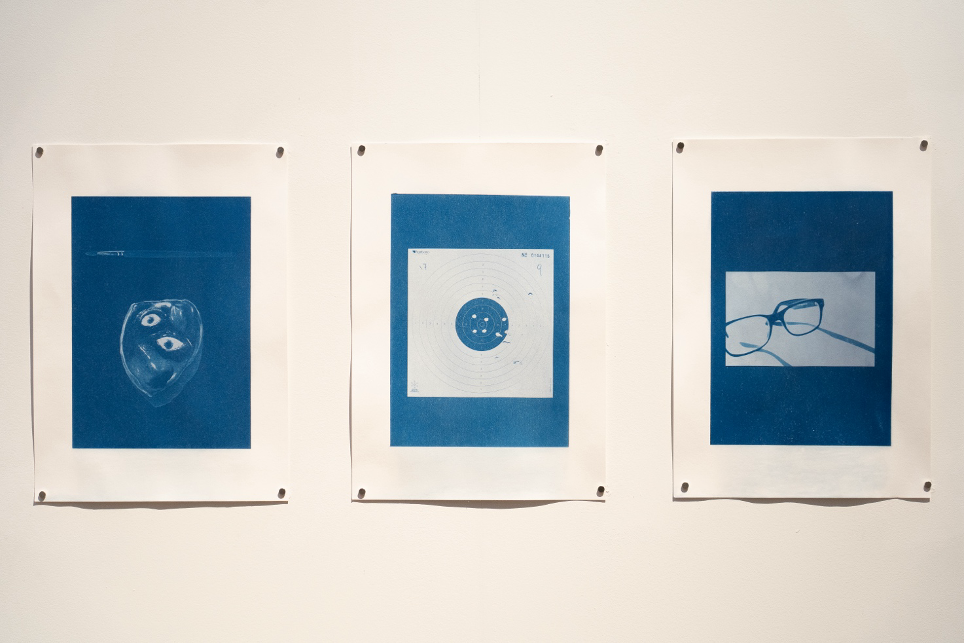
Finally, the Italian-Somali artist Leyla Degan, in her work Untitled, explores how data are structured and used, with a focus on the growing civic participation in neighbourhoods.


Milan, paradoxes and opportunities, curated by: Damiano Gullì and Jermay Michael Gabriel, director Black History Months Milano, Triennale di Milano, within the exhibition Inequalities, until 9 November 2025


Copyright reserved ©
Loading...

Brand connect

Loading...

Newsletter

Notizie e approfondimenti sugli avvenimenti politici, economici e finanziari.

Iscriviti