
The foundation revolution: skincare and technology change the rules
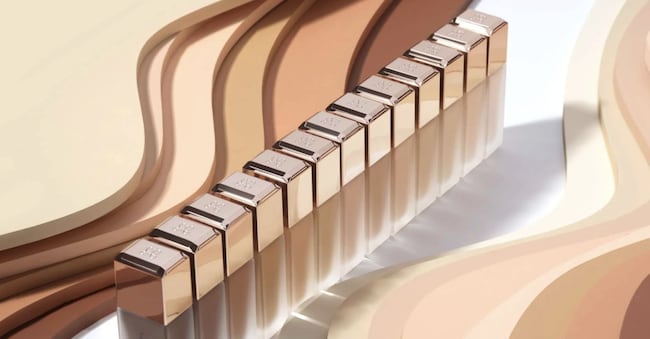
In the backstage of beauty trends, foundation is back in the spotlight: no longer a uniform mask, but an intelligent second skin. The latest generation formulas work in transparency, modulate light, adapt to the natural tone as if they already knew our skin. They forget the chalk effect, embrace hydration, protection, impalpable hold. "Over the last five years, foundation has undergone a radical transformation," says Michele Magnani, Global Senior Artist at Mac Cosmetics and spokesperson for Mac Italy worldwide. "From 2020 onwards, thanks to the growing attention to skincare, cosmetic houses have begun to completely rethink formulas and performance. Skincare has become an indispensable daily ritual: today we remove make-up carefully, choose targeted products, use masks and specific treatments. An approach that has pushed brands to create increasingly hybrid textures, capable of combining make-up and treatment".
Skinification is the watchword
Skinification is now an integral part of the beauty routine: it starts with targeted cleansing and moisturising, and then continues with make-up products enriched with skincare actives that offer additional benefits to the skin. "The foundation no longer has the task of concealing imperfections, but of nourishing the skin from within, making it radiant and radiant," continues Magnani. "The inclusion of skincare actives in foundations amplifies the benefits of the morning beauty routine and remains active throughout the day. It is a paradigm shift from the formulations of a few years ago, which were often not very moisturising and more focused on coverage than on skin well-being. Today, on the other hand, there are foundations that can contain up to 80% skincare ingredients, and even soft matte formulas that contain more than 87% skincare components. The result is skin that is moisturised for up to 24 hours, while maintaining a natural, adjustable finish'.
The era of 'flash friendly'
Another key issue concerns photographic rendition. With the constant use of selfies, smartphones and digital content, products must be 'flash friendly': no flashback effect, the one that in the past has betrayed even stars like Nicole Kidman, who ended up on red carpets with unsightly white spots. The new generation formulations are micronised, uniform and reflect light in a healthy way, giving a plumped effect without interfering with camera sensors.
How to choose the right foundation
Getting the perfect shade is not easy. Thanks to the new shade finders based on artificial intelligence, a selfie is enough to find the ideal shade in a few seconds: tools such as Match My Shade by L'Oréal Paris and MAC Foundation Shade Finder compare the image with thousands of shades and select the one that best suits your complexion. "Be careful, however, the result can be different: artificial light deceives," explains Magnani. "It is always a good idea to try the base outdoors and identify your undertone: warm, neutral or cold. A warm undertone is more golden or olive; a cool undertone is more pinkish, while neutral is in between. How to identify the ideal shade? The most common mistake is to apply it on the back of the hand and, even worse, on the back: instead, it should be applied on the jawbone, and if you can't see the gap you have chosen the right shade. To be on the safe side, it is always a good idea to go to the shop and do the field test. Or you can create your own foundation with the help of expert formulators. City Lab Cosmetics in Milan offers this service. The skin is analysed with state-of-the-art machinery; based on the results, the most suitable texture is identified and the perfect shade for the complexion is developed. You also select your favourite active ingredient and fragrance, and then enter the laboratory to create your own personalised foundation.
How to apply it
The latest formulas have made foundation application much more intuitive: modern textures glide effortlessly over the skin, even when simply using fingertips. "For liquid and fluid products, finger application remains the easiest," explains the make-up artist. "The product should be spread from the inside out and, on the forehead, from the bottom up. You can also use the brush, preferably flat and shaped, to be used with circular movements to obtain an even result, or the beauty blender, the latex sponge, ideal for spreading any texture and perfect for targeted touch-ups. Used dry, it provides more coverage and a sophisticated finish; when wet, it lightens the product and creates an ultra-light effect. Should concealer be applied before or after foundation? "It depends on the objective," concludes Magnani. "If it is used to camouflage dyschromia and imperfections, it should be applied before the base. If, on the other hand, the aim is to illuminate the eye contour, the advice is to dab on a small amount after the foundation, choosing a slightly lighter shade to enhance the shadow areas".

