
The spells cast by the sorceress Circe on the walls of Pompeii
Maria Chiara Scappaticcio analyses the 12,000 written fragments from the city in which the Homeric hero is mentioned

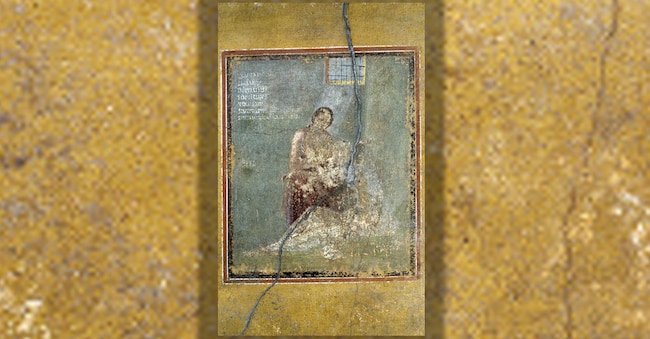
For centuries, Ulysses has roamed the Mediterranean, ancient libraries and the walls of Pompeii: how could he be absent from such a rich and multicultural city, second only to Rome? On a wall of the House of Eumachia (Regio VII), verse 70 of Virgil’s eighth Eclogue is inscribed. The Latin poet extols the powers of the sorceress Circe: ‘carminibus Circe socios mutavit Ulixi’ (with her song, Circe transformed Ulysses’ companions, CIL IV 1598) and whoever carved the hexameter did not render the name Ulysses correctly, for instead of ‘Ulixi’, they wrote ‘Olyxis’. But that matters little; what is important is the comparison: the quotation extols the hostess, Eumachia, a generous woman, whom some saw as a ‘new Circe’.
The graffiti depicting Ulysses is one of over 12,000 fragments unearthed in the city in Campania and studied in Voices of Pompeii: Latin and Literary Culture, written by Maria Chiara Scappaticcio. The lecturer in Latin Language and Literature at the University of Naples Federico II offers a meticulous analysis of the inscriptions fossilised by the eruption of Vesuvius in 79 AD: the result is a methodological guide and a panorama of civilisation, of the archaeological landscape that encompasses not only Virgilian verse but also swear words, obscenities and electoral propaganda: ‘From a renewed and recalibrated perspective, it is now clear just how promising a comprehensive analysis of the city’s written records, its “speaking remains” and its literary culture can be – a reality that needs to emerge in all its possible details to teach and recount its story again and again’. The epigraphic collections of past centuries, from Theodor Mommsen onwards, are detailed but cold archives. They reproduce the epigraphy, not the life that teems, shouts and rejoices within these pages.
The presence of Odysseus in Pompeii illustrates just how widely literature was studied and how prevalent it was amongst the wealthier classes. On the city’s walls, references to the Odyssey are (almost) absent, whilst those to the Aeneid abound. Even when an episode from the Odyssey is cited, it is done so through the poetry of Virgil, who had established himself both academically (as the Latin ‘counterpart’ to Homer) and culturally – that is, politically. In particular, the graffiti in question demonstrates how, in early Imperial Pompeii, the Odyssean myth had not faded and continued to survive (primarily through imagery), but Virgil (and with him the thoroughly Roman myth of Aeneas) evidently held greater sway. Among Latin writers, only Propertius and Ovid were his equals.
All this is revealed by a graffito, an inscription. And much more besides, as the essay demonstrates; drawing on material dating from the 5th century BC to 79 AD, it focuses on the theme of languages. The earliest inscriptions from the 5th century BC are found on imported objects; then there is Oscan, the language of pre-Roman Pompeii; Greek, which gives voice to the elegant Greek literary tradition but also to insults and vulgarities; Aramaic, as evidenced by the triclinium of the House of the Cryptoporticus; Safaitic, a Semitic script recording an ancient Arabic dialect: prior to the Pompeian graffiti, Safaitic had never been attested in the West, and no one can explain its presence in Pompeii. Then there is Latin, or, as the lecturer writes, the Latins: the apparent grammatical irregularities should not be read as ‘errors’ – although certain texts are not without them – but as a clear expression of linguistic variation, of that specificity which Latin possessed, presenting itself in different forms depending on the speakers.
We must also consider the private and public nature of a fragment (which enables us to reconstruct history), as well as the style of writing – whether monumental, as on funerary stelae, or graffito, as found in brothels or commercial premises. On the walls of the ‘fullonica’, the laundry, by Fabio Ululitremulo, one reads ‘Fullones ululamque cano, non arma virumque’ (I sing of the washermen and the owl, not of weapons and the hero), a clear corruption and mockery of the first line of the Aeneid. Rather than war, it is better to tell of the washermen, their toil-filled lives and the goddess Minerva, their protector, reflected in the owl.


