
The stamp celebrating the absence of popes
The Sede Vacante is the philatelic issue that for 86 years has marked the days between the death of the Vicar of Christ on Earth and the election of his successor

4' min read
Key points
4' min read
Philatelic collecting is experiencing a setback on many fronts, a passion that still involves boomers and less so the younger generation. But that interest in old and new Vatican stamps could involve the world of Catholic Christians in the wake of the new issues and the strong impact Pope Francis has had on his pontificate.
The Sede Vacante MMXXV stamp and its predecessors
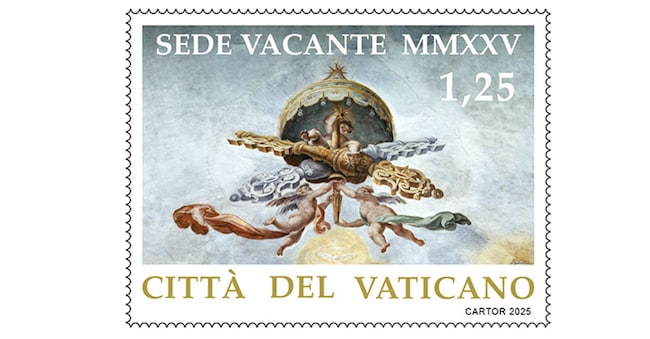
.On 28 April 2025, Vatican City issued a set of four commemorative stamps, known as "Sede Vacante" stamps, with a circulation of 70,000. Each stamp depicts the Pavilion of the Apostolic See supported by angels, protecting the decussate keys, i.e. the keys of St. Peter arranged in a St. Andrew's cross; one gold, the other silver: the first refers to power over the kingdom of heaven, the second alludes to the Pope's spiritual power on earth. It bears the inscriptions: 'Sede Vacante MMXXV', 'Vatican City', with an indication of the respective value: €1.25 - €1.30 - €2.45 - €3.20, i.e. the various postage rates. The name Sede Vacante is given to the philatelic issue that - since 1939 - celebrates the period from the death of the Pope to the election of his successor. The current Sede Vacante dedicated to Pope Francis is the eighth: the first was issued in 1939, on the death of Pope Pius XI; the second in 1958, on the death of Pius XII; then in 1963 (the death of John XXIII); 1978 welcomed two (Paul VI and John Paul I). The last three Vacant Sees are from this millennium: 2005 (John Paul II), 2013 (resignation Benedict XVI) and 2025 precisely.
Collecting Interest of Vatican Philately
To secure the latter, interested parties queued for several hours under the Colonnade. Apart from the emotional interest aroused by this stamp, one wonders what the purely collector's interest might be. "Although it is equal to one tenth of what it was in the golden age of philately, a number like 70,000 is not synonymous with rarity: it represents more than double the number of ordinary series issued annually by the Vatican," explains Pier Guido Landi, former wholesaler for the Holy See and from 1985 to 1992 president of the National Federation of Philatelic Dealers. "In any case, the €3.20 value was already sold out on the morning of Friday 2 May". At the time of writing, the 'Sede Vacante 2025' can be found online from €50 to €150. "The FOMO (fear of missing out, ndr) is fuelled by TV reports on international channels. Once the peak of interest has passed, however, prices collapse and these stamps become worth very little again," is the comment of Alberto Coda Canati, director of the philately department of Il Ponte Casa d'Aste; "it is the rarity, as well as its state of preservation, that makes a collector's item valuable.
Has a sede vacante stamp ever passed through auctions? "Absolutely not," answers Luca Alagna, deputy director of Cambi Aste's numismatics department and philatelic expert, former president of the Italian Numismatic Professionals (Nip). "These are fairly common issues, with laughable quotations. Just think that, from the catalogue, the first Sede Vacante issue is worth €50; moreover, the catalogue value is only theoretical and higher than the real one. To say, one finds sede vacante John XXIII at 2.30 €, Paul VI at 40 cents. Although they are special issues, made on rare occasions, the high print runs mean that they never reach appreciable economic values. The discourse changes if we speak of Sede Vacante coins or medals, whose tradition is lost over the centuries. Sede Vacante postage stamps in fact only came into being with the Vatican City (i.e. on 11 February 1929; the first philatelic series was dedicated to the Conciliation); "coins and medals, on the other hand, were already in use throughout the existence of the Papal States," Alagna continues. Are there at least 'varieties', i.e. stamps with printing errors, so dear to philatelists? "As far as sede vacanti are concerned, I have no memory of them," answers Pier Guido Landi.
The Provisional Series and the Future of Vatican Philatelic Collecting
The most valuable Vatican series, the one with the highest value, is actually the 1934 Provisional one: it has the characteristic of having the figures overprinted with the previous ones, and in the catalogue it is quoted at €4,000, which means that the collector pays €1,600 at retail, a figure that equates it with the stamp "Errore di gioventù", celebrating Lisbon Youth Day, issued on 16 May 2023 and then immediately withdrawn from circulation because it was accused of "celebrating colonialism". "Some people don't have the Provisional and bought the withdrawn stamp. For me, it was better to buy the Provisional, of which there seems to be a whole sheet of 100 series only in the Holy Rooms," says Enrico Capone, a Roman philatelic dealer, who calls the interest in the Sede Vacante series "straw fire". "It is a purely speculative phenomenon, also fuelled by the difficulties that the Vatican has been creating for several months for the philatelic supply". According to Capone and Landi, it has in fact become very difficult to obtain new philatelic issues from the Oltretevere "for at least six months". The official reason is that the Holy See "is in the process of sorting out the registry," says Capone, who laments the strong risk of repercussions on the very survival of collecting precisely because of these snags. Landi is more optimistic, although he admits that philatelic collecting is not currently enjoying great fortune: "At the moment there is a great disaffection towards postage stamps; the pleasure of staying at home to take care of one's collection, to study, is missing. There is a lack of the culture of collecting, which is tantamount to slowly weaving the ball of memory. But there are 1.4 billion Catholic Christians in the world. I think that in Asia and the poorer countries - also thanks to the low prices of stamps - a new golden age of Vatican philatelic collecting can slowly be revived".

