The discovery

The star and the cosmic feast: betrayed by an excess of lithium, it devours its own planets

It has already swallowed one of its massive planets, but that was just an appetiser. The main course is coming up shortly: a brown dwarf in the vicinity

4' min read

Translated by AI
Versione italiana

4' min read

Translated by AI
Versione italiana

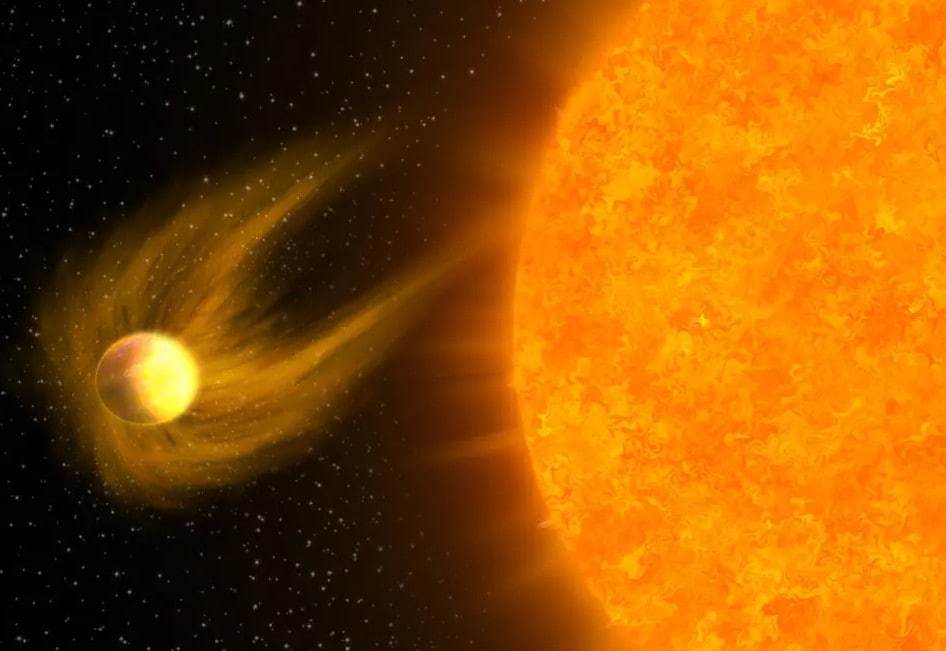
1,300 light-years away from us – not too far, then, in astronomical terms – a star has been discovered that shows clear signs of having had a cosmic feast, so to speak: it has swallowed one of its own massive planets. The evidence comes from an excess of lithium – yes, that element again – the chemical that pervades our lives today, from smartphones to electric cars, as well as other elements typically found on planets but not in the atmospheres of stars. So why are they there, the astrophysicists wondered.

It seems, however, that this has merely been an appetiser for our star, and that the main course is due to arrive shortly: a brown dwarf located nearby. ‘Shortly’ in astronomical terms, of course.

Loading...

That’s quite a mouthful, because a brown dwarf is a rather unusual celestial object – larger and more massive than a giant gas planet, between 10 and 80 times the size of our Jupiter, so to speak, but smaller than a star.

To put it simply, it cannot become a star: it is too small to trigger hydrogen fusion and become a proper star. So TOI-5882 – that is the star’s technical name – is thought to have swallowed one of its own planets and is now preparing to make a big move.
We know that, as stars such as our Sun evolve, they undergo a significant expansion, due to the fact that the star experiences energy problems, which it compensates for by expanding.

In about four billion years’ time, the Sun will do just that: it will expand, particularly its outer layers, increasing in diameter from 1.3 million kilometres to nearly 300 million kilometres, swallowing up Mercury, Venus and perhaps even our own Earth. However, even if we are not swallowed up, conditions on our planet will be dramatically different.

The fact that a star can devour one of its planets is therefore nothing new: it is expected and has been studied. The point is that here, astrophysicists, in two papers published very recently in the field’s most important international journal, have found evidence of the ‘crime’.

In the final impact, when the planet enters the star that is drawing it in, it is effectively fused – to use an easy-to-visualise image – and its elements are distributed throughout the outer regions of the parent star.

And so, in the atmosphere of this star, we suddenly detect the ‘signatures’ of chemical elements that are not typical of stars but rather of rocky planets, such as our own Earth. The light reaching us from TOI-5882 indicates the presence of very Earth-like elements, foremost among them lithium, an element that is easily identifiable by analysing the composition of the light.

“We know that there is much more lithium in planetary material than in stars,” explains Brooke Kotten of the University of Michigan, the study’s lead author. “So, if a star swallows a planet, it ends up becoming enriched with lithium.”

This is a surprisingly rapid process on a cosmic scale, which can be completed in a matter of weeks, or even days. Precisely because it is so brief, it is almost impossible to observe it in real time, and so we must resort to deductive methods to reconstruct these events retrospectively, through the traces left behind in the star system.

But let’s get to the point: the star hasn’t expanded – it’s still a long way off – so why on earth did the planet fall into it, we might ask. This planet may have had its orbit disrupted and been sent towards the star by a troublesome neighbour: a sub-stellar object known as a brown dwarf, which was already known to exist and orbits very close to the same star – all of which has been published in *The Astrophysical Journal*.

With a mass approximately 22 times that of Jupiter, the brown dwarf exerts a very strong gravitational influence, sufficient to disrupt the orbits of the innermost planets in the system, to the point of altering them and causing the planet to fall into the star itself.

Bullies, however, generally come to a bad end in the Universe, and the brown dwarf, as far as we can tell, is also destined to plunge into its much more massive parent star, which is 30 per cent larger than the Sun. And then we’ll be in for a treat. The brown dwarf’s orbit passes so close to the larger star that it is certain it too will be swallowed up, after having pushed the planet towards its demise. In 25 million years, perhaps a little more, nothing will remain of the brown dwarf either, save for a trace of its existence in the light of the star TOI 5882. Astrophysics is often a science that works by piecing together clues, but in the end, the culprit is found.

Copyright reserved ©
Loading...

Brand connect

Loading...

Newsletter

Notizie e approfondimenti sugli avvenimenti politici, economici e finanziari.

Iscriviti