
The disappointment of Emerald Fennel: a Wuthering Heights between feigned transgression and banality
Two very good actors, Robbieed Elordi, forced into macchiettes by Fennel who rewrites Emily Brontë's novel, betraying its spirit

Key points
All that is stormy here is the dismay of some lovers of Emily Brontë and previous film versions of Wuthering Heights. Emerald Fennel's film retains the sense of torture and impotence that innervates the love story between the two protagonists of the English literary masterpiece, but spices it up with unnecessary elements of feigned transgression, starting with the opening, in which moans and squeaks make one think of a risque situation. And, no, the scene is not even as risque as it promises, it is just tasteless.
The plot
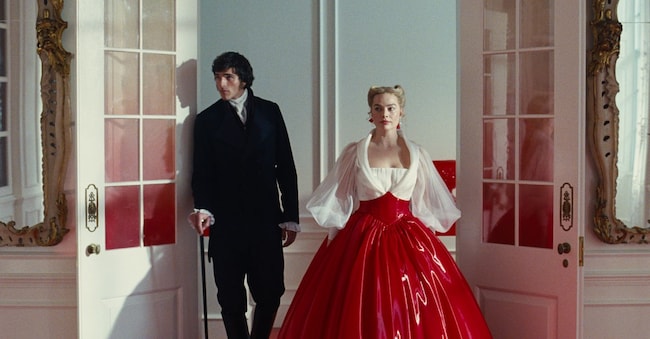
In 1800s Yorkshire, Catherine, played first by Charlotte Mellington and later by Margot Robbie, grows up without a mother, with her lady-in-waiting Nelly (Hong Chau as an adult), when her abusive father (Martin Clunes) brings home a foundling (as a child Owen Cooper and later Jacob Elordi) whom Catherine renames Heathcliff, after her dead brother. Catherine finally finds happiness by losing herself with her young friend on the moors, until the arrival of the wealthy Lintons breaks the unique bond between the two young lovers and unleashes a spiral of revenge and torment. Put like that, Fennel appears almost philological, and it almost is in the first late childish-adolescent part, were it not for the set design (by Suzie Davies) that announces the cartoonishness: Wuthering Heights is a Tim Burton-esque gothic backdrop thrown in there without coherence, because the rest (including Linus Sandgren's photography) is a string of candy-coloured gimmicks and soaps.
The Key to Toxic Love
Similarly, the key to toxic love, which might say something to contemporary audiences, trespasses into déjà vu and boredom amidst TikTok-like jerks and wiggles. Right from the title, the director needs inverted commas to explain that it is a revisitation. Andrea Arnold's 2011 version also broke with tradition, yet it truly rendered the novel's innovative and sweeping spirit, wanting James Howson, a black actor, for Heathcliff, and rightly focusing on the liminal age as a place of discovery and ruffled struggles with self and new desires. The age of the actors must be that which allows an absoluteness of feeling, as Zeffirelli well knew, who chose Leonard Whiting, then 17, for Romeo, and Olivia Hussey for Juliet, then 14, for the Shakespearian drama transposed onto the big screen.
GenZ and 30+
Why then waste words on such a banal film? There are so many of them, after all, especially blockbusters, cleverly designed to bake crowd favourites for 90 (hopefully) minutes of eye candy. Perhaps because this version of "Wuthering Heights" cries out to the four winds that it is as scandalous and immoral as the book was judged to be when it was published. Instead, it betrays it with vulgarity. The British director, who had made an original debut with the feminist A Promising Woman, could have taken advantage of the enormous appeal of the two leads on different audiences - Elordi on the GenZ and Robbie on the 30 plus - to offer new cinema to two different generations, uniting them under the aegis of the big screen. It did not do so and further burned itself out by moving away from the age of the novel's protagonists.
The previous film versions
Laurence Olivier and Merle Oberon in William Wyler's The Voice in the Storm (1939) were no boys either, but the stature of the classic was all there. And if we have already said about Arnold, Peter Kosminsky with Ralph Fiennes and Juliette Binoche (1992) set up a romantic meatloaf, but did not disfigure the text.Fennel, on the other hand, only pretended to be on the same track as Brontë and desecrated a literary milestone. He has taken two very good actors and reduced them to macchiettes.


