
The Strangelove for the control room
The film in which Oscar winner Bigelow depicts the US under nuclear attack is a real case on Netflix. First in terms of viewership, the film is not liked by the Pentagon, which complains about the sloppiness with which the reaction of the top brass is depicted

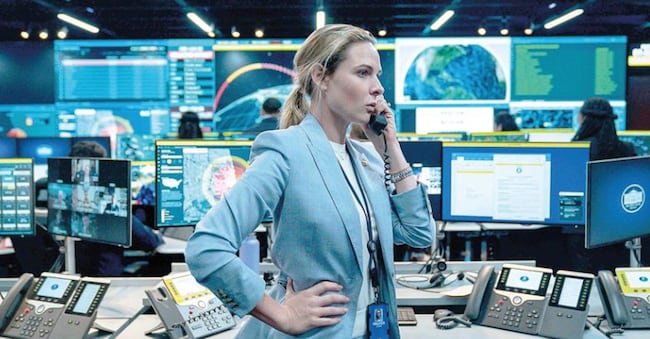
has become a case Kathryn Bigelow's House of Dynamite, first in viewings globally on Netflix. The platform, which produced the film, is rubbing its hands even harder at the Pentagon's shady and resentful reactions to the film, which are driving up clicks. The US defence brass is grumbling that the thriller assumes sloppiness, inaccuracy and vulnerability of the world's greatest power in the face of aggression.
The film gets its start thanks to the dubious and cryptic feminine strength - which is never at the expense of professionalism in Bigelow's films - of Captain Olivia Walker (Rebecca Ferguson), who finds herself handling the quintessential emergency in the White House Situation Room. The plot, in three pictures, tells of the disconnect of American society in the face of the threat of a nuclear missile, of unknown origin, about to strike the United States. Detected by the radar of a military base in Alaska, experts estimate that it should hit Chicago in 19 minutes, killing more than 10 million people. Immediately the military, diplomatic forces, experts, defence analysts, the Army leadership, and the Government in contact with the President of the United States (Idris Elba) are activated to determine who started the offensive, how to react and neutralise it.
Unlike Kubrick's Strangelove, in House of Dynamite there is no suspicion of Russia, but of North Korea. And if Kubrik had filmed a satire on the incompetence of the men in charge and the weaknesses of the controllers, here there is little to laugh about, except the malfunctioning of the Kremlin in the most connected era in history. With this film, the director abandons the front line, the theatre of her previous films, and enters the control room, where the same story is watched by the protagonists according to their personal and professional backgrounds, taking decisions beyond their competence.
Bigelow's The hurt locker and Zero dark thirty changed the world of cinema, proving that muscular, rifle-slinging, camouflage-wearing films are not the exclusive preserve of the male world.
The imprint, no less gory, of these films is Coppola's masterly one in Apocalypse Now, but transported to the new war scenarios in Iraq and Pakistan, seen through explosions, military camps, mine-clearing and in the soldiers' countdown to return home. Bigelow puts her anxiety-inducing camera at the service of testosteronic action, applying it to a context that is not only made up of psychosis but also of balancing and disorientation. This new, twofold step, violent and reflective, won her, the first woman ever, the Oscar for directing The hurt locker in 2010. Precise and shrewd in the verisimilitude of movements, equipment and war dynamics, Bigelow records without transport or judgement the military's dependence on adrenalin, between courage and alienation. A theme already explored, one might say, but who had ever so skilfully brought it back to the 1990s and 2000s?


