Cycling

The strange case of the Giro d'Italia starting in Albania and ending with the new Pope

With Pogacar and Evenepoel absent, it promises to be a more open and hard-fought Corsa Rosa than the previous one. With a generational challenge between the old guard and a handful of youngsters who will try to finally become protagonists

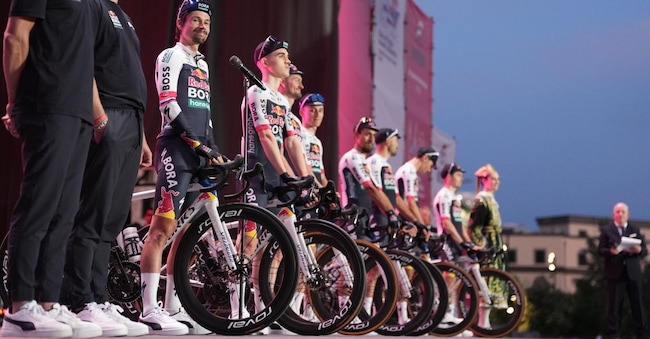
Corridori durante la presentazione delle squadre in vista del Giro d’Italia a Tirana. La corsa partirà venerdì 9 maggio con la prima tappa di 160 km, da Durazzo (Durazzo) a Tirana (Tirana), Albania, mercoledì 7 maggio 2025. (Foto di Massimo Paolone/LaPresse)

6' min read

6' min read

Without too many trumpet blasts, crushed by the feats of Sinner in tennis and the Inter in the Champions League, the Giro d'Italia arrives, as it does every year in May.

Although cycling is globalised and computerised, some incurable romantics still tenderly call it a 'beautiful fairy tale'. Others, more prosaic, remember it as a 'popular novel' to be leafed through like those old childhood books that have survived the inevitable moves from house to house,

Loading...

Be that as it may, it is 116 years ago (1909, pink jersey Luigi Ganna) that when the poppies appear, the pink race enters our lives, adapting to the changes of an ever-faster-changing world.

It seems incredible that the sport that has celebrated champions such as Binda and Girardengo, Coppi and Bartali, Gimondi and Merckx and so on up to today's Pogacar and Van der Poel has remained essentially the same despite the enormous technical and scientific evolution. But perhaps this is the beauty of cycling: that in the end, even with the mental coach and ultralight aluminium bikes, to win you must have a good pair of legs (the famous 'garuns') that push the pedals and make you go faster than your adversaries.

There are two real novelties in this 108th edition of the Giro, which starts this Friday 9 May from Durres and ends on 1 June in Rome in the Vatican gardens, presumably with the blessing of the new Pope Leo XIV.

Schools closed

The first is that it starts from Albania, with three stages winding through Tirana, Durres and Vlora. Although this is the 15th start from abroad, it is the first time it has taken place in a country where cycling is still a pioneering sport and the bicycle, crushed by aggressive car traffic (the railway network used under the dictatorship in Albania is in disrepair), is a means for daring and unconventional nonconformists.

Suffice it to say that so far the land of the Eagles has only had one professional cyclist, a certain Eugert Zhupa, who, however, grew up as a child in Reggio Emilia. However, there is great anticipation in Tirana for the Giro, which is considered not only a great popular festival, but also the 'biggest sporting event ever hosted in these parts'. Even the schools will keep reduced hours to allow all the children in Durrës to follow the first stage, which will end in Tirana after 160 km.

The second stage, on Saturday 10, is a 13.7 km time trial from Tirana to Tirana. The triptych closes on Sunday 11 May, with another fairly demanding stage of 160 km from Vlora to Vlora. Clearly, this twinning of the Giro d'Italia with Albania is synergic with a more general twinning between our government and that of Prime Minister Edi Rama, a former national basketball player who, as a boy, followed the exploits of Felice Gimondi and Vittorio Adorni at the Giro d'Italia on Italian radio.

A choice, this of Albania, that should not come as too much of a surprise. It is a tradition (and also good business) for the pink race to start outside the borders. It has been done from Belgium, from Ireland, from Athens, from Holland. In 2018, in less turbulent times, the tour started from Jerusalem and in 2022 from Hungary. For these three stages, the Albanian government would have paid RCS around 8 million. A considerable amount if you think that for a normal start you pay around 150 thousand euros and for a finish around 250 thousand. Figures to be taken always with approximation as the same turnover of the Giro, which would be around 80 million (160 the Tour de France).

Absent Pogacar

.

The second novelty, which is however no longer news, is the absence of Tadej Pogacar, the new Merckx of cycling, already winner of the previous Giro d'Italia with almost ten minutes' lead over the second, and absolute protagonist of the last spring classics: in all of them, in addition to winning Flanders and Liège-Bastogne-Liège he always managed to get on the podium. A star rider, the world champion, who inevitably makes the difference. Luckily for his rivals, Tadej preferred to skip a lap in order to arrive fresher at the next Tour de France, where he will have to contend with Jonas Vingegaard, the only one who can put a spoke in his wheels at the Grande Boucle.

In pole Roglic and Ayuso

So what? Who is in pole? Bearing in mind that the Belgian Remco Evenepoel, another five-star big name, will also be missing, on paper it looks like a Giro that will certainly be more open and hard-fought than the previous one. With a generational challenge between the old guard, who dominated before the advent of his majesty Pogacar, and a handful of youngsters who, taking advantage of the absence of the castigamatti, will try to finally become protagonists.

Any names? Surely, among the old favourites, there is another Slovenian, that Primoz Roglic who already won in 2022 and who is always among the favourites at the Giro. Strong in climbs and time trials, Roglic is however already 35 years old and has a team with many cocks in the henhouse starting with Jai Hindley (pink in 2023) and Dani Martinez (second in 2024). In this dream team, the Red Bull Bora, there is also our Giulio Pellizzari, a young revelation also in 2024.

Moving on to the New Wave, in the front row is the Spaniard Juan Ayuso, 22 years old, an excellent climber and also very gifted in time trials. Considered a kind of Messi or Yamal of cycling, the Spaniard starts with the aura of the predestined. Winner of the last Tirreno-Adriatico, with 13 victories on his CV, he rides with the same team (Uae-XRG) as Pogacar. The impression is that in the absence of his boss, young Juan wants to put his first mark on the Giro. In addition to proven champions such as Egan Bernal, Richard Carapaz, Simon Yates and Nairo Quintana, it is hoped that our own Giulio Ciccone and Antonio Tiberi will come out on top. The Abruzzese rider, second at Liège, will be aiming above all for some stage exploits. The best climber in the 2019 Giro and the 2023 Tour, Giulio is returning to the roads of the Giro after a two-year absence to make his career complete. He is strong, but not very strong. Brave but also subject to sudden breakdowns.

Looking for baby samples

.

Different story for Antonio Tiberi, 23 years old, fifth with the white jersey of best young rider in the previous edition. He is a jewel that must be protected but also finally put to the test, especially in time trials. Let's keep our fingers crossed, since Italian cycling, among the boys, is increasingly in retreat.

The other gentlemen of the pink are the usual ones: the Belgian Wout Van Aert, 30 years old, 49 victories, a great goal hunter for the first time at the Giro. And then there is the Briton Thomas Pidcock, 25 years old and 9 victories, another one to keep an eye on from a classification perspective.

Let us conclude with some numbers. There are 21 stages with three rest days for a total of 3443 kilometres. There are 184 starters for 23 teams. The route is hard, but not very hard, with two time trials (total 42.3 km), 38 km of gravel, three uphill finishes, and seven sprints. The most feared climbs are those of the Mortirolo (Versante di Monno, Bormio stage) and that of the Colle delle Finestre (at an altitude of 2178 metres) to be tackled on 31 May in the penultimate stage with the finish at the Sestiere.

Here in 2018 Chris Froome, with an incredible breakaway that lasted 2 hours and 23 minutes, overturned the classification, recovering almost 4 minutes from the pink jersey Simon Yates. A wild race that even overshadowed Marco Pantani's on the Galibier in the 1998 Tour. Feats from the mythology of cycling. But surprises, even without Pogacar, are never lacking at the Giro.

Copyright reserved ©
Loading...

Brand connect

Loading...

Newsletter

Notizie e approfondimenti sugli avvenimenti politici, economici e finanziari.

Iscriviti

Tutto mercato WEB