Venice Film Festival

'The Stranger', Ozon signs an elegant transposition of Camus' masterpiece

French director's new feature film in competition in Venice

by Andrea Chimento

3' min read

3' min read


Loading...

"Immersing myself in L'Étranger meant reconnecting with a forgotten part of my personal history": these are the words of director François Ozon, who brought "The Stranger", a transposition of Albert Camus' masterpiece, published in 1942 by Gallimard, to the Venice Film Festival.

The challenge was not the easiest, because in 1967 the text had already been brought to the big screen by Luchino Visconti with Marcello Mastroianni as the performer.

Set in 1938 in Algiers, 'The Stranger' features Meursault, a quiet, modest clerk in his thirties, who attends his mother's funeral without shedding a tear. The next day he starts a casual affair with Marie, a colleague, and quickly returns to his usual routine. Soon, however, his daily life is disrupted by his neighbour, Raymond Sintès, who drags him into his shady business dealings, until tragedy strikes on a beach on a hot day.
Reduced by the thriller 'Under the Leaves', released in our cinemas this spring, Ozon continues to make one film a year, confirming himself as a truly prolific filmmaker, but also an author capable of giving all his works the right amount of attention.

One can sense how much this is a project he particularly cares about, not only because of the challenge of bringing Camus to the stage, but also because of elements related to his personal history.


A refined black and white

.


"My maternal grandfather was an examining magistrate in Bône (now Annaba), Algeria, and in 1956 he had escaped an attack, an event that accelerated my family's return to mainland France," Ozon revealed, adding how he realised, during this filming, how all French families have a connection to Algeria and how heavy the silence weighs on this common history.

Ozon aims to remain largely faithful to the source text, while also managing to offer a topical vision with sociological cues capable of connecting to the present time. It lacks great narrative flourishes, but the film has an elegant staging, thanks to a refined black and white, effective in conveying all the alienation of the main character.

Bravo to Benjamin Voisin for playing him and thus confirming himself as one of the most interesting young actors in contemporary French cinema: we had already seen and appreciated him in films such as "Summer '85" by Ozon himself, "Lost Illusions" by Xavier Giannoli and, last year, again in Venice, in "Us and Them" by Delphine and Muriel Coulin.


A House of Dynamite


Also in competition was Kathryn Bigelow's new film, 'A House of Dynamite'.

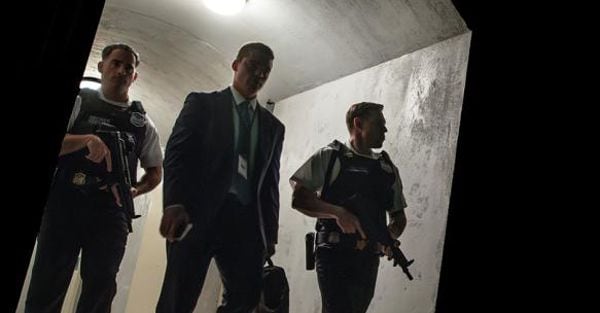
Eight years after 'Detroit', set at the time of the 1967 race riots, Kathryn Bigelow returns to talk strictly about the present, hypothesising a mysterious attack on the United States: a missile of unknown origin threatens to level the city of Chicago and for those in power it will be a race against time to determine who is responsible and how to react.

As dystopian as it is extremely realistic, 'A House of Dynamite' is a film that confirms the American director's great ability to handle choral sequences and dramatic tension in the best possible way.

However, the film has a tripartite structure, in which actions are repeated following different points of view, which risks limiting the overall involvement and making some passages less successful than others.

The first part, in any case, is dazzling and the result is a feature film capable of shaking you up even if, with a few shrewdnesses, it could have been even more incisive. The hope is that it will not be another eight years before the director of such great films as 'Strange Days' and 'Zero Dark Thirty' returns behind the camera.

Copyright reserved ©
Loading...

Brand connect

Loading...

Newsletter

Notizie e approfondimenti sugli avvenimenti politici, economici e finanziari.

Iscriviti