
The Sun of Francis, singer of the world
In full voice. The musical vocation of the poverello of Assisi lives again from the stage action "The Mad Saint" to "Sora nostra morte corporale" to the repertoire of the male voices of the San Francisco Chanticleers

Cultured and inclusive, refined and popular at the same time: nothing is lacking in the project - we will avoid calling concept the main idea of the great cultural event of the city that welcomed the Supreme Poet in exile and has guarded his remains for seven centuries - of the XXXVII edition of the Ravenna Festival. A verse from Dante's Paradise, 'Nacque al mondo un sole' (A sun was born into the world), is the motto chosen to celebrate another giant of the Middle Ages: Francis of Assisi. Having lived a century before Dante, and like him very modern, Francis is capable of imparting lessons to today's civil coexistence on a whole series of themes. There would already be enough to make him the inspiration for an all-round cultural event such as the Ravenna festival, except that there is also a specific musical element. Francis is in fact a singing saint: his Canticle of Creatures is not only, as Gianfranco Contini claimed, the first conscious proof of vernacular literature: it is in all likelihood destined to song, of praise to the creator and brotherhood with the whole of creation. A musical vocation to which the Franciscan order has preserved memory and fidelity over the centuries: from Father Martini, continental reference of the science of composing in the eighteenth century (including Mozart) to Stanislao Mattei, Rossini's maestro, to the historic Angelicum orchestra, initially only for women, founded in Milan in 1941 and protagonist for half a century of the twentieth-century musical scene.
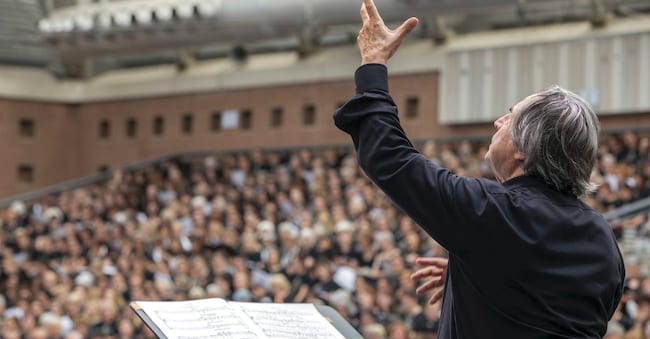
It will come as no surprise, then, if the commitment to vocality - a vocation for singing - that Riccardo Muti so happily introduced into the Ravenna Festival programme last year is renewed around Francis. The success of that 'journey into chorality', entitled, on the authority of St. Augustine, Cantare amantis est, a call to music by choral groups from the entire peninsula, summoned for a two-day open rehearsal in which to 'make community by singing together', was so successful that it suggested a second edition. Against this choral and popular backdrop, which says that singing is "an expression of our souls and of the differences that dwell within each of us", other, numerous and valuable occasions stand out.
Ravenna, with its thousand-year-old basilicas, moreover offers the most suitable venues for singing. Beginning, of course, with that of St. Francis, 'home' of the supreme poet's Ravenna guests, the Da Polenta family, and the place of Dante's own funeral. Il Santo folle, a scenic action by Guido Barbieri with music by Marcello Fera, engages the latter, the voices of Nicola Zambon and Ludovico Dal Pra, actress Astra Lanz, the Conductus Ensemble and the Vocal Group Heinrich Schütz in a musical reflection on Francis' prophetic journey to the Sultan of Egypt. Historian Franco Cardini, on the other hand, will contextualise the figure of Francis through Umbrian and Florentine lauds by the La Reverdie ensemble, while the Giullari di Dio project, conceived by medieval musicologist Francesco Zimei, proposes with Patrizia Bovi's Ensemble Micrologus the musical reconstruction of the Cantico delle creature, always surrounded by the philological sound of contemporary lauds. Looking beyond the Middle Ages, the concert Sora nostra morte corporale by the Coro & Ensemble 1685 of the Ravenna Conservatory conducted by Antonio Greco, offers motets by Bach and Zelenka's Requiem; Vincent Dumestre's Poème Harmonique, also featuring Bach, the Magnificat BWV 243a and the pieces that accompanied its first performance in 1723. Specialists in the Neapolitan Baroque, Leslie Visco, Marta Fumagalli and the Cappella Neapolitana conducted by Antonio Florio offer a seductive repertoire of lullabies, cantatas, tarantellas and pastorals in the concert Per la nascita del Verbo.
Other important choral ensembles will take turns on the Ravenna stage again this year, such as the Estonians of Vox Clamantis, reference performers for Arvo Pärt, for whose ninetieth birthday the programme And I heard a voice was conceived. At the same time, the same choir will engage with other groups such as the San Francisco-based Chanticleer men's 'orchestra of voices' (whose repertoire literally knows no boundaries, from the motet of the Middle Ages and Renaissance to jazz and contemporary), the Vikra chamber choirs and the Ljubljana Conservatory (engaged in the confrontation of tradition and contemporaneity in the Catholic and Orthodox repertoires) in the traditional presidium of liturgies in the basilicas of Ravenna, entitled In templo Domini.
The voice is also the protagonist in the novelty of the English Child, which reworks a chapter of the never-ending story of Ravenna, taking as its protagonist Allegra Byron, daughter of the Romantic poet, who relives in the imagination of Elena Bucci (author of libretto, dramaturgy and direction), with music by Paolo Baioni, born in 1963, interpreted by countertenor Helmar Hauser. There is no shortage of other detours, such as the concert by Portuguese singer-songwriter Dulce Pontes, the first Italian stop on the tour dedicated to 35 years of a career at the crossroads of pop, folk and fado, or that of a singer-songwriter from a younger generation such as Emma Nolde, assisted by the Orchestra La Corelli. But think also of the Pasolinian reading/tribute/oration P.P. Profezia è Predire il Presente by Massimo Zamboni, of the band CCCP, with the Reggio Emilia Intercultural Choir. Also intimately vocal is the tale Una panchina, due finestre, in which Giovanna Baviera lends her 'singing on the viola' (da gamba) to a 'story of loneliness and encounters around a bench in Via Mazzini'. Nor will the singing end with the summer: the Autumn Trilogy Mozart 1791 will feature three marvels of Mozart's extreme vocalism with Ottavio Dantone conducting the Cherubini Orchestra and Chiara Muti directing: La clemenza di Tito, L'ultimo incanto - an original and visionary account of Mozart's life from the arias and dialogues of Die Zauberflöte - and the unfinished Requiem, leaving us with the endless regret of what other paths the Salzburger's singing would have taken, had it not been abruptly interrupted.

