
The 'Supermoon' and the News: Inside the News Factory
The television newsroom as a laboratory in Andrea Rustichelli's book: between power, format, 'newsworthiness' and the risk of increasingly standardised information

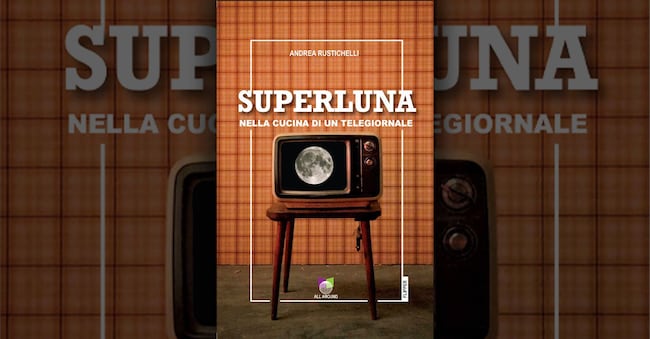
There's a red moon rising in the sky and an editorial team setting off. Not to understand, but not to fall behind. In 'Supermoon. Nella cucina di un telegiornale', Andrea Rustichelli, journalist and anchorman of Tg3, constructs a story that is both novel and essay, with a precise key: to observe the news machine from the inside and question its method.
It is not a memoir in disguise, nor is it an environmental novel: rather, it is a critical device, which uses the narrative form to interrogate the method of information.
The context is that of a television newsroom - Altro Tiggì - observed from the inside, in its daily mechanisms: meetings, hierarchies, construction of the summary, tension between editorial line and journalistic practice. The narrative pretext is the arrival of an astronomical event, the 'Red Moon', which immediately becomes a media event. But more than the event itself, its management is of interest.
In Altro Tiggì, a well-packaged, recognisable, even authoritative - but also predictable - newscast, figures move around who are both characters and functions: Belardelli, a critical journalist refractory to homologation; Bagassoni, the director who embodies editorial power and the primacy of the product. More than a personal conflict, it is a dialectic between two ideas of journalism.
The narrative pretext - the Red Moon - serves to show what transpires very clearly: the conditioned reflex of the media. When a theme emerges, the system compacts, amplifies it, consumes it. 'News' becomes what everyone talks about. And the risk comes to be that of a saturation that empties the contents, makes them interchangeable.


