
The surly grace of border art between Karst and shrines
Friuli Venezia Giulia artists from Friuli Venezia Giulia exhibited at Palazzo Morando in Milan, from Afro to Zoran Mušič, Tullio Crali and Marcello Mascherini

4' min read
Key points
- The movement of Friulian artists
- Miela Reina and Tullio Crali
- The Power of Karst
- Leonor Fini and the new recruits
4' min read
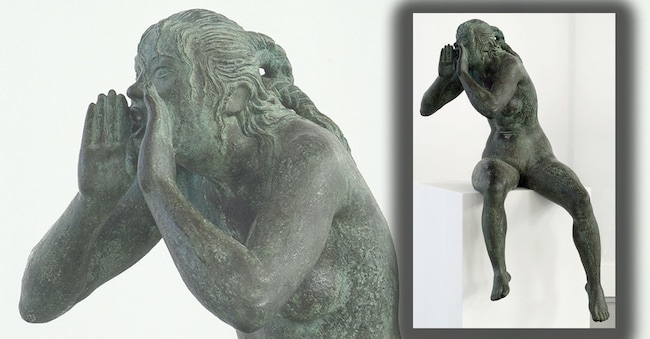
Inviting visitors from Via Sant'Andrea, in the heart of Milan, is a girl. They call her Summer: she has her hands clasped around her mouth to convey her call well, her wet hair falling over her face. She is a young bronze girl at natural height: just out of the water, without clothes or modesty, she distracts people from the luxury shops of the fashion district to take them to Palazzo Morando to enjoy an exhibition on the artists of Friuli Venezia Giulia, Un viaggio da fare (until 15 June). Summer is like that portion of Italy that is a little out of the way that the exhibition offers in the form of art: wild but gentle, rough, easygoing but no less welcoming, without veils, direct but hospitable. This land is spoken of on the anniversaries of the wars fought on the border, or of the 1976 earthquake, from which it rose again, hatching the 'miracle of the North East', or of Trieste, the beautiful, with Svevo and Saba, psychoanalysis and cafés.
The movement of Friulian artists
.Instead, the exhibition tells of a movement of Friulian, Julian and Slovenian artists who conveyed the vision of their time in tapestries, paintings, sculptures and objects. And it is an example of a collective effort that becomes a team: the Friuli Venezia Giulia Region with the Department of Culture, under the artistic direction of Massimiliano Finazzer Flory, the curatorship of Lorenzo Michelli and the organisational support of Fondazione Pordenonelegge. In the beautiful rooms of Palazzo Morando, the art of a land with a surly grace is recounted, as are the people there, without a word more. There is the vulgata that Friulians are great workers, humble and proactive, and perhaps it is also because of this contagion that the writer, arriving incognito, is welcomed by a spontaneous guide, zealous without being intrusive, enthusiastic about this part of Italy, despite not having Friulian roots of his own, 26-year-old Andrea Comerio. A fine example of grafting, as the exhibition is intended to be.
Miela Reina and Tullio Crali
Immediately to the left is the triumphant panel by Miela Reina, a painter, graphic artist, cartoonist, set designer and sculptor from Trieste, represented here by a foldable, so to speak because it is almost three metres long, from 1970 (acrylic on faesite) representing a pop art made up of symbols, hearts and arrows, an alphabet with strong colours combined with clean lines, with the technique of collage using recycled material. Reina transforms the severe and refined graphics of Eastern Europe into a cheerful material artefact. It is no coincidence that, next to the work, there is an almost futuristic poem by Reina, an expression of Triestine witz: "CHE BELLEZZA, che finura!/Averting to culture!". On the opposite side, a breathtaking painting by Tullio Crali from 1939, a dive into the void, Before the parachute opens, oil on plywood. The painter himself is looking down from above, as he jumps from an aircraft, the arc of his arms coinciding with the spherical bulk of the parachute when it opens. An example of futurist aeropainting against a backdrop of clouds and geometric fields.
The Power of Karst
.On the next wall, Bogdan Grom's 1979 Carnevale, a colourful tapestry: the blue background houses America, and, in particular, New Mexico, the other background, Karst. Grom, who was born in Devincina, is a product of what this region is, a mixture of languages, Slovenian and Italian, of peoples who are wonderfully and inevitably 'compromised', as GO!2025, European Capital of Cross-Border Culture, demonstrates. The Karst, a rocky land, friable by water - which created the adjective 'karstic', used from literature to science and flaming red in autumn -, is a landscape of rapture, as Scipio Slataper describes it in his masterpiece, My Karst. Also dedicated to this rare heathland is Rocky Landscape (oil on canvas, 1912) by Anton Zoran Mušič, an exponent of the 'lyrical abstraction' of the Parisian School. 'Karst is a stony, dazzling world... a harsh, bitter poem that smells of juniper and limestone', reads an inscription next to another wool tapestry by the painter, abstract and geometric engraver, Lojze Spacal, Boats Hanging in Savudrija (1979). Not far away is Luigi Spazzapan, a radical abstract and informal Central European painter, here in Mural Painting, expressed in coloured biscuits in irregular chequered patterns. We are already in the "acknowledged great masters" zone, to which we add Afro - from Udine, exponent of Informal Art and the Roman School of the 1930s - with Controcanto and Grande grigio, two etchings exhibited frontally, one against the other armed in their neo-Cubist expansion, the former in shades of brown, the latter in black and white. And then Giuseppe Zigaina with an oil on canvas, Dal colle di Redipuglia: neo-realism here is employed in the horror of war, almost like a dragon exploding from the geometry of its spaces. Armando Pizzinato is represented by Figure of 1948, oil on canvas, in his period of adhesion to the Fronte nuovo delle arti, an abstract post-cubism with colours reminiscent of expressionism.
Leonor Fini and the new recruits
The 1908 self-portrait with a flame by Carlo Michelstaedter, a very young philosopher who committed suicide before discussing his degree thesis, Persuasion and Rhetoric , introduces us to the era fraught with mourning and the avant-garde that was experienced by Leonor Fini (to whom an exhibition at the Palazzo Reale in Milan is dedicated until 20 July), an internationally renowned painter, costume designer, set designer, illustrator and writer from Trieste who frequented Bobi Bazlen, Gillo Dorfles, Leo Castelli, Felicita Frai and the Wulz sisters. Her Portrait of a Woman (1953), oil on canvas, opens the dances to a selection of works by contemporary women artists (Marina Ferretti, Giulia Iacolutti, Francesca Piovesan, Anna Pontel, Banafsheh Rahmani), brought together in the Together Project. Here gold and reflective surfaces dominate above all, like those mysterious mirrors of shallow water in the Grado lagoon...


