
Sustainability at the heart of economic and financial performance
The meeting with Silvia Angeloni, State University of Milan, Chiara Demartini, University of Pavia, Maurizio Fieschi, Ceo Studio Fieschi

3' min read
3' min read
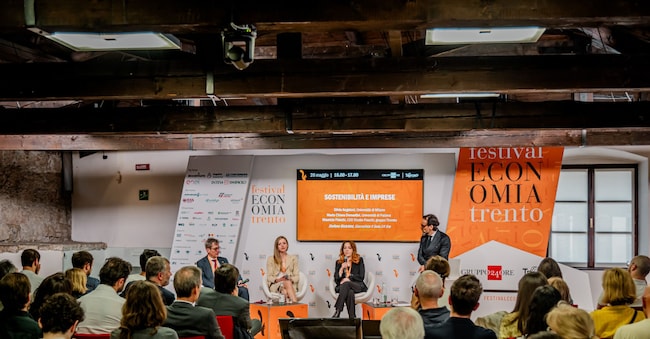
The sustainability reporting of companies, as a key element to explain their economic-financial and non-long-term performance, was at the centre of the meeting at the Buonconsiglio Castle dedicated to the topic 'Sustainability and companies', which had as speakers Silvia Angeloni, who teaches Balance Sheet Analysis at the State University of Milan, Chiara Demartini, Professor of Business Economics at the University of Pavia, and Maurizio Fieschi, Ceo Studio Fieschi, Tinexta Group. Full hall and audience that at the end, with some questions, remained the topics analysed by the speakers.
Starting from the assumption that companies with better sustainability performance are able to obtain debt and risk capital at a lower cost than companies that are less virtuous in terms of sustainability, Demartini explained how "companies can adopt different strategies related to sustainability reporting, showing a more 'authentic' approach, whereby companies tend to communicate more and more effectively about their performance to provide more information to stakeholders, who will then make decisions based on this information and will tend to support the companies that show better performance. This approach is called incremental information, precisely because it leads companies to provide more information to gain competitive advantages in the market. Other companies, on the other hand, adopt a sustainability reporting strategy called impression management, in which companies communicate a better image of themselves than their actual sustainability performance in order to exploit the resulting benefits'.
This approach is motivated by the assumption, as Demartini explains, that "the market is not able to distinguish between information that is truthful and information that is false, or improved, or even hidden, from stakeholders, thus leading to greenwashing phenomena, with consequent distortions in the markets. In order to mitigate the risk of impression management strategies and the spread of greenwashing, the scientific literature has been studying for several years what are the main characteristics that can effectively explain the level of transparency of information related to sustainability. Among those most commonly agreed upon are completeness, conciseness, readability, and tone'. Silvia Angeloni, on the other hand, points out that 'sustainability has long been high on the agenda of European and international policy-makers, and is increasingly the focus of attention of financial markets and the business world. However, with an unexpected acceleration of history, 2024 represents a watershed, destined to change the face of corporate information and, above all, the way of doing business. Thanks to a series of stringent legislative interventions, sustainability will be the new normality of business, imposing a rethinking of strategies and business models, as well as a review of internal and external company processes, to assess and measure the company's ability to align with ESG (environmental, social and governance) criteria'.
Angeloni explains how 'the University of Milan seeks to provide training and information on such a topical and sensitive issue as sustainability, through the "Sustainable Channel", one of the 18 research streams of the Human All science hub, as part of the Musa Project aimed at learning about and publicising the good practices of sustainable and inclusive companies, using the agile and direct tool of company interviews.
Hence the collection of the experiences of 13 leading sustainable companies, starting with their diversity, inclusion and welfare initiatives. "The study, in which a number of Sole 24 Ore journalists participated, showed," Angeloni emphasises, "how there is no company that, in terms of business, cannot be sustainable. Involving the students of the Università Statale di Milano, in a perspective that does not lose sight of the intergenerational perspective of sustainability, Angeloni recalls how the "video-interviews, the subject of the study, were carried out by students of the Statale belonging to different courses, after an appropriate training activity on ESG factors and soft skills".

