
The sustainable way of wooden satellites
After the Japanese experiment, the Finnish Wisa woodsat's project with Esa instruments is in preparation

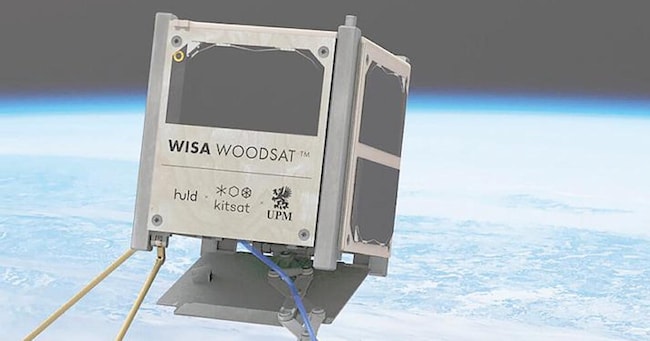
Magnolia or birch, which is more appropriate? We are not talking about wood for home furniture, but satellites, one of the technologies being experimented with for their construction is the use of wood for the supporting structure. So Japan, with magnolia, has already tried this, and Finland, with birch, may be trying it soon; this strange futuristic technology has what it takes to catch on.
What are the advantages?
The advantages are obvious: no pollution problems, or almost no problems, in re-entry into the atmosphere and absolute and complete permeability to electromagnetic radiation in orbit, as far as the radio frequency domain is concerned. In the first case, re-entry into the atmosphere causes only a little soot, not very different from the soot we produce by burning wood or pellets; in the second case, the near-transparency of the wooden structure to radio waves allows possible antennas to be placed inside the satellite.
Japanese protagonists
The first wooden satellite was the Japanese Lignosat, shaped 1U, i.e. a cube with a side of 10 centimetres, which apparently had no luck. We say apparently because it was launched from the International Space Station, Iss, on 9 December 2024, and failed to make contact with either the Iss or the Earth, but was nevertheless a successful re-entry. It may seem strange in view of what we have said, but the important point was that Kyoto University, which designed and built it, was able to verify the goodness of the magnolia wood in the construction phase, resistance to the environment and, above all, in re-entry into the atmosphere.
Lignosat stayed in orbit for a good 116 days, suffering the ravages of very low temperatures in the night phase and high temperatures in the day phase, some 100 degrees above or below zero. It also withstood the action of the solar wind, consisting of beams of particles of very high energy, above our providential atmosphere; certainly the wood was affected, as was the metal generally used, but the lightweight satellite was not affected in the slightest.
Finland tries again
The one that has been promising to go into orbit for some time is the Wisa woodsat, from Finland, made from birch wood, of which that country is a large producer. This wood has very good characteristics for its intended purpose: it is easy to process, highly resistant to temperature changes, and Finland has considerable experience of its use, even in technical installations.


