
The Taipei Biennial explores nostalgia
Political and poetic force of our time at the 14th edition curated by Sam Bardaouil and Till Fellrath with 54 artists and 33 new and site-specific works

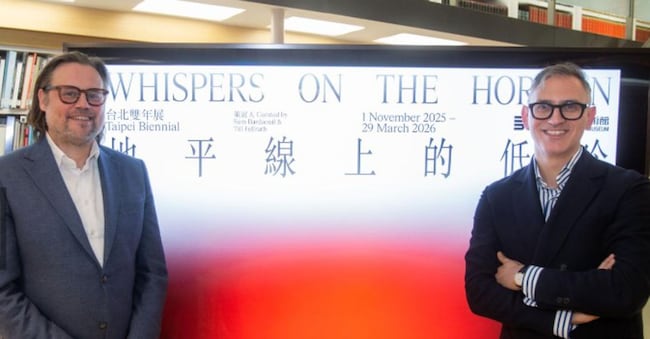
What do a puppet, a diary and a bicycle have in common? These three objects form the conceptual core of the 14th Taipei Biennale, "Whispers on the Horizon". The puppet by Li Tian-lu, the diary "My Kid Brother Kang Hsiung" by Chen Yingzhen and the bicycle of "The Stolen Bicycle" by Wu Ming-Yi, although not physically present in the exhibition, run through its spirit. "Each, despite its simplicity - wood, paper, metal - encapsulates a world of desires and memories: the puppet evokes the silenced voices of the colonial era, the diary a utopian nostalgia that breaks down, the bicycle a story of human migration and loss, a tension towards that which escapes and remains absent even when pursued," explain curators Sam Bardaouil and Till Fellrath. Directors of the Hamburger Bahnhof - National Gallery of Contemporary Art in Berlin, the two curators did not build the Biennial around a theme, but around a concept that is difficult to render in Italian with a single word: in English, yearning, meaning "a deep and perhaps unattainable longing, the expression of a tension".
The exhibition, staged at the Taipei Fine Arts Museum, presents the work of 54 artists from 35 cities, including 33 new works and site-specific installations. Among the participants are also two Italians, Monia Ben Hamouda (Milan, 1991) and Jacopo Benassi (La Spezia, 1970): two artists of different generations who represent, in the curators' choice, the growing international attention to authors capable - each in his own way - of pursuing a research now recognised on the global scene. The dialogue with the curators begins with Taiwan's complex history: colonial, political and identity-related.
How did this affect the selection of works and the exhibition's narratives?Taiwan is an island where histories are intertwined: Japanese colonisation, martial law, democratisation and migration. This complexity does not act as a backdrop, but shapes the way artists reflect on desire, identity and belonging. This is also where the Biennale comes from: not to tell a single story but to show how narratives can be fragmented and contradictory. Some artists, such as Ho Yen Yen and Musquiqui Chihying, unearth forgotten histories and objects rewritten by power; others, such as Skyler Chen and Zih-Yan Ciou, reinterpret the martial law era and colonial legacy. Together, their works reveal that Taiwan's history is not marginal, but integral to global issues of identity, memory and desire.
What criteria did you use to select the artists?
We sought resonances rather than traditional criteria, asking each artist: what are you nostalgic about? The answers, mainly through the works, ranged from intimate gestures to collective rituals, from speculative fictions to acts of reparation. The Biennial brings together voices from different generations and geographies - from Taiwan to Guatemala, from Lebanon to Korea - and different media: sound, film, painting, sculpture, installation and performance. What unites them is not style or nationality but the urgency of nostalgia, which translates into a desire for justice, memory, wholeness or futures to be imagined.
What the artists have in common is not style, but a condition: the unresolved, the incomplete, the fragile. Some work with fragments - re-assembled ceramics by Yeesookyung, distorted archive images by Jeremy Shaw, digital skeletal remains by Simon Dybbroe Møller - others with ritual and care, such as the glowing stones of Edgar Calel or the gardens of memory by Fatma Abdulhadi.

