Essay

'The theatre of thinking machines': Ai between false myths, fears and hopes

In his latest book, Stefano Epifani warns of our illusions about artificial intelligence and outlines a practical guide to overcoming them

by Massimo De Laurentiis

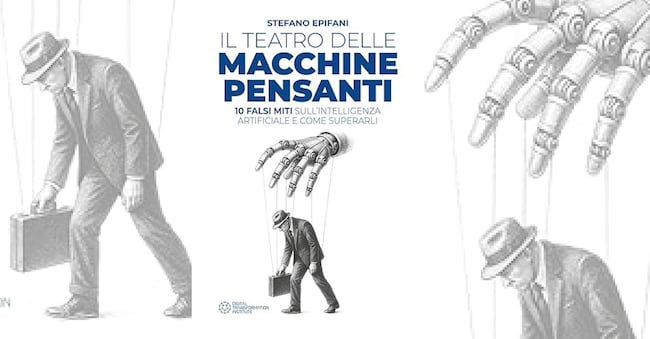
“Il teatro delle macchine pensanti. 10 falsi miti sull’intelligenza artificiale e come superarli” - di Stefano Epifani

4' min read

Translated by AI
Versione italiana

4' min read

Translated by AI
Versione italiana

Since November 2022, when ChatGPT was launched and introduced generative Ai to the general public, it seems much more than three years have passed.

Artificial intelligence is no longer just a technology. It is a cultural tool that pervades every sphere and brings with it doubts, fears and expectations.

Loading...

The models on the market have made huge strides and society is trying to keep up with innovation. 'Ai' has become a buzzword, as the Americans would say, a term that is very fashionable and used everywhere, often inappropriately.

Going Beyond the Surface

In this context of epochal changes at an unprecedented speed, Stefano Epifani's 'The Theatre of Thinking Machines' attempts to scratch the surface of the debate on a technology that is as transformative as it is misunderstood.

From the very first pages of the essay, the invitation is to question our beliefs. Ai is not just a set of algorithms, but 'a narrative device that feeds myths, that constructs illusions and that, as in any self-respecting theatre, entrusts each actor with a mask'.

As the subtitle suggests, Epifani's book analyses ten false myths about artificial intelligence and proposes hints on how to overcome them. A tidy and schematic volume that reflects the author's pragmatic approach, a true survival manual that is clickbait-proof and counter to utopian or catastrophist narratives.

Ai is not like us

One of the key points is the deconstruction of false beliefs that lead to anthropomorphising artificial intelligence, giving it intelligence and intentionality. This misrepresentation of the real nature of Ai models, predictive systems on a purely statistical basis, can lead to the most serious error: attributing a soul to an algorithm.

The big technology companies developing artificial intelligence are among the prime culprits of this misunderstanding, bombarding the public with bombastic announcements about increasingly sophisticated models or the imminent arrival of Artificial General Intelligence (AGI).

Scrolling through the chapters of the essay, we realise that the idea of an intelligent, sentient and perhaps even sensitive technology is nothing more than a projection that reveals our desires and fears, but does not reflect the capabilities of Ai.

No, artificial intelligence is not intelligent, it does not function like the human brain, it has no intentions of its own and does not 'hallucinate'. At most it emulates, simulates, predicts. Very convincingly, but it is still code that is only capable of generating results that the machine does not understand.

The infallibility of Ai

Perhaps even more dangerous are the false myths about how Ai works, which lead to confusing technological sophistication with infallibility. The latest frontier in a long tradition that sees technical progress as the key to solving every problem is the thought that the algorithm is always right.

Obviously not, artificial intelligences do make mistakes, and the most insidious fact is that they do not know they are wrong. The models convincingly perpetuate the statistical nonsense they often produce by piecing together sequences that are probable, but certainly not certain, let alone knowledgeable. The danger of ignoring this fact and blindly relying on machines is a deresponsibility that we cannot afford.

A child of the same illusion is also the belief that Ai, given its mathematical nature, the most objective of sciences, is impartial or neutral.

Again, as the reader has learned by this point in the book, the reality is quite different. Artificial intelligence, as Epifani writes, 'is nothing more than a sophisticated amplifier: a sounding board that returns, amplifying them, the data it receives'. The outputs mirror the inputs, and on both sides there is us, fallible, incomplete, partial human beings.

Overcoming false myths

These false myths must be fought not for the sake of knowledge, but for practical reasons: misconceptions about such pervasive technology create a cultural climate in which choices are made based on a distorted perception of reality.

And such powerful technology, when used, disseminated and regulated by people who do not understand it, is the perfect recipe for disaster.

But to truly understand Ai, it is not enough to dismantle the false myths about it. What is also needed is a concrete commitment to building a society that does not passively suffer technology, but helps shape it from the values that underpin it.

Hence the battle for transparency. Today, the opacity of models is presented as an inherent and unavoidable limitation, but for a sustainable development of Ai, these (often real) limitations must not be taken for granted.

Transparency means control and accountability, two key ingredients of a democratic society. Because, as the author writes, letting data govern without any filter means abdicating democracy itself.

To do this, it is necessary to shift the focus from the ethical codes of Ai to an ethics that 'before it is written in the code of algorithms, it should be engraved in the awareness of users'.

As in any time of transition, understanding, managing and regulating major change is a continuous process. In this context, 'more than definitions we need questions. Those that question the obvious. Those that do not seek immediate answers, but common directions."

Copyright reserved ©
Loading...

Brand connect

Loading...

Newsletter

Notizie e approfondimenti sugli avvenimenti politici, economici e finanziari.

Iscriviti