
The therapeutic power of trees: how green is good for your health
Forests represent more than one third of the national territory. A study on the effects of monoterpenes is underway at the CNR Ibe: 95% of cases show clear improvements in asthma and mood

2' min read
Key points
- Forest therapy
- The Robin Wood project
2' min read
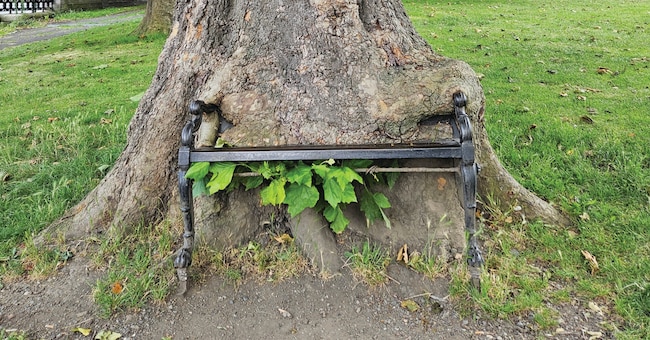
The power of trees is 'monstrous'. One only has to look at the plane trees that are able to take possession of any object leaning against them as can be seen in the photo taken in Herbert Park in Dublin. But this is just a great metaphor for greenery: if managed well, plants, woods and forests are our allies. Not just for absorbing pollutants, CO2 as we are used to hearing, or for cushioning hydrogeological disruption. The latest research shows that immersing oneself in the woods is increasingly considered a true therapy for our health. Thus, more and more Italians are looking to the woods as areas of salvation. Within everyone's reach given the 11 million hectares of forests, equal to 36.7 % of the national territory, as shown by data from Crea, the Council for Agricultural Research and Analysis of Agricultural Economics.
Forestry Therapy
.They call it forest therapy and it is also useful for combating anxiety. The principle is scientific and at the CNR-Ibe in Florence they are studying it starting from the effect of monoterpenes, components of the essential oils emitted by plants that 'immediately reach the brain areas,' specifies Francesco Meneguzzo, CNR-Ibe researcher and member of the central scientific committee of the CAI, 'as well as the blood circulation and therefore all organs and tissues.
Research is also underway to understand how to combat asthma without resorting to medication, but in the meantime, 'objective analyses of the data collected on about two thousand people at over 60 forest sites throughout Italy between 2021 and 2024,' Meneguzzo continues, 'indicate often statistically significant (at least 95 per cent) improvements in symptoms of anxiety and total mood disturbance. And the species that give us the best are conifers (firs, pines) and deciduous trees, such as beech, chestnut and eucalyptus. For Giulio Senes, professor of rural landscape planning and design at the University of Milan, parks and gardens also have their good effects on our health. He calls them 'healing gardens' and has already planned some at hospitals, schools and RSAs where they also have benefits for Alzheimer's patients.
All forests should be protected as World Heritage. According to the Global Biodiversity Framework it is necessary to protect at least 30% of the areas to favour the recovery of terrestrial ecosystems, but also marine ones. And Italy, as the National Biodiversity Future Centre points out, absolutely must work to protect the 85 types of terrestrial ecosystems, 68% of which are endangered, so much so that 30% of species are at risk of extinction.
The Robin Wood project
.This is where the Robin Wood project comes in, a collaboration between Walden, an innovative SME from Piedmont, with the support of the Erica Cooperative of Alba and the Canavese Forestry Consortium. "It is true," comments Lucio Vaira, the project's technical manager, "that Italy is covered in forests, but 99% of this heritage is abandoned or inadequately managed. Thus, Robin Wood not only takes care of natural resources by protecting and improving carbon stocks, but also preserves biodiversity and the multifunctionality of ecosystems. "Interventions are designed alongside forest owners, public administrations and local communities," Vaira continues, "and can be supported by companies and private citizens.

