
The Scene of Thought. William Kentridge at Villa Rufolo
His theatre piece, on show until 5 September, is a framework in which images, words, music and memory are assembled, erased and reassembled

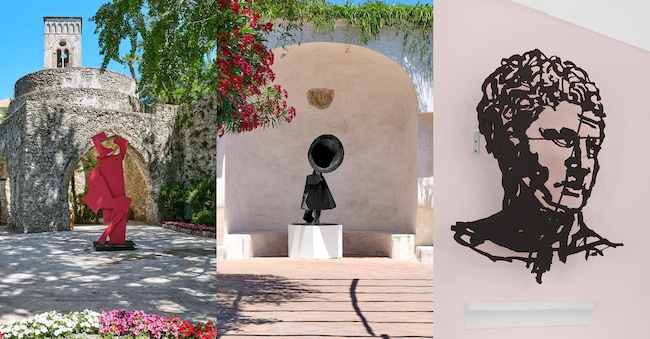
William Kentridge’s theatre is not confined to the stage. It is, rather, a form of thought. A mechanism through which images, words, music and memory are continually assembled, erased and recomposed.
The festival and exhibition
The exhibition hosted at Villa Rufolo as part of the 74th edition of the Ravello Festival – the result of a collaboration with the Lia Rumma Gallery – does not merely explore the South African artist’s relationship with opera or the stage: it highlights how his entire body of work can be interpreted as a grand theatre of memory, where every mark is the provisional result of a process and never an end in itself.
In focus
Drawing, the original core of Kentridge’s practice, is not a tool for representation, but a space in which to exercise critical thinking. The erasures that characterise his famous charcoal drawings never completely eliminate what has been drawn; they allow the previous images to survive as visible ghosts. In this persistence of the mark, one recognises a striking affinity with Aby Warburg’s theory of the ‘Nachleben’, according to which images never belong exclusively to the time that produced them, but continue to re-emerge across different eras. Every work by Kentridge is inhabited by these survivals: figures that return, memories that settle, gestures that resist erasure. His theatre is therefore a living atlas of visions rather than a succession of scenes, and its task is to preserve doubt in a living form. Ambiguity becomes the true driving force behind his poetics.
The works
Within the exhibition, Preparing the Flute (2005) constitutes one of the most significant moments in this exploration. The projection onto a miniature theatre, derived from the famous staging of Mozart’s The Magic Flute, is not merely a refined scenographic device, but a veritable epistemological machine. As in the ‘Theatre of Memory’ conceived in the sixteenth century by Giulio Camillo, the stage becomes a space intended not so much for performance as for the organisation of knowledge. The small theatre brings together historical, political and cultural issues concerning the legacy of the Enlightenment, colonialism, the construction of the Western gaze and the ambiguities of knowledge. The work does not merely illustrate Mozart: it critically examines the implications of his work.
Similarly, Theatre Drawing I (La Fenice Theatre) demonstrates how, for Kentridge, theatre architecture becomes a place of memory rather than a space for performance. The scene appears to be criss-crossed by erasures, revisions and layers that transform the drawing into a living organism. Memory is not an archive, but a surface that is continually rewritten.

