
The Mille Miglia through Italia’s hidden landscapes

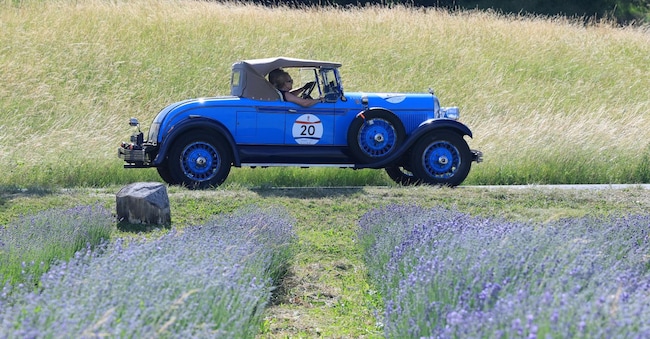
Padua has not yet shaken off the excitement of the previous evening’s arrival, and onlookers are already out and about early in the morning at Prato della Valle, where the engines of the cars mark the passing of time like the old sirens of a school or a factory. A few cars have their bonnets open and the mechanics are rushing to finish their checks; some are even wiping the bodywork with a cloth to polish a handle, a mudguard, a headlight or the windscreen. Then the flurry of staggered departures begins and you find yourself gazing into the distance, holding your breath: will it rain today? A city on the plain puts anyone at ease who moves along the horizontal axis of a parataxis: one foot after the other, one turn of the wheel after another, and we proceed in high spirits.
If the Mille Miglia were like this all the way, we wouldn’t have bolts coming loose, water temperatures rising, or pistons overheating. The race would feel like a stroll through the fields. This is, in fact, the initial impression, once you leave Padua and enter the open countryside, still green, interspersed with canals, rivers and irrigation ditches, where there is always someone willing to bet on the arrival of the procession. Most often they are solitary cyclists, stationed at crossroads or in the shade of trees, but you also see grandparents and grandchildren, elderly friends out on their bikes to do the shopping, and workers from a family-run business who have stopped work and lined up along the pavement. The convoy proceeds amidst applause, waves, raised hands and shouts of encouragement, and it is always a celebration, as if the passing of the cars were proof that these places are not mere geographical abstractions, inventions of an invisible Italia, but already exist simply by virtue of taking part in the race. They exist to be listed in the roadbook, the magical white tome that every crew received at the start and which marks, day by day, the route to be taken with meticulous care: bends, junctions, traffic lights, distances, refreshment points, sections of road designated for timed stages or regularity tests, marquees where race documents are stamped, monuments, trees, shops. Every page of the roadbook contains the information needed to assist the competing cars, and the descriptions are so meticulous that anyone with even a modicum of familiarity could close their eyes and picture the day’s stage before even having driven it. The most experienced might not even need to move, as they could simply skip to the last page and find themselves in the town of Montecatini, where the evening finish is scheduled. It is clear that there is a certain paradox to this reasoning, and the conventional symbols indicating arrows, traffic lights and U-turns conceal the privilege of encountering that hidden Italia which no map could ever describe in detail. Indeed, this is precisely the miracle of the Mille Miglia: what appears to be a little-known stretch of geography, the province made up of small villages and towering bell towers, the deep, sleepy countryside that lives in the shadow of the big cities, seems to suddenly wake up as the cars pass by, setting up a marquee with chairs and a canopy, displaying flags, and putting on an impromptu show with microphones and loudspeakers. Each of those places would have a story to tell, and being ready for the procession’s passage is already a form of storytelling: we’ve spruced ourselves up for you – the many villages between Padua, Ferrara and Modena seem to say – we’ve put on a celebration for you. But the cars always pass by too quickly to hear the stories of each place. They begin to climb the hairpin bends of Abetone, facing the final exertions of the day. Some of them falter from the strain, panting, gasping, coming to a halt at the roadside. It needs to catch its breath if it is to reach the summit, and there is no guarantee it will succeed. The race marks the first goodbyes. It takes next to nothing for all the beauty of the anticipation, the year-long preparation, to meet the obstacle that brings it to a halt. These cars are giants, but they have feet of clay.


