
The three grandmothers of Kaha Aden
Two books dedicated to the Pavia-born writer, born in Mogadishu in 1966, are an opportunity to rediscover those writers who live in our country but are defined as migrants

5' min read
5' min read
Kaha Mohamed Aden had three grandmothers. It is of them that she speaks when asked for a self-portrait, which was to become her first short story. Born in Mogadishu in 1966 and moved to Pavia in 1987, where, after graduating in Economics, she lived the rest of her life, the writer and activist rather than herself describes her ancestors. "Three very strong women, different from each other and descendants of nomads - like all my relatives. Two of them grew up in the city; the other was born and lived in the savannah and only came to the city when she was ill'. It was her way of explaining to the Italians who she was: 'you can't see, because I speak Italian, but my grandmothers are inside me and they carry a lot of weight'. It was also his way of telling Somalis 'because in everything I do, I always have two looks, and I always talk to both a hypothetical Somali and a hypothetical Italian person - that you can have not only a biological lineage, of blood, but also a lineage, and consequently an identity, an elective one: what you have worked on, what you have studied, which is not necessarily linked to the land where you were born or to your biological makeup(...) I added an elective grandmother, the woman who gave me the Somali rite called gardaaris, which until then was only done to males (when, a week after birth, a person takes their newborn out of the house for the first time, ed). The third grandmother is also an antidote to indirectly, poetically, counteract the law on citizenship in Italy, where the question of ethnicity has a fundamental weight. Even in the Somali war, clan patrilineal descent had a great weight. So for me, it was a way of saying that our identity can be determined by something elective, a literature, a passion, in short, that we can choose the things that make up our identity,' the author tells another writer, like her Italian and Somali, Ubah Cristina Ali Farah, concluding: 'I am a little bit of everything, and practically nothing.
This can be read in the collection of interviews dedicated to Aden Controverse. Writing in diaspora, poetics of becoming, edited by Livia Apa and Ali Farah: an interesting dialogue on paper between two generations of Italian women writers: Gabriella Ghermandi, Espérance Hakuzwimana, Wissal Houbabi, Djarah Kan, Gabriella Kuruvilla, Kaha Mohamed Aden, Stella N'Djoku, Igiaba Scego, Nadeesha Uyangoda.Ali Farah, moreover, in his The Stations of the Moon (66thand2nd) tells of an Italian girl with two mothers: one is the 'milk' mother, the Somali woman who nursed her and helped her grow up.
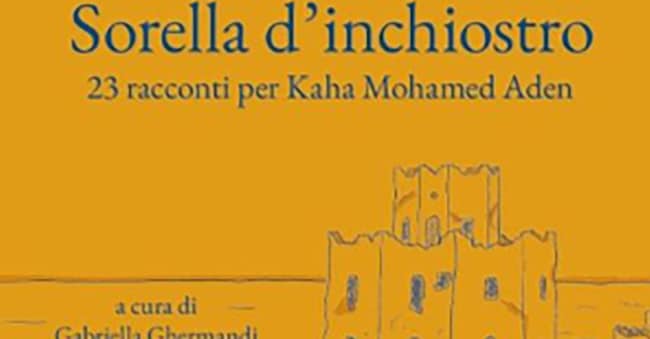
Disappeared in 2023, for Kaha Aden, "the first Afro-Italian writer to leave the scene", another book has also just been published, which instead collects 23 short stories, almost all unpublished, by her friends, Italian writers who, like the previous ones, are 'strangely' not included in Italian literature, but rather are included in migrant literature (or similar definitions), which moreover is not a subset, nor even a set that intersects with Italian literature. And this is not only because some were born in a country that is not Italy, even if they have lived there for a long time and write in Italian, but also simply because they have a parent who comes from non-'white' countries (a writer born in Italy and with a French or American parent would not be defined as a migrant writer, he would be defined as Italian).
It is entitledSorella d'inchiostro, a phrase taken from Tahar Lamri's memoir, and is an example of the authors, including Italian authors, and of African origin, who since the 1990s have recounted in Italian not only their cultures of origin, but also and above all their relationship with Italy and Italians "thus creating a picture of the encounter with the other and investigating migration as an experiential fact," explains Africanist Itala Vivan, who edited it with writers Gabriella Ghermandi and Kossi Komla-Ebri. Vivan, who also signed the introduction, points out that the Africans who came to Italy, unlike those who moved to other colonising countries, 'established a special relationship with the Italian language. The vast majority of them, in fact, arrived without knowing it, and learned it in a variety of situations, often through oral communication. This factor has played a fundamental role in the structuring of their Italian, rich in orality and free from those normative rigidities that characterise a language strongly imprinted by the written tradition closely linked to a literary Italian". Having also 'found themselves having to juggle with the double binary of Italian/dialect, which is so prominent in Italy, they have become entirely new Italian writers, who contribute to the already variegated Italian linguistic landscape with elements of authentic innovation'. The Italian language 'so near and so far: our island of freedom and, once again, of exile' says Lamri in greeting his friend Kaha.
And indeed, this volume, also signed by Emmanuel Edson Moukoko, Hamid Barole Abdu, Jorge Canifa, Amor Dekhis, Erminia Dell'Oro, Soumaila Diawara, Abdou M. Diouf, Shirin Ramzanali Fazel, Pap Khouma, Karim Metref, Sonia Lima Morais, Ingy Mubiayi, Paul Bakolo Ngoi, Rahma Nur, Judicael Ouango, Paola Pastacaldi, Angelica Pesarini, Igiaba Scego, Abdelmalek Smari, Maria Abbebu Viarengo, is a journey into an Italy unknown to most and which has much to say, about itself and the rest of the country. Perhaps it is also due to the fact that they know other cultures well that allows the authors to put a distance between themselves and our reality that enables them to see it more clearly, in an overall context, and not to have the mental barriers favoured by being brought up in one place by people who have known nothing else.


