
The ‘Thun Code’ and the genius loci that must be honoured, because people are always seeking it
Matteo Thun. The architect is one of the most committed to local sourcing, reuse and beauty, principles he applies to hospitality projects as well as public works all over the world

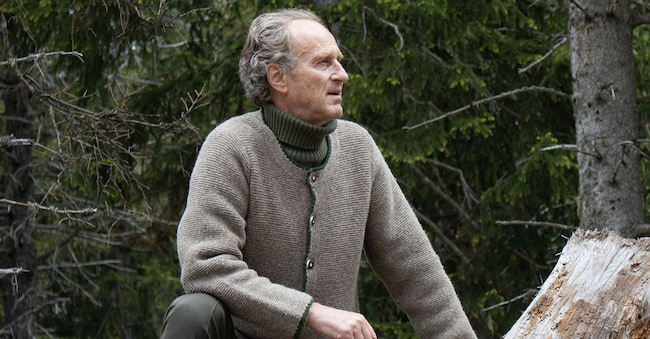
From Theseus to Borges to Masone’s, the labyrinth is often a journey of self-discovery. Setting out, searching, arriving. Matteo Thun’s Milan studio is somewhat reminiscent of this: in a building on Via Appiani in Milan, it has evolved since 1984 by incorporating and connecting spaces, inhabited by people, computers, books, notes and plants. Umberto Eco would have classified it as a networked labyrinth, where every point is connected to the others. The studio is also a layering of self-awareness – of who one is, what one does and where one wants to go. In the meeting room, meanwhile, a huge walnut table serves as the ideal centre of gravity around which the projects of one of the world’s best-known Italian architects take shape – an architect appreciated and sought after for his focus on sustainability, a term which, 25 years ago, ‘exactly on 11 September 2001’, notes Thun, he decided he would never use again, replacing it with consciousness, awareness and conscience, ‘of having to make a contribution’.
His journey began in the grand rooms of Klebenstein Castle in Bolzano, where Matthäus Antonius Maria Graf von Thun und Hohenstein – his full name, which reveals his family’s ancient and aristocratic origins – spent the early years of his life. Modelling clay, his mother Lene created the little angels that would bear their surname and give rise to the famous ceramics company. As a child, he was allowed into the studio; he was exceptionally talented at creating animals. ‘I’ve always thought that the intelligence of the hand precedes that of the brain,’ he notes. In the same year that Thun opened his studio, in Collezione di sabbia Calvino elevated craftsmanship to a form of knowledge. And the writer’s six proposals for the new millennium – lightness, speed, precision, visibility, multiplicity, coherence – together with the pursuit of simplicity championed by Ettore Sottsass, one of his mentors, and the ability to grasp the essence of things, which he learnt at a very young age at Oskar Kokoschka’s Schule des Sehens, helped to create a ‘Thun code’, which the architect applied to countless projects ranging from homes, corporate headquarters, hotels, resorts and spas, to coffee cups (the famous Illy ones), vases, clocks and yacht interiors. A code that has spread throughout the world, but which has found its heimat in the Alps, his homeland.
Speaking in a calm yet firm tone, Thun has no doubts – not just in the Alps, but elsewhere too: ‘We should halt all new construction and focus on regeneration. Even though there is a strong tradition of this in Italia, I find it unacceptable that some colleagues still want to prioritise new builds.’ In our country there are around 7 million abandoned buildings, ‘unburied architectural corpses’, as Ernesto Nathan Rogers described them. In his journey of self-discovery, Thun has long since reached the decision to prioritise regeneration: in Venice, for example, he has designed beautiful hotels in abandoned spaces, such as the JW Marriott Venice Resort & Spa on the Isola delle Rose and The Langham, which is currently being completed in a former glassworks in Murano. In Salò, he has just transformed a former mineral water factory into the Falkensteiner Resort Lake Garda, and in Treviso, the Mulini Mandelli site – abandoned for almost a century – will be home to residential properties and parks. When designing new buildings, Thun does so whilst almost concealing their origins: this was the case with the recent extension to his friend Gustav Thöni’s hotel, the Bella Vista in Trafoi, built using wood and stone worked by local craftsmen, elements shaped by the waters of the Rio Trafoi and fabrics inspired by the traditions of the Val Venosta. ‘All our work begins with identifying and respecting the genius loci ,’ he says, ‘it is a project that must submit to the intrinsic beauty of a place, not the other way round.’ One of the materials that best expresses the essence of a place, because it is formed from its own elements, is wood – not coincidentally Thun’s favourite, which he has made his trademark ever since, in the 1990s, he designed “O sole mio”, a pioneering project for an eco-friendly and self-sufficient wooden house: “Wood is the concrete of the 21st century and fits perfectly with our ‘three zeros’ philosophy: zero km, zero emissions, zero waste.” One of Thun’s most famous timber projects is the Vigilius Mountain Resort, situated at an altitude of 1,500 metres on the Monte San Vigilio Pass, with a structure that stands silently amongst the trees. Especially at this time of year, one’s thoughts turn to the queues on the trails leading to Instagram-worthy spots, where people snap a selfie and leave. “The right to the mountains must be protected, but if we go to the Alps, it is to seek beauty, and so we cannot destroy it ourselves. Even when building a hotel, the mistake is to conform, to pander to guests’ expectations. The genius loci must be respected, not least because, ultimately, that is what people are looking for.’ His projects are often associated with luxury experiences, but Thun strongly emphasises that ‘that’s not all we do. For example, one of the projects I’m most proud of is the Marina di Venezia campsite in Cavallino Treporti, which is truly affordable for every budget.” Rather than ‘luxury’ – a concept currently facing a certain existential crisis – the key word is ‘quality’: ‘Architectural quality is measured first and foremost by its ability to stand the test of time. Wood improves with age, and teaches us how to relate to materials,’ he emphasises. There is also a return to traditional methods in its use, for example with ‘lunar timber’ (that is, timber cut during the waning moon, ed. ), which, together with timber harvested in January, offers superior quality.”
This word also features in his reflections on fashion, a world that Thun loves and has come to know intimately thanks to his wife Susanne, who worked in fashion publishing in the 1980s and is now the studio’s art director: ‘Even the big brands are losing quality, and this has led to a shift in people’s relationship with fashion. I look with interest at China, at its break with the past, which affects architecture as much as fashion: many architects are increasingly focusing on restoration, and the younger generations have no interest in spending on historic brands, such as Dior or Hermès, as their parents did.” Thun opened his studio in Milan during the fashion boom, having previously been part of Studio Memphis, founded by Ettore Sottsass – a collective that championed colour and whimsical design in opposition to the greyness and functionalism that dominated the scene at the time. The Righeira band wore their ties, and Karl Lagerfeld collected their creations: ‘The city in the 1980s was fantastic, brimming with creativity. Of course, what is happening today in terms of taxation (the reference is to the flat tax of 300,000 euros on income earned abroad, ed.) certainly attracts many people, but it creates a huge economic divide. However, whilst the polarisation of society cannot be denied, I believe the younger generations will be better. Even in the United States, things have already changed: I am certain that over the next ten years, the different sides will manage to influence one another and engage with one another. The radical right has no future. But I don’t want to talk about politics.”
Yet architecture today cannot help but be political – in its design, materials and processes. The regeneration of places can lead to the regeneration of people, whose awareness must not be imposed but rather encouraged through everyday spaces, not just holiday destinations: ‘We have created the concept of “Hospitecture”, according to which one can be treated as a guest, with all due consideration, even in hospital’. The reference is to the Waldkliniken in Eisenberg: set in the forests of Thuringia, Germany’s largest specialist orthopaedic centre has been expanded with the same philosophy – and aesthetic – as a wellness hotel. This approach also shaped the Davines headquarters near Parma, designed as a village nestled within a large garden, and even a biomass incinerator in Schwendi, Germany: “We architects have a duty – a commitment we undertook when we became architects – to contribute to the aesthetics and functionality of public spaces,” notes Thun.


