
The timeless wonder of Ebla
Life as an archaeologist. Paolo Matthiae retraces excavations, memories and ideas that, amidst cats, intuition, difficulties and diplomacy, led to the discovery of the city
4' min read
4' min read
There is a cat on the cover and it is a book of archaeology and wonder. Syria, Ebla, courtyard of the Italian Mission house: Paolo Matthiae is at the work table, his eyes on his papers, his pipe in one hand, the other just resting on Filippo, the cat who is watching him and who, for years, has been part of an incredible team in the history of archaeology. Paolo Matthiae had the first intuition and led scholars and workers who, from 1964 onwards, made the 'discovery of Ebla an epoch-making success, which made it possible to place the important proto-Syrian urban centre of the second half of the 3rd millennium BC in contact with northern and southern Mesopotamia and the middle course of the Euphrates of the late Protodynastic age, and with Old Kingdom Egypt of the 4th to 6th dynasties of the Nile valley'. And Philip - so christened by his wife Gabriella, remembering the emperor Philip the Arab - witnessed discoveries, disappointments, sunny days, workers' strikes, impractical cooks, cultural diplomacy that Paolo Matthiae collects in Without Veils. Memories of the archaeologist who discovered Ebla. More than a book, the author himself emphasises, 'fragments of memories, as befits an archaeologist'. And the fragmentary nature enhances the vividness of the tale. One breathes in the joy of certain finds, the fatigue, the doubts and the attempts in the field.
Passionate about Egyptology, he attended courses in the Ancient Near East disciplines and graduated from the Sapienza University in Rome with Sabatino Moscati. At the beginning of the 1960s, Matthiae had his first excavation experiences in the Near East and remembers arriving in Syria in a speeding taxi: 'Late at night, tired and happy to find myself finally on Syrian soil under a sky shining with stars, having crossed the then desolate frontier post of Bab el-Hawa, the Gate of the Wind, in the sudden coolness of the nights of the pre-desert climate, I observed in the fleeting shadows ever denser expanses of olive and pistachio trees: the not uncommon pops coming from some trees I only knew later were the ripe pistachios opening in the darkness' and in front of Aleppo. During that stay, in a warehouse housed in a madrasah, where the archaeological museum's artefacts were collected, 22-year-old Matthiae noticed a rectangular basin with two juxtaposed square basins and recognised its uniqueness, tried to understand its provenance: a large tell, the Arabic name for the artificial hills covering ancient settlements, some fifty kilometres south of Aleppo.
That tell is in the village of Mardikh and two farmers, Mohammed Hardan and Ali Khodr, point out with incredible certainty a limited area where the basaltic basin of Aleppo was allegedly found during agricultural work.
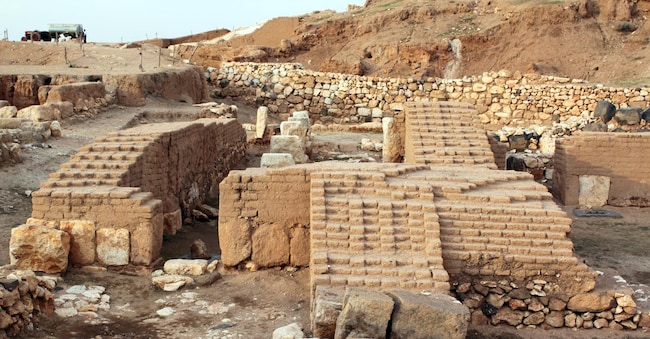
The greatness of Matthiae, and of the story, almost a spy-story, is in that insight: Matthiae tells Moscati to ask for the concession for Tell Mardikh. The first campaign began in September 1964 with the opening of three building sites. The identification of the Temples of Ishtar and Rashap confirms the first intuition: that settlement must have been an urban centre of particular historical importance in the Old Syrian period, the first half of the 2nd millennium BC. The adrenalin rush of everyday life clashes with physical exertion and communication difficulties. But the ride continues: it is in September 1968 that the first epigraphic discovery of great importance in the history of the Mission is made: a headless torso in basalt, clearly of a ruler, with a cuneiform inscription of which the Belgian colleague André Finet judges: 'The name of Ebla is safe in a totally unusual context. It is a votive statue from the early 2nd millennium BC with Palaeo-Assyrian features. The goddess Ishtar is mentioned'. Ebla, indeed Ebla!
The excavations continued, as did the memories of Matthiae, almost a chronicler of great beauty: in 1975, the discovery that changed history. The Great Archive L.2769 is the Royal Archive, containing thousands of cuneiform texts, dating back to the third quarter of the 3rd millennium BC. The tablets were originally arranged for the most part on two three-shelved wooden shelves resting upright against two of the perimeter walls. They had then slid towards the centre of the room when the shelving burned and collapsed in the flames that destroyed the building. It took eight days to remove the material, which was delivered in 99 crates to the Aleppo Museum.


