
The tragedy of having to be a bourgeois hero
İlker Çatak tells the story of two artists dismissed by the Turkish regime, investigating the difficulties and contradictions of those who come to terms with ruin

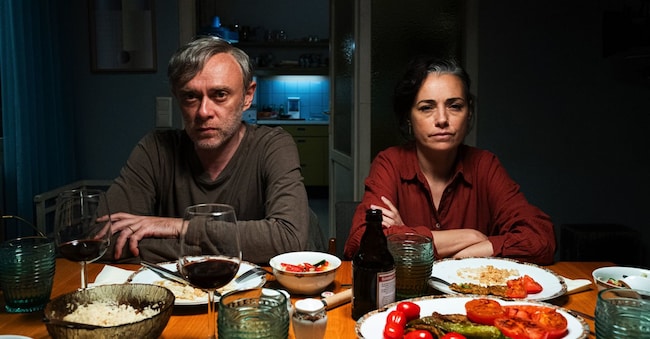
İlker Çatak, a German director of Turkish origin, has a scriptwriting and directing style that is very reminiscent of one of his Turkish compatriots, Nuri Bilge Ceylan. That is to say, a particular ability to dissect one position and then espouse the opposite point of view. ceylan's Once Upon a Time in Anatolia (2011) (and only secondarily Winter Sleep, 2014), from a chronicle pretext, puts the protagonists with their contradictions back to the wall through a twisted and challenging writing in a wear and tear of everyday interiors, which only sometimes opens up to the outside world by approaching an absolute Nature. This is the case with Yellow Letters, in which the exteriors are Berlin, playing the role of Ankara, and Hamburg, as Istanbul.
Two artists romantically linked
The cities in Çatak's film are as much characters as the main protagonists, Derya (an exceptional Özgü Namal) and Aziz (Tansu Biçer). Rivers and buildings reveal moods, conditioning their existences to the point of physically changing Derya and Aziz. If everyday life in the capital has made them an intellectual, bourgeois couple with a certain ease, on the Bosphorus - where they were both born and where they are welcomed into Aziz's mother's flat - they turn into apathetic, neglected proletarians. Derya and Aziz are a pair of well-established and respected artists: she masterfully interprets the plays he writes, subtly critical of the Turkish government. In addition to his role as a playwright, he teaches drama at Ankara University.
The Regime's Front
With their performances, they manage to be a front for the regime, remaining unscathed. At their premieres, the government poppets take criticism from the front row, perhaps so distracted by their mobile phones that they do not understand the subversive messages of the play. Derya and Aziz feel safe, so much so that Derya doesn't give too much thought to the request for an institutional photo with the authorities on the evening of a premiere, and Aziz invites his students to desert his class to attend a demonstration calling for respect for human rights and peace, in solidarity with Ukraine. Suddenly the pair is reached by two 'yellow letters', official announcements announcing their dismissal: in Derya's case from the theatre, in Aziz's from the university. The idea for the film stems from Çatak's account of a number of people in the Turkish entertainment industry who lost their jobs for absurd reasons (for example, for smoking a cigarette in the dressing room). Between 2016 and 2019, some 2,000 performers were suspended in Turkey and taken to court for signing a petition for peace.
The script
Çatak worked - together with his wife, Ayda Meryem Çatak, and Enis Köstepen - on a screenplay that emphasises the political element, but also investigates the internal and surrounding changes around a person who is stripped of the dignity of work and has become socially undesirable. Husband and wife collect the solidarity of Aziz's colleagues, who have also been dismissed from the university, and fight, while suffering betrayals from unsuspected people. Every time they knock on a door, they find a passer-by with the usual 'I am not the one who decided'. Soon financial difficulties begin, and gradually Derya and Aziz see their identity as artists, created with effort and merit, fade away, gradually reabsorbing the forms of their former lives or what they would probably have become had they not moved to Ankara. Derya rediscovers herself close to the religious values she had abandoned and becomes an apprehensive, inquisitive, at times bigoted mother. Aziz is forced into a night job, writes during the day and is completely self-centred, absorbed by the prolonged pendency of the trial he has to answer after a student's complaint.
Like a play
One glimpses the subtle remnants of a patriarchal culture that Ankara had abraded. The camera follows them with close-ups, sequence shots, counter shots, turning their lives into a play. Derya is tempted to take part in a television series that will go on the regime's channel to solve her economic problems. Aziz, who in his spare time has taken up work in a small dissident theatre, scorns Derya's temptation. He speaks of moral integrity: but to what extent can one who has lived off state theatre subsidies do so? Bringing them to the turning point is the couple's young daughter, Ezgi (Leyla Smyrna Cabas), with her adolescent blindness and selfishness.As in The Teachers' Room - nominated in 2024 for the Oscar for Best Foreign Language Film -, Çatak deflates human contradictions in the face of existential and principled questions. That film was shot in Germany, where the director studied filmmaking, in German with Leonie Benesch in the lead. Today, Germany remains the set but the acting is in Turkish. An arduous linguistic challenge for the director of photography, Judith Kaufmann, with whom he had worked on The Teachers' Room, and the other crew members who do not speak Turkish. But the film has perhaps found its perfect blend because of this: the erosion of dignity and rights speaks all the languages of the world.


