
Translator aims for singularity: Translated launches Lara's AI
The Italian artificial intelligence-based translation company presents its new translation platform with the aim of outperforming professional translators

3' min read
3' min read
Two people talk to each other via videocall from opposite ends of the world: each speaks in his mother tongue, the other listens live in his own language. So one speaks French, the other receives the simultaneous translation as if the other person were speaking in Chinese, in their natural voice. And vice versa. This is the new frontier of machine translation using artificial intelligence in Translated, the Italian company that has been working for almost twenty years on the perfect translator, learning from human professionals through machine learning.
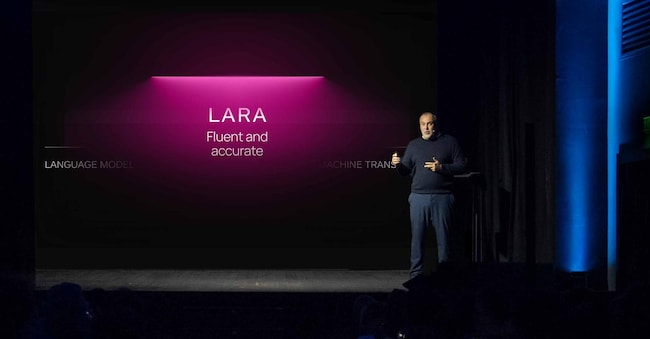
Simultaneous live video conference translation is not yet ready, but it won't be long now. In the meantime, Translated has refined the quality of its translation by introducing Lara, the artificial intelligence trained to reach the quality of the best professional translators. Trained on the basis of 25 million real translations processed with 1.2 million Gpu hours thanks to an agreement with Nvidia, Lara has set the bar high in terms of quality: last year it was at 11 errors per thousand words compared to 4.6 by the average translator and only one by the perfect translator. "This year we are down to 2.5 errors per thousand words for Lara and next year we will match the human performance, even touching the speed of one second per word: we will actually reach linguistic singularity," promises Marco Trombetti, CEO of Translated. The launch is part of a global expansion drive, following a $30 million investment led by Ardian in 2021 to bring its language technology to a global audience.
The new translator AI integrates large language models with the best translator models, combining professional quality with the ability to understand concepts within the context in which they are embedded. For example, Lara is able to understand from the reasoning in which the word is placed whether we are talking about land in the sense of the planet, farmland or, perhaps, the red earth of a tennis court, adjusting itself accordingly. At the same time, it also provides the choices made in natural language translation, just as if it were a person.
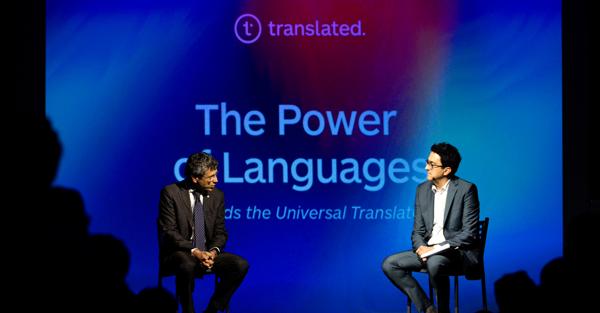
Yes, the people... What about the translators? Will they be replaced by Lara? 'We are underestimating the importance of the human element: language is a more complex function than translation and we can therefore be sure that no one translates a human like a human,' explains Trombetti. Translated has always aimed to revalue the human element, with the goal of automating standardised translations, thus unlocking and enabling a potential market that was previously inhibited by excessive costs.
Thus in recent years it has expanded its machine translation offering from 62 to over 200 supported languages, developed the Trust Attention technique, which classifies training data according to their reliabilitỳ, thus improving the accuracy of generative AI, and won customers such as Airbnb, SpaceX, Uber and Glovo. For them, Translated makes it possible to offer texts and ads on the site automatically in the user's language. 'Language,' Trombetti concludes, 'has driven human evolution, enabling collaboration for a better future. With the latest advances in AI, we estimate a growth in demand for both machine translation, to the extent of one hundred times, and human translation, to the extent of ten times. By supporting global understanding, Lara helps us reach the next stage of human evolution'.

