Space economy

Trump's obstacle race towards space tech defence

The president wants to build an anti-missile system capable of protecting the US from attacks. But the best technologies are in the hands of Musk

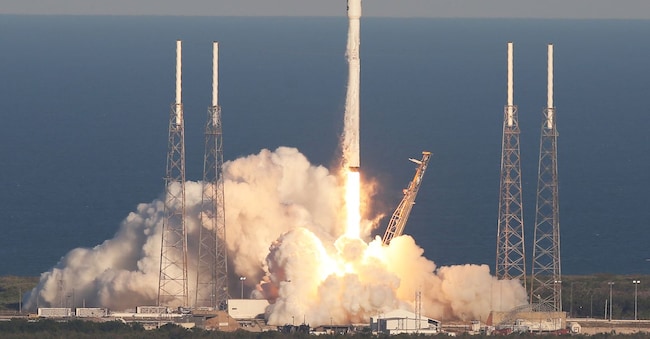
Alleanza Musk-Bezos. 24 satelliti del progetto Kuiper di Amazon sono stati lanciati su uno dei razzi Falcon 9 di SpaceX da una rampa di lancio sulla Space Coast della Florida (Red Huber/Orlando Sentinel/Tribune News Service via Getty Images)

4' min read

4' min read

President Trump wants to succeed where Ronald Reagan failed in the 1980s: to equip the US with an anti-missile defence system, the Golden Dome, to protect the nation from all kinds of attacks from space. In essence, an ultra-modern defence system, based on land, sea, air and space, that would destroy enemy offensive weapons launched towards the US before they could do any harm.

According to Trump it will cost a lot of money, but not as much as the bureaus in charge of doing the real maths say, and it will be done and finished within the three years left in his term. If there are many doubts about these statements by the President, the need for such a system is there, now more than ever, as many people think that the defence of the United States, meaning of its own territory, is old if not outdated.

Loading...

The New Threats

.

If not everything, in fact, much has changed in this field, especially we are now dealing with new means of offence, first and foremost the impregnable hypersonic missiles, but also the nuclear warheads that are dropped from very low orbit, 200 kilometres above the ground to get an idea, or the nuclear bombs exploded at an altitude of 100 kilometres or more, and finally the terrible Fobs, Fractional Orbital Bombardment System, theoretically prohibited by the Salt treaties. These are spacecraft in orbit, loaded with nuclear devices, which can be activated and dropped at any time. All weapons that until recently simply did not exist.

For example, a nuclear charge exploding 100 or 200 kilometres above the ground would create an electromagnetic pulse discharge with consequences worthy of the apocalypse, knocking out aircraft electronics, management and control devices of all kinds. Virtually everything that is serviced or controlled by computers or electronics of some kind would stop working, from the automatic gate at home to hospital equipment to communication systems.

Why do we need the Golden Dome?

.

Donald Trump's idea, announced last January and forcefully reiterated recently, has a motivation. Indeed, now that the American press, Washington Post in the lead, has described simulations of the possible US response to a nuclear attack, the issue is hot and public. Perhaps egged on by the Pentagon, the American press describes a terrible scenario: if an attack on the US from a nuclear power were to be carried out, in fact, the President would only have 45 minutes to decide whether and how to respond, from the moment the infrared surveillance satellite system would launch the alert.

The idea we have when we think of these disastrous scenarios is related to the old Icbm, powerful ballistic missiles, capable of quietly going from North Korea or Moscow or Beijing to Washington or Miami. But they are the easiest case since, the moment I watch the launch, I can already know everything about that missile: where it will go and how long it will take. Basically like kicking a ball, which then goes where it is supposed to go.

Even so, if we compare it to the Iron Dome protecting Tel Aviv, it is very efficient, but a few missiles still get through undisturbed and hit the target. When it comes to nuclear warheads, it only takes one to pierce the defence.

Russia and China are also investing in technologies that are far more difficult to counter. The black beasts of the moment are the hypersonic missiles that travel, for most of their trajectory, at ten times the speed of sound, exit the atmosphere, re-enter it nimbly when close to the target, and can change direction and height without any problems: in short, they are a big problem to intercept.

Of the Golden Dome, therefore, there is a need, the question mark shifts to whether it can be done and who can do it, given also Trump's bad relations with Musk who, objectively, has the best space industry.

Trump stated in his speeches that the Golden Dome could only cost $175 billion and be designed and built within three years, during his presidency.

The cost node

.

With all due respect, the estimate seems almost humorous when compared to that of the US Congressional Budget Office (Cbo). For this important and listened-to office, the cost is estimated at USD 542 billion over 20 years, and only for the space part. Not insignificant figures even for the pharaonic US defence budget.

Even the physicists of the American Physical Society are getting in the way that America would need 36,000 space interceptors to neutralise just ten North Korean intercontinental ballistic missiles. Any larger missile salvoes by Russia and China would increase the need for interceptors to unrealistic numbers.

A final point lies in the fact that, if realised, the Golden Dome would change the existing balance and 'increase the risk of space turning into a battlefield', as Chinese Foreign Ministry spokesman Mao Ning openly stated, on the other side of the camp Ambassador Robert Hunter, who was the US negotiator for arms control, including nuclear. and of the same opinion.

We were already there in past decades, but now it seems that with the desire for deregulation we have forgotten that the most effective weapon is Peace.

Copyright reserved ©
Loading...

Brand connect

Loading...

Newsletter

Notizie e approfondimenti sugli avvenimenti politici, economici e finanziari.

Iscriviti