The new attack

Trump's threat to Cuba: a US aircraft carrier 100 metres from the coast

The US president decrees further sanctions, including against foreign banks and announces to "take the island almost immediately". Havana's retort: "Illegal and offensive measures"

by Roberto Da Rin

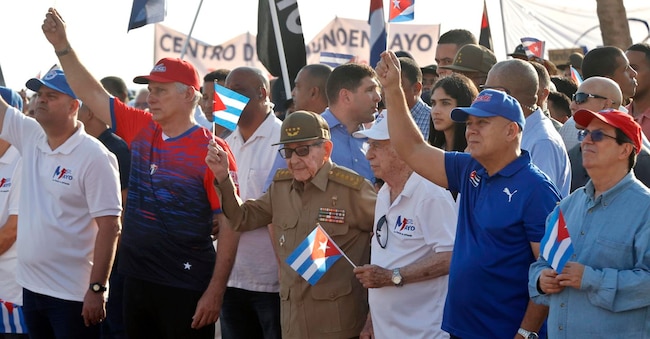
L’ex presidente cubano Raul Castro, 95 anni, con gli attuali leader de l’Avana alla manifestazione del Primo Maggio EPA

3' min read

Translated by AI
Versione italiana

3' min read

Translated by AI
Versione italiana

A US aircraft carrier '100 metres from the coast of Cuba and new sanctions'. This is Donald Trump's latest threat.

The 1 May procession recently disbanded, protesters busy reeling in the largest banner, La solidariedad no se detiene, solidarity does not stop. A warm evening in Havana, prelude to a long weekend. A few beers and young people, as always, on the Malecón, the city's promenade that is not just a street, it is a break.

Loading...

Breaking the placid monotony of Havana hit by a severe energy crisis that has faded into a food crisis, Donald Trump's announcement: 'I like to finish a job first. Maybe on the way back from the Middle East, one of the aircraft carriers could stop' in Cuba. The American president relaunches his aims of conquest and announces new sanctions 'against Cuba, which continues to pose an extraordinary threat' to the national security of the United States. Trump's statement specifies that he intends to take Cuba 'almost immediately'. With the intention of sending the aircraft carrier USS Abraham Lincoln 100 metres off the Cuban coast.

The new sanctions, which target foreign banks that cooperate with the Cuban government and impose immigration restrictions, are contained in a presidential decree published on the White House website.

The measures announced, which do not name specific individuals, focus on key sectors of the Cuban economy, notably mining, financial services, energy and defence. Any person or company operating in these sectors or doing business with the Cuban regime will suffer a total freeze of their assets in the US. In addition, if a bank in another country facilitates a 'significant transaction' for any of the aforementioned entities, it will risk having its accounts on Wall Street frozen. And a ban on trading in dollars.

The executive decree goes far beyond previous provisions. It punishes not only members of the Cuban government, but also businessmen, officials or individuals at any level who participate in the sanctioned activities. In other words, Trump the decree imposes sanctions on any foreign financial entity that engages in transactions on behalf of Cuban individuals or companies subject to US sanctions.

"Those who meet these criteria will also not be allowed to travel to the United States unless Secretary of State Marco Rubio determines that their presence is necessary for Washington's national interests."

The sanctions take effect immediately, 'due to the possibility of transferring funds or assets instantaneously', so that they cannot be circumvented by prior notifications.

Cuban Foreign Minister Bruno Rodríguez condemned the new wave of US sanctions against the country, calling them 'illegal and offensive'.

An executive order, signed by Trump, targeting officials in the energy, defence, financial and security sectors of the Cuban economy, as well as those who he said were responsible for 'human rights violations' or acts of corruption. Rodriguez then wrote on X: 'We strongly reject the recent unilateral coercive measures taken by the US government'. And then again: 'The new, clear and direct threat of military aggression launched against us by the president of the United States, after drastically tightening the economic embargo, raises the aggression against Cuba to dangerous levels, with no other pretext than the desire to please the small elites who promise him electoral and financial loyalty'.

The emergency situation prompted Raul Castro, who will turn 95 in a few weeks, to participate in the 1 May parade. With him is his nephew Raúl Guillermo Rodríguez, known as, el Cangrejo, the Crab, who has been entrusted with the responsibility of negotiating with the delegates of the US Secretary of State, Marco Rubio. President Miguel Díaz-Canel posted a photo of the gathering with the comment: 'United, close, we call for peace and reiterate our readiness for dialogue without conditions. Fear has no place here'. In recent days, the Diaz-Canel government has accused the United States of 'fabricating pretexts' to attack the island, rejecting Marco Rubio's claims about the alleged presence of military and intelligence services of 'adversary' countries. In short, a double blackout in Cuba. On the streets and in bilateral relations with Washington.

Copyright reserved ©
Loading...

Brand connect

Loading...

Newsletter

Notizie e approfondimenti sugli avvenimenti politici, economici e finanziari.

Iscriviti