
The 20th century ends with the decline of the factory idea
In Antonio Pennacchi's 'Mammoth' there is a search for human and social redemption and a passport in the great game of History
4' min read
4' min read
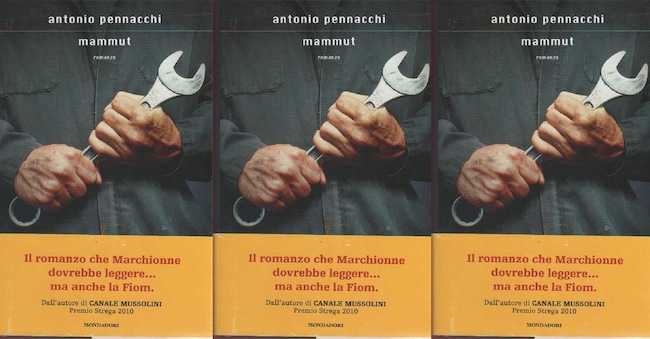
Antonio Pennacchi recounted that Mammut was conceived during the time he worked at Fulgorcavi, in the province of Latina. He spent the nights in the factory studying, while his departmental colleagues filled in for him during the shifts, and only after he had finished did he get on board his yellow Fiat 127 and set off, with his wife and children, for Milan. He knocked on the doors of all the publishers in the disarming expectation that they would listen to him, and in 1994, just as he was graduating from the Sapienza University with a thesis on Benedetto Croce, he realised his dream of becoming a writer without ceasing to be a worker. The two goals - the book and the degree - had travelled hand in hand to reach the finishing line at the same time and were the sign of his very personal victory over the social condition to which both the character and his author belonged. Pennacchi knew the industrial reality so well from the inside that he allowed himself the luxury of shaping the life of his character, the trade unionist Benassa, inventing a kind of third-person autobiography where everything happens thanks to a curious process of mirroring and similarities.
In fact, it was unimaginable that he could start his adventure as a writer from a completely different subject, because Mammoth is exactly the overlapping of Pennacchi and Benassa in the name of a profession that makes them be on the same side, citizens of a common homeland where the glorious flag of the blue overalls flies, both deluded and disillusioned, convinced to the death that the sun of the future would continue to shine on their destiny and then falling into the disenchantment that nothing of what they expected would come true. This is why the parable of the workers' narrative finds its fulfilment in this book, which is both the pitiless confession of a defeat and the announcement of a civilisation at the end of its tether, the workers' civilisation, which blindly believed in class consciousness - an expression that was so accredited in the language of an unrelenting 20th century - and strenuously fought to achieve it, building bolt after bolt the great scaffolding on which history should have sanctioned the triumph of the blue overalls, only to realise that it would not be possible.
"You see, Pasqua'" confesses the 'I' in this novel in the chapter of greatest narrative tension and does so in blunt but not vulgar speech, syncopated as in a dying confession. 'I had a myth in my head. An idea. Unfortunately, history has moved on: class is something else. Above all, there is another fact: the working class, as a class that was supposed to run everything, as Marx said..." And here he pauses, gathers his forces, then blows the trumpets: "...I was saying, that the class, by now, is an endangered species. Also numerically. Like the wolf. We see it here too: the more we go on, the fewer we are. Automation increases, computers increase. In thirty years, all factories will be automated. Completely. Workers will no longer exist at all." He pauses again and again increases his dose: "Culturally, then, let's not talk about it. Worker hegemony? Please... We are an extinct class. We are already extinct. Like the bison of Europe. Like mammoths... There are no mammoths anymore... And us? We are extinct, my love. Culturally. Politically. Numerically. Like mammoths'.
Not only has the working class never gone to paradise, disavowing what the title of a famous film by Elio Petri declared, but it has been so radically affected by the transformations that took society in a certain direction in the 1980s that it suddenly feels like a prehistoric animal, a fossil of a buried world, lacking even the hope of survival. "When I began, there was, on my part, idealism, that is, of the working class. That it had to make the revolution. I believed it was necessary to build the revolution. Because I thought it was right that the workers should rule, not the bosses,' Benassa confesses in his usual halting syntax. "Then, however, the revolution was no more. On the contrary. The country changed. Always. In a way that was always different from what I dreamed of. I firmly believed, at the beginning, in the trade union and the left-wing parties. Above all in the trade union'.
There is no clearer explanation than this to justify the utopia and disenchantment of an entire category, and only the voice of a writer without superstructures, bordering on the a-ideological like Pennacchi, could render so effectively the sunset of an idea that coincides with the sunset of the 20th century. This could happen because there is a human (much more than literary) gift that leaks out in Pennacchi's gaze and that is authenticity. He has never been a bluff writer, even with a mocking, ironic smile, barely kept under his blue Soviet locomotive driver's hat, accompanied by the ever-present red scarf. Getting to know him closely, one realised that his way of looking was typical of the world to which he belonged, humble and popular, dignified even if from the perspective of the bottom and yet never completely dialectal, despite the fact that the streaks of dialect were the cradle where he went to take refuge, to defend himself from the world or to feel at ease. What Pennacchi was looking for in fiction was a nation that had lost its way, the idiom of an epic that had to capture the story of a civilisation, his own and that of his character who, when he spoke, expressed something unrepeatable in the feeling of urgency, gave his voice a primordial impetus, he manifested a Promethean attitude that characterised the heroic years spent between conical and bi-couples, chasing the forms of a human and social redemption, the conquest of a passport in the great game of History for those destined to remain invisible.


