
The urgency of memory in the new season of hatred
Bianconi remembers the Rebibbia prison guard, killed by red terrorism.
4' min read
- The return of verbal violence
- The book and podcast on Stefanini
- Alarming incidents today
- Pertini's words
- At Rebibbia 6 former female terrorists in external employment
- Aldo Moro and the memory of 9 May
4' min read
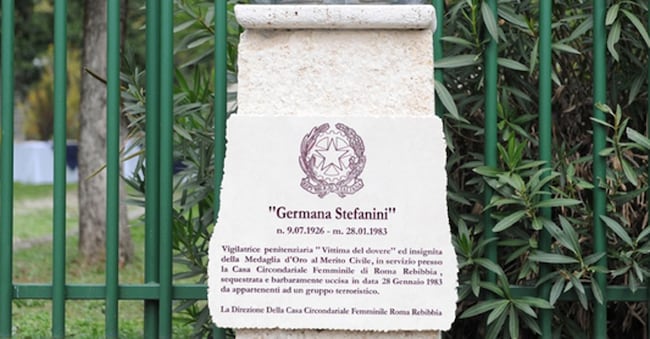
If it is true that only memory helps to prevent what has happened from happening again, it should be a collective civic urgency to recall the stories and names of those who have remained alone for too long in the memories of their loved ones. Like Germana Stefanini, a prison guard at Rome's Rebibbia prison, the only female victim of red terrorism, to whom a book and a podcast are now dedicated. And it has become a civic urgency, as well as a judicial one, to know the truth about the death of Fausto and Iaio, frequenters of the Milanese social centre Leoncavallo, whose crime has just been reopened. Names mentioned yesterday by the president of the Senate, Ignazio La Russa, together with that of Sergio Ramelli, a militant of the Fronte della Gioventù, killed 50 years ago.
The return of verbal violence
.An urgency to be felt with even greater necessity at a time when verbal violence is de facto cleared through customs and hatred has returned to shore up public debate. What has happened instead is that - at least for the moment - the proposal by the mayor of Milan, Beppe Sala, to name a street after all the young men killed in those years when life was worth less than nothing, has come to nothing; and what has happened is that the relatives of many victims of that period have contested the 'lack of involvement' in the organisation at the Chamber of the 9 May day dedicated to the memory of those who died in terrorism and massacres. 'Leaving out the collocation of the events in the historical framework in which they occurred,' they write, 'eludes that hoped-for need for understanding that, to be such, demands that everyone also reckon with their own history'.
The book and podcast on Stefanini
In this context, then, it not only assumes the value of a dutiful tribute to a servant of the State, slaughtered in a tail of red subversion, but also helps us to read our times with a more aware gaze in the latest book by Giovanni Bianconi, the leading writer of the Corriere della Sera, One of us (Treccani, 192 pp., 18 euro), dedicated to Germana Stefanini, the Rebibbia prison guardian whose lively voice also echoes in Elisabetta Fusconi's exciting Radio24 podcast, Silent and good.
Alarming episodes today
It is also necessary to remember what happened in order not to underestimate episodes of the recent past, such as the burning of two cars of agents of the women's section of Rebibbia or the Molotov cocktail against the prison gate or the banner that appeared in that same summer of 2021 in the Prenestina, Roman suburbs where Stefanini lived and where she was 'tried' by three terrorists. Militants of the Armed Proletarian Power, who killed the daughter of a stagnaro - a plumber - who was in charge of the packages in the prison: she had arrived here because 'when my father died, where was I going to work? At this age where do they take me? I had to go and be a maid but I don't,' she replied to her torturers that evening of 28 January 1983, almost as if to justify an employment that had made her the target of those who wanted to know nothing about the actual working conditions in penal institutions.
Pertini's words
As a profound connoisseur of that night of the Republic, Bianconi reconstructs the entire context in which the crime matured at a time when terrorism had already been bent 'in the courtrooms and not the stadiums', according to an expression attributed to Sandro Pertini. The then President of the Republic attended Stefanini's funeral and a week later - the diaries of the Quirinal quoted in the book record - went to visit Paolo di Nella, a nineteen-year-old member of the MSI youth movement in hospital after a brutal attack. Because 'violence, hatred and terrorism act against all the Italian people. I, who want to be the president of all Italians,' he told those who complained of being second-class victims, 'can only condemn Paolo's attackers. Whatever their political matrix'. Words to unite. Bridges, like those evoked by Pope Leo XIV..


