
The US and Iran (and beyond): when football becomes the crossroads between war and peace
In the round of 16 of the 2026 World Cup, scheduled for 7 July, the USA and Iran could face each other in a clash where football and armed conflict intersect – a scenario that has occurred on several occasions throughout history
There was one date that FIFA executives and White House officials had circled in red before the World Cup kicked off: 3 July – the date on which the United States and Iran national teams were most likely to face each other in the round of 16 in Dallas. This would have happened if both teams had finished their respective groups in second place. However, the USA’s two victories against Paraguay and Australia, and their top spot in Group D, have led to a different – albeit less likely – scenario: should Iran also top Group G, a clash with the USA could materialise in the round of 16 on 7 July in Seattle.
If, on the other hand, Iran were to finish second or third in their group (the top two teams and the eight best third-placed teams from the 12-day tournament qualify for the knockout stages), a direct clash with the host nation at the 2026 FIFA World Cup could only take place in the semi-finals or final. Tonight’s match against Belgium (9.00 pm) in Los Angeles is therefore a decisive one (Iran will then face Egypt on 27 June).
Meanwhile, Iran has lodged a complaint with FIFA against the restrictions the team is facing as a result of the security measures imposed by the United States, starting with their forced relocation to Mexico. These measures have not been eased even by the peace agreements currently being finalised.
The potential match between the Stars and Stripes and the Ayatollahs’ national team – which, rather than being a clash between two warring nations, could turn into an opportunity for public reconciliation – would add to that chapter of international football history written on the unstable boundaries between sporting competition and political conflict.
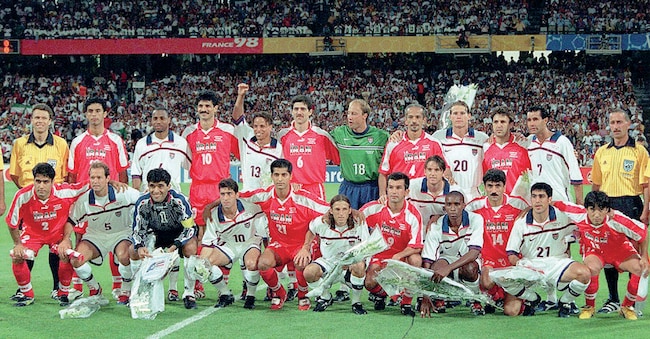
One of the most iconic precedents, incidentally, involves the USA and Iran at the 1998 World Cup in France. The match in Lyon on 21 June came, in fact, after almost twenty years of severed diplomatic relations following the 1979 hostage crisis. The run-up to the match was marked by logistical and protocol-related tensions. According to FIFA rules, the team designated as ‘B’ – Iran – was supposed to approach for the initial greeting. However, the Iranian leadership prevented a gesture deemed politically sensitive. The solution was a compromise: the Americans advanced simultaneously towards the Iranian players, who presented their opponents with white roses. The teams then posed together for a photograph and the match went ahead without incident. On the pitch, Iran won (2–1), but off the pitch, the prevailing view was that sport could become a common language of renewed harmony.


