The US auction market is driving the classic car market
This week, the four specialist auction houses have recorded half a billion dollars’ worth of transactions: supercars from recent decades are in high demand

Key points
The traditional week of Californian auctions in August, coinciding with the Pebble Beach Concours d’Elegance, has, for the first time, exceeded half a billion dollars in sales, with over 600 million dollars shared between the four international auction houses involved. The total comes to just under $650 million if one includes a lot sold for charity and the immediate post-auction sales that some auction houses include in their reported figures. This represents a significant increase compared with the previous peak of around $420 million in 2022. The increase is due to the strengthening of the over-one-million-dollar segment, with as many as 116 lots out of 600 offered, compared with 83 last year out of 533 lots auctioned at the time. Of these, the top ten sales accounted for around a third of the total – over $200 million – reflecting an unusually high level of concentration.
On the other hand, almost half of the lots were offered without reserve, a key factor in reducing the number of unsold cars to just one in ten. The market is increasingly divided into three different age segments, all of which are performing well but with shifting relative values amongst the classic cars of the 1930s, the racing cars of the 1950s and 1960s, and the supercars of recent decades.
The Ferrari Luce anomaly
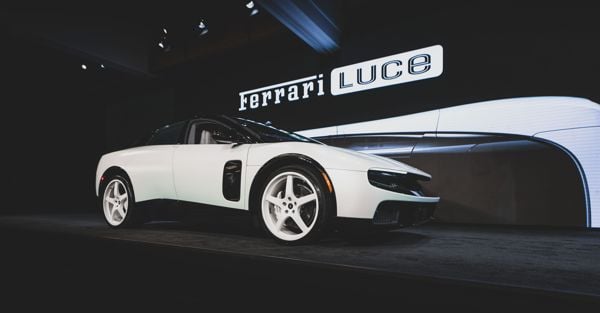
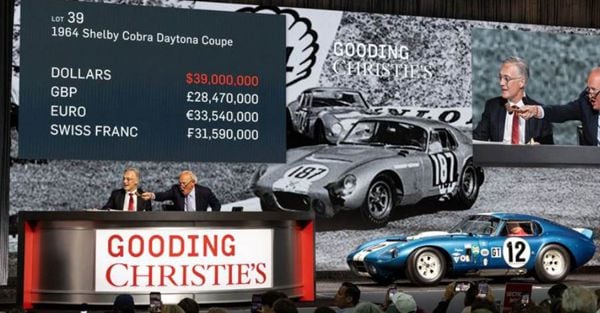
Only a racing car of great historical value, sold for 43 million dollars, has spared us the embarrassment of having to list the Ferrari Luce as the week’s top sale. The $40 million paid by an elderly and eccentric American philanthropist for the first ‘Tailor Made’ model of the much-discussed electric car bearing the Prancing Horse is an anomaly linked to the tax regime governing donations – which are largely tax-deductible in the US – and the social prestige associated with them, as well as the ‘free’ publicity, and very little to do with the car model’s intrinsic value. The proceeds from the auction will, in fact, go to the American Ferrari Foundation dedicated to education. In any case, this remains a successful marketing coup for Ferrari, following the recent debacle surrounding the model’s launch, whose clumsy and ungainly appearance seems all the more jarring when compared with the icons of the past, born from the pens of great car designers rather than those of household appliance designers.
In any case, this is a one-off result, and the ‘Luce’ models are bound to lose value just like the rest of the ‘mass-produced’ models, and perhaps even more so when the issue of battery replacement comes to a head.
The rivalry between RMSotheby’s and Gooding & Christie’s
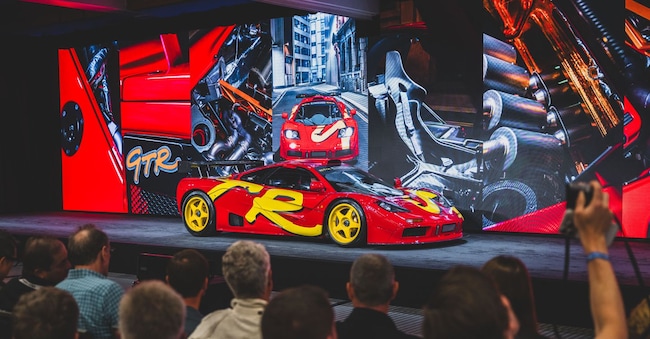
The ‘Luce’ is the most expensive lot sold by RMSotheby’s, which accounted for no fewer than 380 of the 650 million dollars sold, and even surpasses the far more deserving 1996 McLaren F1 GTR previously owned by Pink Floyd star Nick Manson, which – despite its provenance and unique red livery featuring ‘Pop Art’ elements – fell just short of the $35 million estimate, selling for $34.6 million including commissions.
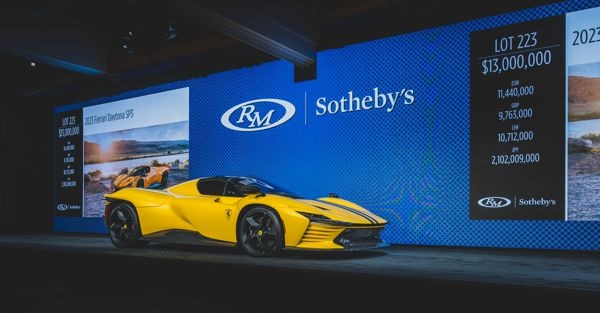
Despite a small number of cars being offered without reserve, the Canadians sold almost all of the 199 lots on offer, including numerous Ferraris from recent years, such as a yellow 2023 Daytona SP3 for $17.8 million, just one million less than the 1963 Chevrolet Corvette Grand Sport, a competition car that sold for $18.7 million.
The five limited-edition Ferraris, whose value seems to be rising unstoppably, confirm their strong appeal to the speculative market: to date, it would take $50 million to take them all home, starting with the new record for the rarest and oldest, a 1985 288 GTO at $11.5 million; a record price was also set for a 1991 F40, which is close to $8.4 million, whilst the less sought-after 1995 F50 commands a whopping 12.1 million, and the 2003 Enzo 9.4 million, culminating in a new record for the 2015 La Ferrari at 8.7 million dollars. All cars feature the classic red livery and have very few miles on the clock.