Tariffs

EU-US tariffs, agreement between European institutions postponed to 19 May

From 'Liberation Day' to ongoing trialogues, the main stages of the difficult relations between the US and Europe during the second Trump presidency

aggiornato il 7 maggio 2026 ore 22:30

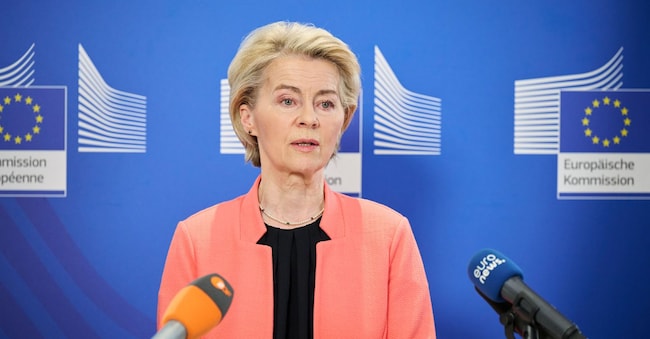
Ursula von der Leyen, presidente Commissione europea IMAGOECONOMICA

4' min read

Translated by AI
Versione italiana

4' min read

Translated by AI
Versione italiana

Liberation Day

On 2 April 2025, on so-called Liberation Day, US President Donald Trump announced a large package of trade tariffs against many states: the one against the European Union included tariffs of 30% on most products imported from the EU.

The Turnberry Chords

On 27 July 2025 Trump and the president of the European Commission, Ursula von der Leyen, met at the golf course owned by the US president in Turnberry, Scotland. The result of those talks was an agreement in principle to lower US tariffs from 30 to 15 per cent on most products imported from Europe.

Loading...

In return, the 27 EU countries agreed to increase direct investment in the US and to increase the purchase of certain categories of goods produced by overseas factories including industrial machinery, food and fashion.

For the European car sector, the Turnberry agreements were also a significant victory as they raised tariffs from 27.5% to 15%.

On European steel and aluminium destined for the US, however, it had been decided to keep tariffs at 50%.

The Greenland Crisis

In the months following the Turnberry agreements, tensions between the EU and the US have increased, starting with President Trump's threats to annex the Danish territory of Greenland to the US. Thus, in January the Europarliament decided to suspend approval of the trade agreement reached in July. Meanwhile, Trump's reciprocal tariffs were also rejected by the US Supreme Court itself.

Defended by the EU Commission as the best possible, but long criticised by many MEPs in Strasbourg, the agreement was finally approved by the European Parliament at the end of March, but only after the addition of a safeguard clause allowing it to be suspended if the Trump administration was found responsible for new threats or breaches of the pacts.

The ongoing trilogues

Following the Europarliament's approval of the agreement with the addition of the safeguard clauses on 26 March, the trilogue phase also began involving the EU Council and the Commission, with the latter two taking a softer stance towards Washington than the Strasbourg hemicycle.

Among the most controversial issues are the differential treatment of steel and the MEPs' demand that the agreement should automatically expire on 31 March 2028.

The new car tariffs

On 1 May, Donald Trump reopened the trade conflict with the European Union, once again calling into question transatlantic alliances and agreements.

An offensive that will start immediately in the crucial car and truck sector: tariffs to 25% from Monday 4 May, a sharp increase from the current 15% agreed so far on EU-branded vehicles and components.

The US President's accusation is that Brussels has failed to implement the compromise signed last year in Turnberry.

Possible agreement on 19 May

Six hours of intense negotiations, which began in the evening of Wednesday 6 May and ended late into the night, were not enough to reach the white smoke on the tariffs agreement with the US. The trilogue, the table that brings together the Council, the Commission and the Eurochamber, concluded with 'substantial progress' but without the green light for the Turnberry agreement.

"The OK will be there on 19 May," the parties promised, looking especially overseas and at Donald Trump's possible reaction.

A few hours later, the US president's response. This time it was not a threat, but an ultimatum, albeit with reasonable time coordinates. "If by the 250th birthday of the US", on 4 July. Europe does not comply with the agreement "tariffs will immediately skyrocket to much higher levels" than the 15% expected.

Trump said this directly to Commission President Ursula von der Leyen, with whom he had a telephone conversation.

Those who feared that the tycoon would immediately realise his 25% threat to European cars and trucks breathed a sigh of relief

A few hours earlier it was EU commissioner Maros Sefcovic, who had tried to reassure the US despite the black smoke from the nightly trilogue. 'We are making significant progress and have already achieved a lot - although, of course, nothing is agreed until everything is agreed. The goal,' he remarked, 'remains threefold.

Firstly, to demonstrate that the EU keeps its promises and honours its commitments. Second, to ensure an outcome that fully respects the EU-US Joint Declaration. Third, to protect the interests of EU stakeholders, including by equipping the Commission with the necessary tools to ensure that the EU-US Joint Declaration is faithfully implemented by both sides'.

The Commission's pressure for a green light on 19 May will be constant in the coming days.

But, at the same time, the Berlaymont Palace could provide a partial backing for the demands of the Eurochamber, i.e. the retention of the so-called 'sunrise' and 'sunset' clauses inherent in the legislative passage of the Pe agreement as a safeguard against the US not fulfilling its commitments.

Both clauses - which do not please the EPP and do not enthuse the Commission - are unlikely to survive the negotiations. But a mediation that would still protect a system of guarantees in the face of Trump's unpredictability might be within reach.

"At the moment there is a compromise on the most important elements but we still need implementation" on some issues"and I am sure that at the next meeting, either on 12 or 19 May, an agreement will be found, I am positive about that", emphasised the Chairman of the EP Trade Committee, Bernd Lange.

The Trump-von der Leyen phone call certainly clarifies the trade picture between now and the next two months. But Washington's posture does not change.

The US ambassador to the EU, Andrew Puzder, not surprisingly met with European Parliament vice-president and Patriots MEP, Mieke Andriese, with a focus on tariffs.

The US knows that, within the Plenary, the anti-Trump front has grown in recent months and seeks to shore up support in those groups traditionally closer to the Maga movement.

Copyright reserved ©
Loading...

Brand connect

Loading...

Newsletter

Notizie e approfondimenti sugli avvenimenti politici, economici e finanziari.

Iscriviti