Middle East

The UN Security Council approves the peace plan for Gaza. China and Russia do not veto

Two-year mandate for transition. Trump: 'historic vote'. However, Netanyahu remains opposed to a Palestinian state and Hamas calls the US resolution 'dangerous'

by Marco Valsania

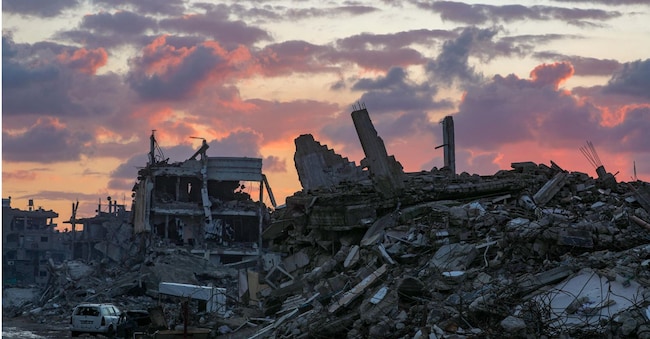
Un edificio distrutto a Gaza   EPA/MOHAMMED SABER

4' min read

Translated by AI
Versione italiana

4' min read

Translated by AI
Versione italiana

The UN Security Council approved the US peace plan for Gaza, offering crucial political and legal support for Donald Trump's Middle East strategy. The resolution gives the plan a two-year mandate and was passed with 13 votes in favour and none against. Russia and China abstained, choosing not to use their veto power in the face of the support the plan also received from numerous Arab countries. UN resolutions have, at least on paper, binding force and their violation can trigger measures and sanctions to ensure compliance.

Trump celebrated with a message on Truth Social: "Congratulations to the world on the incredible vote at the UN Security Council just now, recognising and endorsing the Board of Peace, which will be chaired by me, and includes the most powerful and respected leaders around the world. This (vote, ed.) will become one of the greatest endorsements in the history of the United Nations, will lead to further peace everywhere in the world, and is a moment of truly historic proportions!" The Board, which will have to take responsibility for the transition to a future of reconstruction in Gaza, is not yet defined.

Loading...

Speaking to the Council before the vote in the evening, the US Ambassador to the UN Headquarters, Mike Waltz, called Gaza "a hell on earth" and described the resolution as a "lifeline" and an important "beginning". Immediately after the yes vote, he thanked the leadership of the multilateral organisation, often criticised by the White House, "for joining us in charting a new course for Israelis, Palestinians and all the peoples of the region". The initiative also represents a diplomatic success for the Trump presidency, which has repeatedly promised leadership capable of resolving conflicts.

There was no shortage of uncertainty. The United States had stepped up its calls for the UN to reach consensus on their plan for Gaza, but Russia had circulated a rival ten-point proposal that removed the reference to the Trump-led transitional authority and instead called on the UN to make an immediate pronouncement on establishing a Palestinian state consisting of Gaza and the West Bank under the current Palestinian Authority.

Washington and the eight countries that played a role in achieving the fragile cease-fire now in place between Israel and Hamas after more than two years of war in the Strip, in response, had publicly called for the 'swift adoption' of the latest US draft resolution by the 15 members of the Security Council. Only one of these eight is a member of the Council, Pakistan.

A joint statement with Qatar, Egypt, the United Arab Emirates, Saudi Arabia, Indonesia, Pakistan, Jordan and Turkey had been issued after the US had moved to address objections by making a few changes to their proposal: in particular, they had included a more explicit reference to Palestinian self-determination under pressure from European as well as Arab countries.

The text that was eventually brought to the vote, based on a 20-point strategy set out by the White House, establishes the debut of an International Stabilisation Force (ISF) to work with Israel and Egypt under an initial two-year mandate and secure Gaza's borders, facilitate humanitarian aid, and support the development and training of a new Palestinian police force. It should also oversee the disarmament of Hamas and other militias in the strip.

The nations designated to contribute troops to the ISF, in addition to Egypt, are Indonesia, Turkey and the United Arab Emirates, and had made UN approval a condition for their role in order to avoid the accusation of being occupying forces.

Among the expected steps is the appointment of the so-called Board of Peace, the body in charge of the political supervision of the transition in Gaza chaired by Trump, which in turn will have a mandate until the end of 2027. Clarifications are also expected on the control and command of the stabilisation force. Day-to-day management of Gaza will take place through what is instead described as a 'technocratic, apolitical committee of competent Palestinians in the Strip'.

The text, significantly though generically, indicates that if the Palestinian Authority, which today has a circumscribed governing role in the West Bank, is capable of reform and if the reconstruction of Gaza proceeds, then the conditions 'may finally be in place for a credible path towards self-determination and the Palestinians' right to sovereignty'.

In the march towards the vote, Arab diplomacy has been on hand to support the project and its ambition to resolve an endless cycle of crises. Egyptian Foreign Minister Badr Abdel Aty held talks with Russian Foreign Minister Sergey Lavrov on the ceasefire agreement between Israel and Hamas signed in Sharm el-Sheikh mediated by Trump. This was reported by the Egyptian Foreign Ministry, explaining that during the conversation Abdel Aty stressed "the importance of continuing to implement all the points of the peace plan" and reviewed preparations for an upcoming international conference to be held in Cairo for the reconstruction of the Gaza Strip.

However, difficult challenges remain in the aftermath of the resolution. The Israeli government of Benjamin Netanyahu has continued to reiterate its firm opposition to any future Palestinian state. "Our opposition to a Palestinian state in any territory has not changed," Netanyahu said on the eve of the vote. In a statement published overnight, Hamas on behalf of the Palestinian factions says for its part that the resolution submitted by the US to the UN Security Council is "dangerous" because it is "an attempt to subjugate the Gaza Strip to international authority". The statement says that the factions reject any clause relating to the disarmament of Gaza or that would harm 'the right of the Palestinian people to resistance'.

Copyright reserved ©
Loading...

Brand connect

Loading...

Newsletter

Notizie e approfondimenti sugli avvenimenti politici, economici e finanziari.

Iscriviti