
The value of 2 June: a young Italia that wants democracy
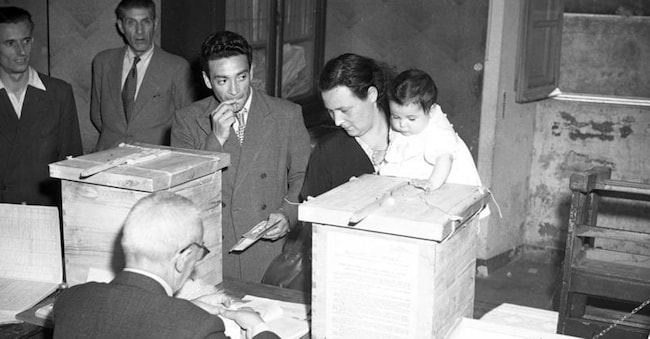
The Italia that emerged from the ballot box on 2 June has the smiling face of a girl who woke up one late spring morning and has dark curls, held by hairpins, combed almost in a good way. She has nothing to do with the female figure who embodied monarchical Italia eighty-five years earlier: the turreted, severe matron, wrapped in a cloak fit to revive the ancient myths of Rome. That was an elegant but serious, grave and nineteenth-century queen. This one, on the other hand, has a fresh face, sincere features, without jewels or make-up, someone you could meet anywhere, in the street, in a shop, in a factory, in a primary school classroom, anything but monumental and rhetorical, a figure of the people, in short, that neorealist cinema would have immortalised in the features of an Anna Magnani, for example, or a Gina Lollobrigida happy to enter the voting booth or, in the best of cases, to be among the constituent mothers.
Therein lies the reason why this young woman cannot fail to smile. They gave her a voice, she became an active part of a society that until then had relegated her to the margins, she even stood as an icon of a time that would not only bring about the transition from monarchy to republic, but also deliver to the future the image of a shared hope, of a good that was to be within the reach
of all.
It may sound like a gamble, but the vote eighty years ago, if it did not open the doors of mass society completely wide, was certainly a penultimate stage, a kind of eve or dress rehearsal. This is indicated by the numbers that give a sense of electoral participation as never before. But so does the attitude of responding to the call, shedding the clothes of those who had hitherto remained outside the boundaries of civilisation, on the margins of history. This applies to women, but also to the poor, the illiterate, that proletariat that Pelizza da Volpedo had immortalised in The Fourth Estate, on the edge of the 20th century. The Italia of 2 June gave a shot in the arm to everything that belonged to the past, starting with the liberal thought that had been the great driving force behind the Unification of the Risorgimento and that had then played a leading role in the political balances in the aftermath of the Great War.
Certainly liberal thought survived the impact of the Constitution, but its sphere of influence lagged behind the mass groupings, the Christian Democrats and the Popular Front. In this respect, too, the season that began in 1946 represents an incomparable unicum and it would be enough to listen again to the voices of witnesses, look at photographs, scroll through the front pages of newspapers to grasp the signs of the novelty that was before the eyes of an entire country, even of the most reluctant to be convinced, and that restores to us, in its fullness, the most authentic meaning of the term democratic.
Let us be careful: democratic not popular. They seem to be overlapping, yet they are not, and this was soon made clear in Article 1 of the Constitution, which first of all defined our Republic as democratic and then took care to specify that sovereignty belonged to the people. La Storia siamo noi declares a song by Francesco De Gregori from 1985 and, although we are sometimes tempted to assert otherwise, the date of 2 June shows us that what happened in the immediate vicinity - the period of reconstruction, the decade of the economic miracle - bears the signature of that smiling girl.


